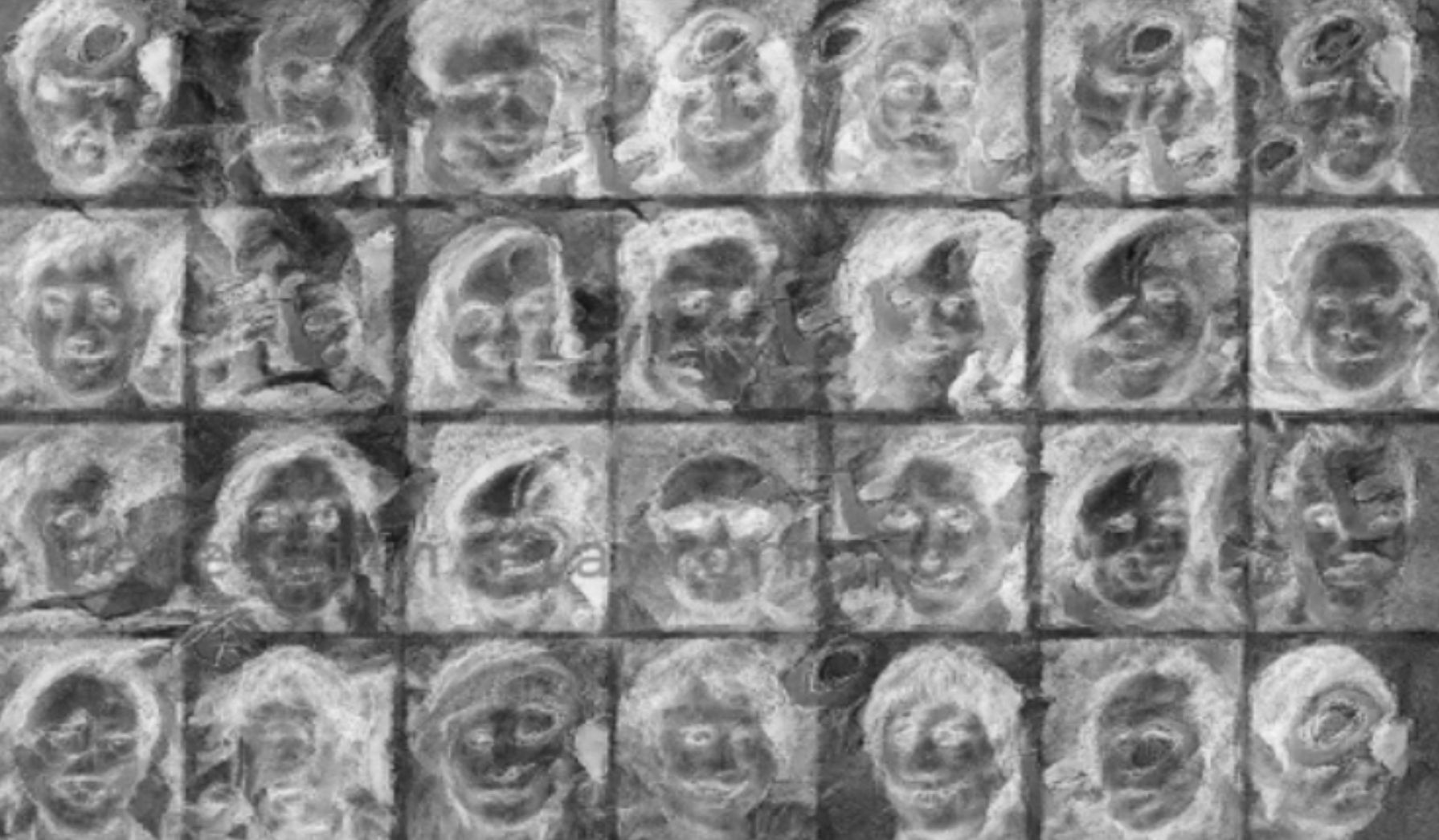
These people faces are pure fake and generated by an A.I.
These people faces are pure fake and generated by an A.I.
Endangered species x distorted mobile notifications
« Cachez ce sein que je ne saurais voir »
Flottant comme des coraux mous ou des algues gélatineuses, ces formes fragiles ondulent doucement dans des eaux sombres, entraînées par des courants invisibles — algorithmiques. Chaque élément est animé par un rythme circulaire, asynchrone : trop proche pour être ignoré, trop éloigné pour établir un lien. Le paysage sonore évoque la vie abyssale : des sons de notifications mobiles, ralentis, déformés, immergés jusqu’à devenir des bulles émises par une créature invisible.
Do Not Touch efface la frontière entre extinction naturelle et saturation numérique. Les coraux deviennent une métaphore : nous protégeons les récifs, mais négligeons l’esprit humain — qui se dissout dans un silence comparable. Ces organismes spectraux reflètent la psyché connectée : surstimulée, isolée, flottant dans un espace sans contact réel.
L’œuvre suggère que l’économie de l’attention est aussi un problème écologique — fait d’érosion émotionnelle, de surcharge sensorielle, d’asphyxie cognitive.
Le récif est numérique.
L’espèce menacée, c’est nous.
Et l’avertissement est limpide :
ne touchez pas, ne scrollez pas, ne détournez pas le regard.
—
These corals are animated with random and circular motions by invisible currents, barely touching each others. Distorted mobile notifications sounds like fish noises in deep waters. Sometimes, more attention is paid to endangered species than to human beings mental health…
Floating like soft corals or gelatinous algae, these fragile forms pulse gently in dark waters, swayed by unseen algorithmic currents. Each is animated in circular, asynchronous rhythm—too close to collide, too distant to connect. The accompanying sound mimics deep-sea life: mobile notification pings, slowed, bent, and submerged until they resemble bubbles from a creature we can’t see.
Do Not Touch collapses the boundary between natural extinction and digital saturation. The corals become a metaphor: we protect reefs, but neglect the human mind—dissolving in a similar silence. These spectral organisms echo the overstimulated, isolated psyche of the connected user.
This work suggests that our attention economy is an ecological issue—one of emotional erosion, sensory overload, and cognitive suffocation. The reef is digital. The endangered species is human. And the warning is clear: don’t touch, don’t scroll, don’t look away.
Spider Web x Addictions to drugs
In the 60’s, studies showed that depending on the kind of drugs that was injected to spiders, they were building their web differently
This video-based artwork explores the surreal territory where scientific experimentation meets symbolic metaphor. Inspired by 1960s studies in which spiders, under the influence of various drugs, spun wildly distorted webs, the piece gradually morphs into the form of a haunted pumpkin – a ghostly Halloween icon.
The sequence evokes the invisible traps of addiction – not only to substances, but to digital feeds, dopamine-triggering notifications, and algorithmic loops. The spiders here become stand-ins for modern users: altered, manipulated, and unaware of the design behind their compulsions. The audio reinforces this tension, blending anxious mechanical glitches with ghostlike whispers, as if anxiety had a voice of its own.
A psychedelic hallucination of a seasonal symbol becomes a warning: in today’s web, what feels festive might in fact be a trap.
Top web & innovation technologies x Synthetic voice x Fire burning
Depuis plus de vingt ans, chaque nouvelle technologie web est vendue comme la prochaine révolution, dans un cycle non vertueux où les individus ne sont plus que des utilisateurs — souvent sans comprendre qu’ils sont en réalité le produit, ou pire, la principale source d’enrichissement de ceux qui poussent à une adoption technologique accélérée.
Burning Techs est une descente hypnotique dans ce cycle de techno-évangélisme. Sur un flux glitché de flammes noir et blanc, les noms des révolutions numériques passées et présentes — Web3, Bitcoin, IA, Blockchain, Streaming, Mobile, Crypto, AR — défilent en langue étrangère en mode crypté, accéléré, illisible. Derrière l’opacité, une voix synthétique murmure, comme pour vendre un salut.
Mais ce n’est pas une utopie.
C’est un brasier.
Un rituel où la promesse remplace la compréhension, et où la vitesse écrase l’éthique.
La flamme n’éclaire pas — elle consume.
Chaque “next big thing” devient un bûcher, et derrière chaque lancement, une transaction silencieuse :
les utilisateurs sont transformés en données brutes, puis en revenu.
Burning Techs révèle cette boucle infernale — un marché de la distraction déguisé en progrès.
Il ne s’agit pas de décrypter les mots.
Il faut sentir la chaleur.
La tech brûle.
Et personne ne tient l’extincteur.
—
Each web technology since more than 20 years is marketed like the next hot big thing and disruption, in a non virtuous cycle where people are just considered as users and they may do not understand that they are the product, or worst the main source of enrichment of these people pushing hardly for a speed techno adoption.
Burning Techs is a hypnotic descent into the techno-evangelism cycle. Over a glitchy stream of black-and-white flames, the names of past and present digital revolutions—Web3, Bitcoin, AI, Blockchain, Streaming, Mobile, Crypto, AR—are flashed in encrypted in foreign language, accelerated and unreadable. Behind the opacity: a synthetic voice speaks softly, as if selling salvation.
This isn’t utopia. It’s a bonfire. A ritual where hype replaces understanding, and speed overrides ethics. The flame doesn’t illuminate—it consumes. Each “next big thing” becomes a pyre, and behind every launch, a silent transaction: users turned into raw data, then into revenue.
Burning Techs exposes this infernal loop—a market of distraction posing as progress. The viewer is not asked to decode the words, but to feel the heat. Tech is burning. And no one’s holding the extinguisher.
Ice flow x Top tech leaders mantras
Cette vidéo critique profondément les mythologies entrepreneuriales propagées par la culture start-up mondiale, en les comparant à la fonte des glaces : lente, inexorable, destructrice. L’oeuvre Ice Flows ne se contente pas d’illustrer une analogie visuelle entre idéologie technologique et crise climatique — elle les relie comme deux formes d’effondrement systémiques, portées par les mêmes mécanismes d’aveuglement collectif et d’auto-illusion.
Les slogans répétés — Fail fast, Disrupt everything, Fake it till you make it ….— deviennent ici des prières toxiques, récitées en boucle par des générations d’entrepreneurs hypnotisés par la réussite de quelques figures emblématiques, sans voir le vide qu’elles laissent derrière elles. Ces mantras, loin d’être moteurs d’émancipation, sont perçus comme des forces d’érosion mentale, sociale et écologique.
Le dispositif visuel — des nappes glaciaires qui se fissurent au rythme de ces injonctions — exprime avec une précision troublante l’impact cumulatif de ces idéologies : elles transforment l’ambition en ravage, la performance en autodestruction. L’innovation n’est plus un projet collectif, mais une course solitaire vers l’irréversible.
Ce travail agit comme un chant funèbre : celui d’un monde qui se vend comme disruptif, mais ne fait que répéter les mêmes schémas d’accélération aveugle et de dépossession humaine.
—
Tech worldwide community and innovative leaders are raising start-up founders with entrepreneurial & success insane mantras. Most of these mantras focused on success and self made man may have no consideration for human impacts of these innovations. These echoing entrepreneurs perpetuate the cycle indefinitely. The whole process where newbies try to imitate tech leaders cause they became rich rapidly seems like for ice flows totally irreversible and devastating for human beings.
On screen, melting ice sheets ripple under the weight of invisible forces—rivers of time, ambition, and ideology. Layered across these glacial surfaces are the sacred incantations of the startup world: “Fail fast,” “Disrupt everything,” “Fake it till you make it.” Mantras looped by founders, mentors, and digital prophets like a hypnotic tide.
In Ice Flows, Clear Shadows draws a stark parallel between climate collapse and ideological dogma. Both are irreversible. Both are sold as progress. Both leave devastation in their wake.
The animation deconstructs these mantras into visual noise, their repetition forming cracks in the visual ice—a landscape of aspiration eroding itself. The tech community, in its obsession with speed and scale, forgets that what melts cannot be rebuilt. This piece is not just about innovation. It’s about what innovation melts through.
A glacial requiem for the myth of the self-made man.
Data cloud mapping
Ink on paper – 30 x 40 cm
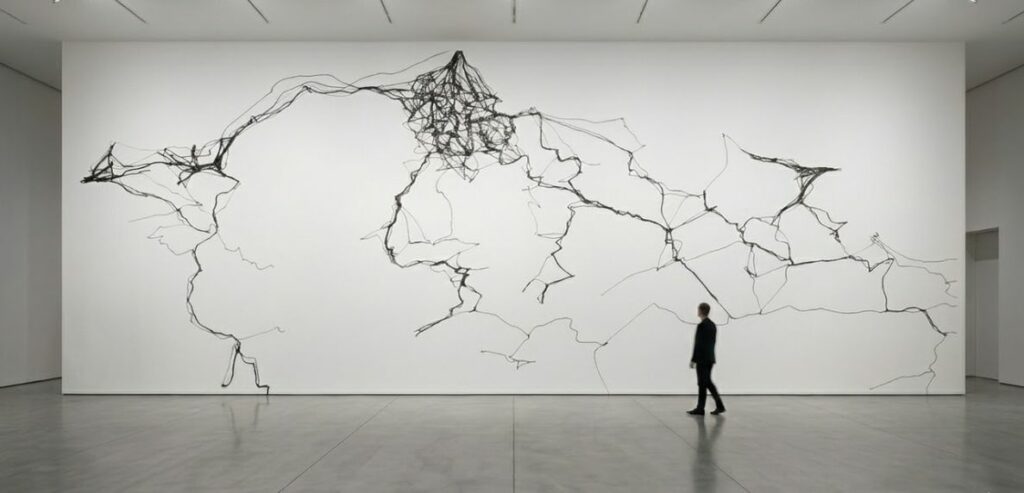
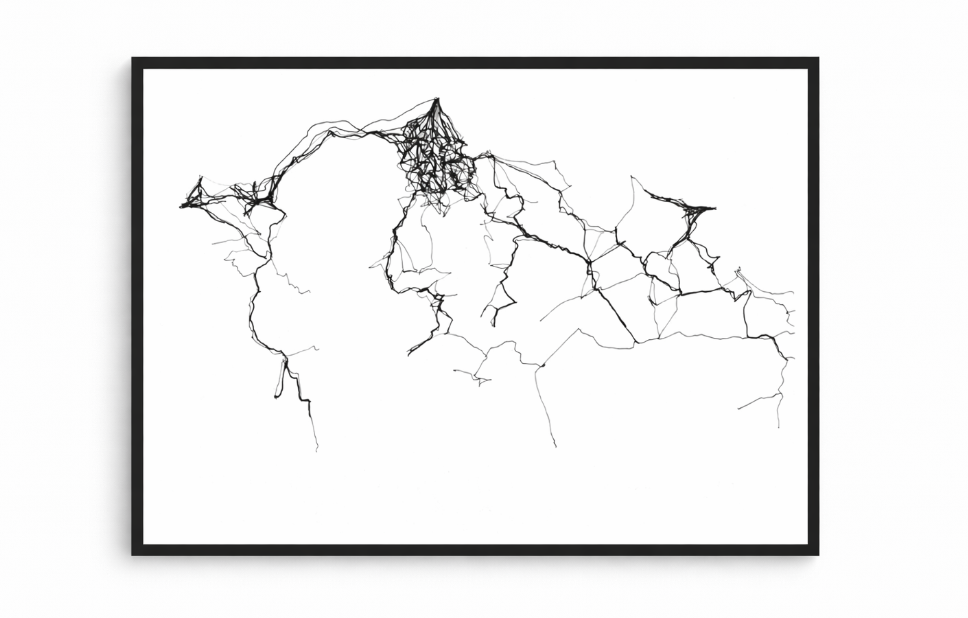
Comme un flash lumineux ou un volcan en éruption, ce dessin repose sur la cartographie réelle des centres de données mondiaux et des flux entre les principales infrastructures de stockage cloud.
Apparaissant comme un glacier fracturé, un éclair ou une cicatrice neuronale, Winter Is Coming trace la géographie concrète du cloud et des data centers à l’échelle planétaire. Chaque ligne représente un flux de données, chaque nœud un point d’hyper-concentration — presque toujours localisé dans le Nord global.
Le résultat est à la fois abstrait et glaçant : une cartographie de la fragilité numérique, qui révèle l’architecture invisible soutenant notre quotidien connecté. Sous la métaphore hivernale se dissimule un avertissement discret : à mesure que les tensions géopolitiques s’intensifient et que les monopoles d’infrastructure se renforcent, ce réseau devient un point de pression — non seulement pour le stockage, mais pour le contrôle, la vulnérabilité, l’opacité.
—
Winter Is Coming évoque à la fois l’effondrement et la consolidation. À l’heure de l’angoisse climatique et de l’accélération technologique, l’œuvre nous rappelle que même le cloud a une géographie — et qu’elle est tout sauf équitable.
—
Like a flash light or erupting volcano, this drawing is based on main cloud storage and data centers positionnings and data flows between them.
Appearing like a fractured glacier, a flash of lightning, or a neural scar, this drawing traces the real-world geography of cloud storage and global data centers. Every line represents a data flow, every knot a point of hyper-concentration—most often in the global North.
The result is both abstract and chilling: a cartography of digital fragility, revealing the invisible architecture that powers our daily lives. Beneath the metaphor of winter lies a quiet warning: as geopolitical tensions rise and infrastructural monopolies grow, this network becomes a pressure point—not only of storage, but of control, vulnerability, and opacity.
Winter Is Coming echoes both collapse and consolidation. In the age of climate anxiety and techno-acceleration, it reminds us that even the cloud has a geography—and it is not evenly distributed.
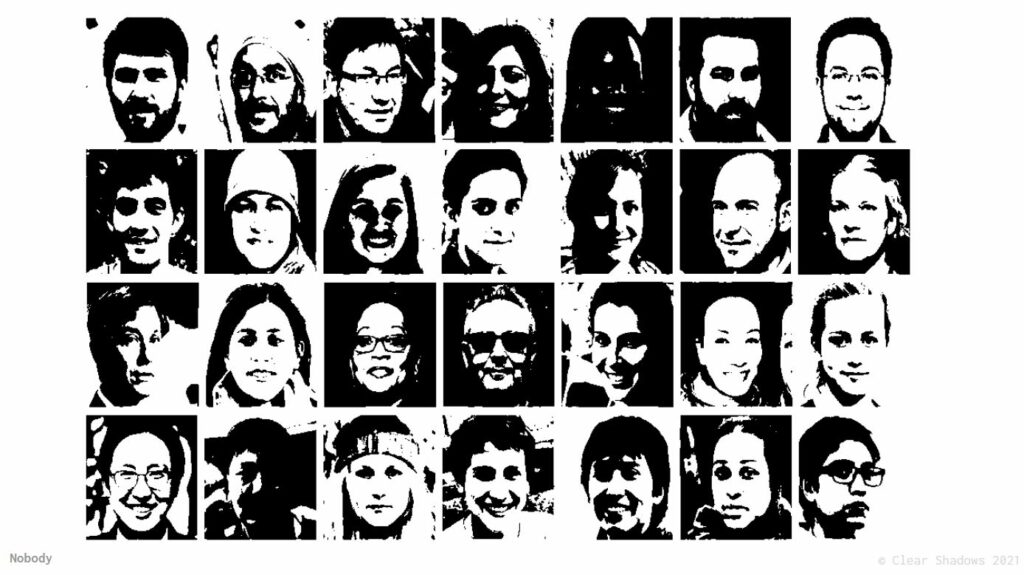
A grid of twenty-eight faces. Smiling, neutral, expectant. None of them exist. These portraits were generated by neural networks before large language models and generative AI tools became household names.
Each face suggests identity, culture, perhaps memory—but they are empty of history. The work anticipates the silent normalization of synthetic humans in media, politics, and communication. The absence of bodies reinforces their non-existence. No breath. No blood. No background.
By freezing them in a stark black-and-white aesthetic, the image emphasizes erasure rather than creation: no names, no context, only simulated presence.
It’s not just a warning—it’s documentation of a threshold. Before the tools exploded, before everyone could make anyone, these ghosts were already smiling.
Tears / rain drops x Aspiration x Anxiety breath
Nomophobia désigne cette angoisse contemporaine : la peur d’être séparé de son téléphone mobile.
Cette installation vidéo simule un état de suffocation anxieuse. À première vue, la surface semble paisible — des gouttes de pluie glissent lentement sur une vitre. Mais à mesure que la boucle progresse, la respiration au centre devient irrégulière, presque convulsive. Ce qui était calme se transforme en une inspiration syncopée, accélérée. Un monstre silencieux — ni présent, ni visible — semble aspirer tout vers le vide. Les gouttes deviennent des larmes, le rythme devient détresse.
Le titre fait écho à une pathologie moderne : l’absence de téléphone devient un manque émotionnel, comme une extension du soi perdue. L’œuvre explore les signes précoces de cette dépendance, à travers ses manifestations physiques : souffle, humidité de la peau, pulsation. On anticipe la panique avant même qu’elle n’explose.
Le centre, qui respire comme un poumon mécanique, incarne l’illusion de sécurité que procurent ces objets qui gouvernent désormais notre calme.
Mais ce souffle, devenu court et rapide, rappelle une vérité :
Même dans la poche, le téléphone ne suffit pas.
—
Nomophobia is a kind of fear of being separated from its mobile phone
This video installation simulates a state of anxious suffocation. At first glance, the surface appears peaceful—raindrops softly clinging to a windowpane. But as the loop progresses, the breathing at the center becomes erratic, almost convulsive. What was calm becomes an accelerated, syncopated inhale. A silent monster—neither present nor visible—seems to pull everything toward the void. The drops become tears, the rhythm becomes distress.
The title « Nomophobia » refers to the modern pathology of being without one’s phone—an emotional void, an extension of the self gone missing. This piece explores the early signs of that dependency, through physical manifestations: breath, skin moisture, pulse. We anticipate the panic before it unfolds.
The center, which breathes like a mechanical lung, embodies the illusion of safety granted by devices that now govern our calm. But the breath, sped up and shallow, makes it clear: even in our pocket, the device is never enough.
Tech leader pitch at American Congress x binary sentences
F. founder explaining his motivation since the begining of F. and making sincere apologies for data sharing scandal in front of the American Congress. Since this testimony. nothing really changed regarding F. overall growth.
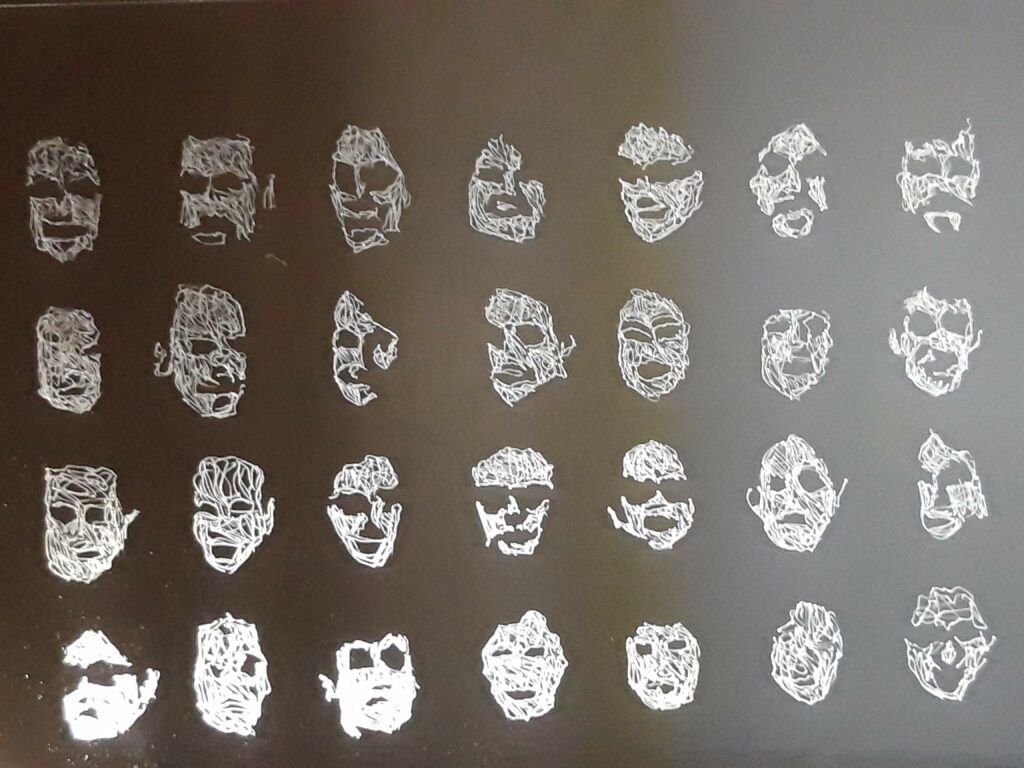
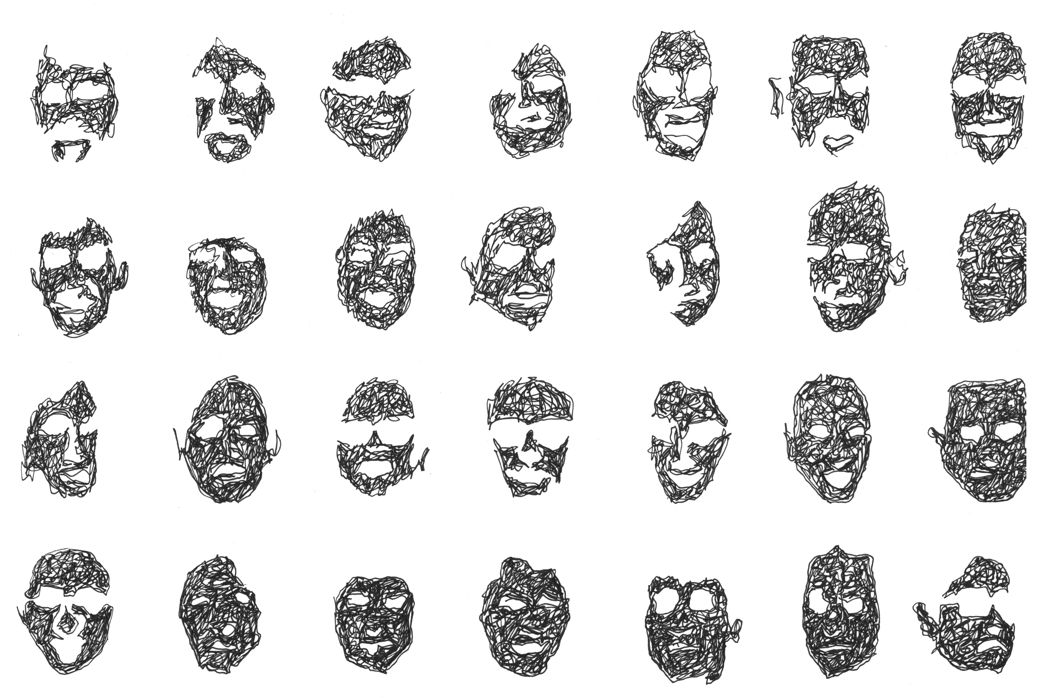
28 masks inspired by deep fake faces
Ink on paper – 30 x 40 cm
Ces 28 masques forment une galerie silencieuse d’identités générées — et immédiatement vidées de leur humanité. Produits à partir de visages synthétiques créés par intelligence artificielle (deep fake), ils présentent d’abord une illusion troublante de réalisme : proportions parfaites, lumière flatteuse, visages crédibles. Mais chaque regard a été effacé, chaque bouche éliminée, chaque oreille gommée. Il ne reste que des enveloppes.
Ce processus d’annulation transforme l’image en masque : ce n’est plus un portrait, c’est une façade. Sans organes sensoriels, ces figures ne voient rien, n’entendent rien, ne parlent pas. Elles incarnent l’ère post-relationnelle où la ressemblance suffit, et où l’émotion est simulée sans origine.
L’œuvre interroge : que reste-t-il d’un visage quand on lui retire la possibilité d’interagir ? Que devient une humanité sans échange, sans mémoire, sans altérité ? Ces masques sont beaux, peut-être. Mais ils ne nous regardent pas. Ils nous ignorent. Comme les algorithmes qui les ont créés.
—
These faces have been conceived first thanks to an artificial intelligence able to generate randomly real-like faces of non existing people; then eyes, mouth, noses and ears have been removed for the final version of the drawing.
Drawing & graving on plexiglass – 30×20 cm

Boehringer metabolics
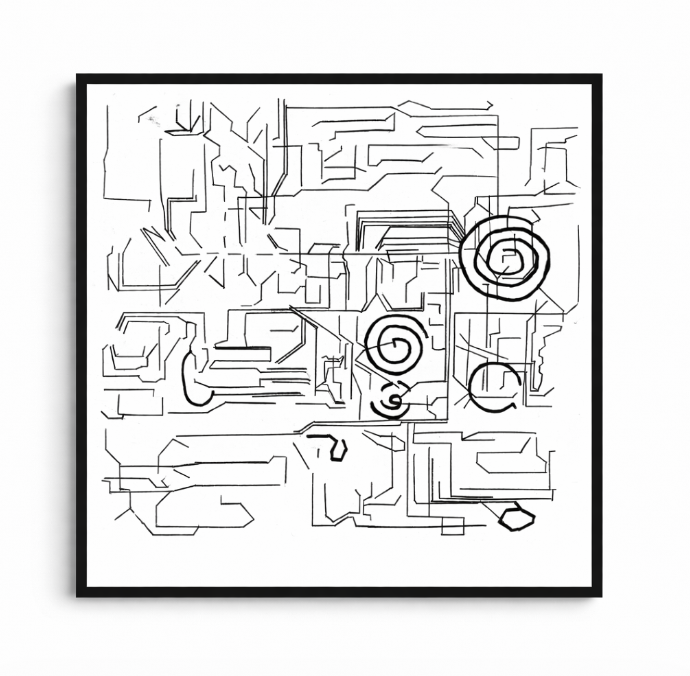
Drawing – 40×40 cm
Ce fragment réinterprété de la célèbre carte métabolique Boehringer ne vise plus à expliquer, mais à désorienter. Ce qui, dans le schéma original, représentait l’élégance et la précision des processus biochimiques devient ici une architecture close, en surcharge, sans issue. Les chemins de transformation du glucose, de l’ATP, ou des acides aminés semblent tourner à vide, piégés dans des boucles auto-référentielles.
Le clin d’œil au film Modern Times de Chaplin n’est pas anodin : dans cette œuvre aussi, l’humain est absorbé par une mécanique trop grande pour lui, broyé par le rythme d’une chaîne de production. Ici, c’est la cellule elle-même qui devient usine. Le vivant n’est plus mouvement, mais maintenance. L’énergie ne circule plus — elle stagne, ou s’épuise à reproduire des motifs absurdes.
Certaines spirales s’ouvrent comme des vertiges. D’autres s’enroulent sur elles-mêmes jusqu’à l’asphyxie. Le corps est toujours là, quelque part — mais il ne fonctionne plus : il gère, il corrige, il compense. Et dans ce réseau en surcharge, c’est l’idée même de finalité biologique qui s’effondre.
Une cartographie de la fatigue. Un diagramme de la survie automatique.
—
Boehringer matrix is a kind of chemical explanation of life and metabolics
This piece reinterprets a section of the Boehringer metabolic chart, a scientific diagram meant to represent the chemical reactions at the core of life. But here, the elegant precision of biochemistry is stripped of clarity—turned instead into a chaotic grid of repetitions, spirals, dead ends, and closed circuits.
The title nods to Charlie Chaplin’s iconic film, where man is crushed under the weight of industrial rhythm and mechanized labor. Similarly, this metabolic labyrinth reflects a form of modern biological alienation: life processes reduced to loops, human movement trapped in invisible pathways, and purpose buried beneath over-optimization.
Some spirals here don’t end. Others regress. Amidst the pseudo-functional architecture, the shapes betray confusion rather than flow—entropy instead of energy. The system is alive, but barely breathing.
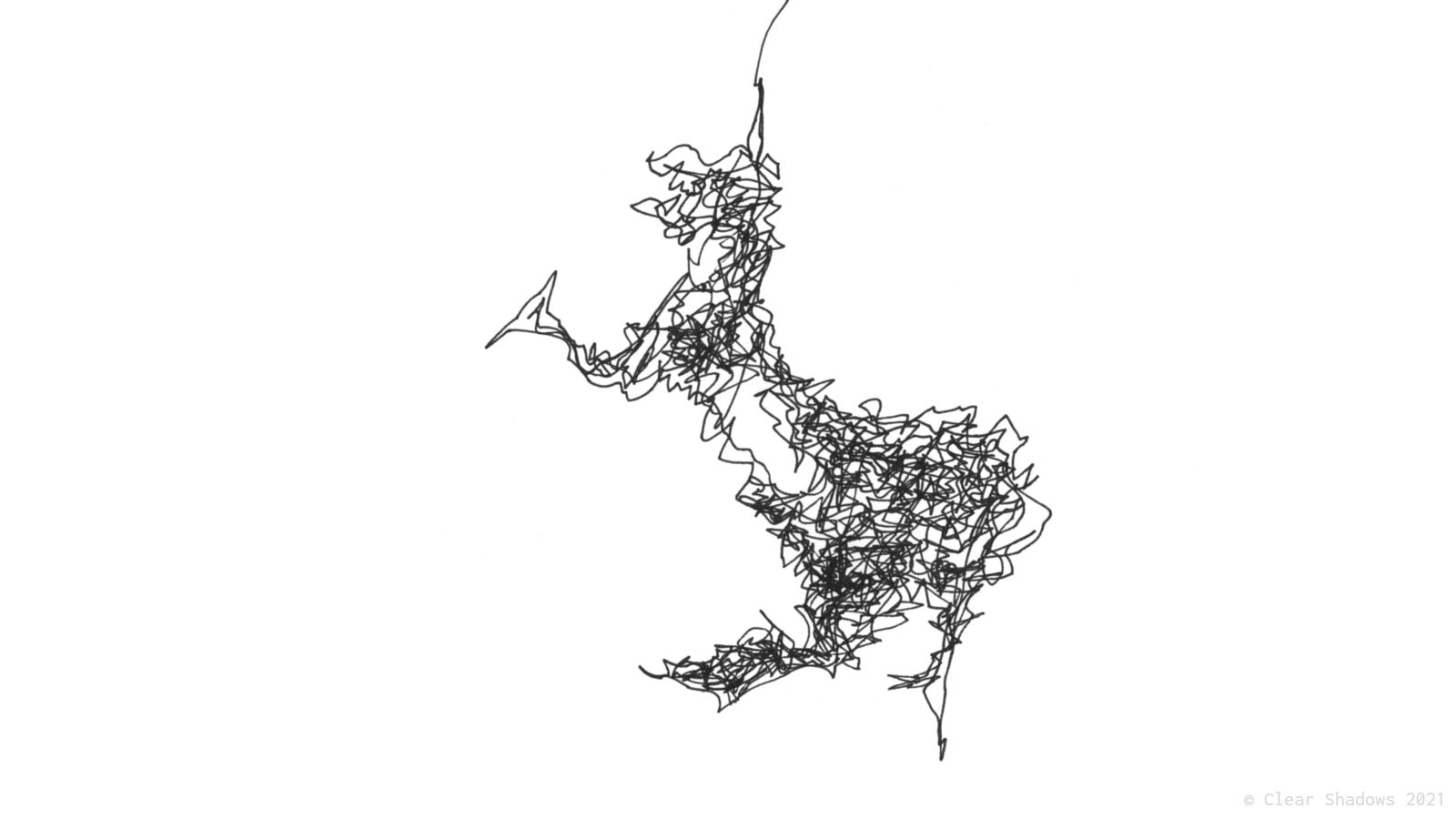
Brownian motion
Unicorns are big start-up valued more than 1 billion dollars and growing rapidly. Most of the time they uberize traditional businesses. This drawning is a pure randon brownian motion that lead to a unicorn shape
Drawing – 30×20 cm
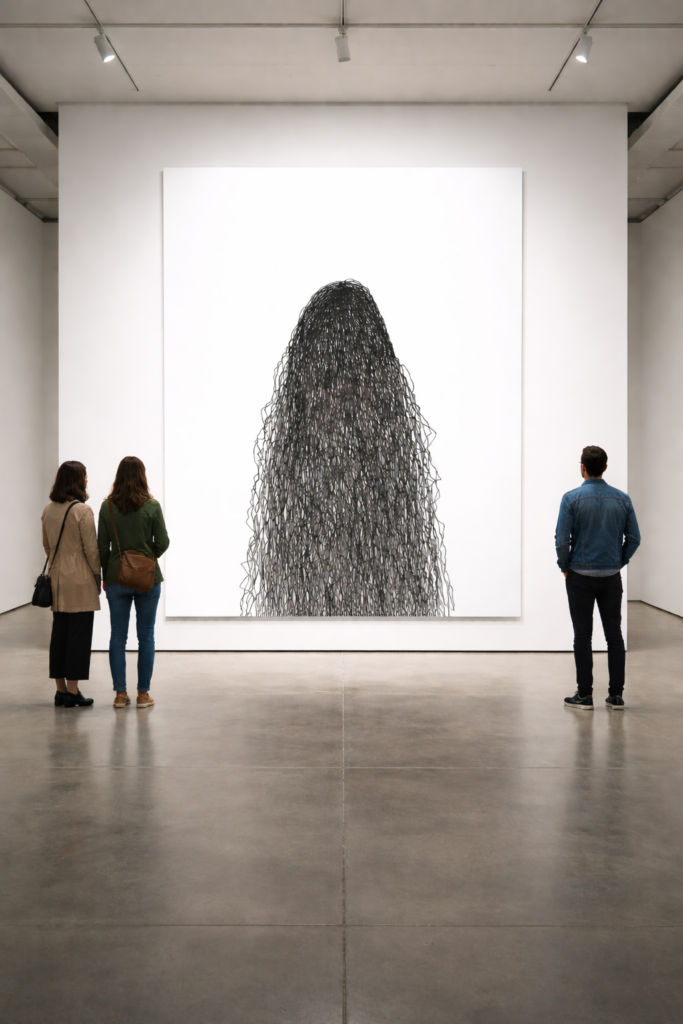
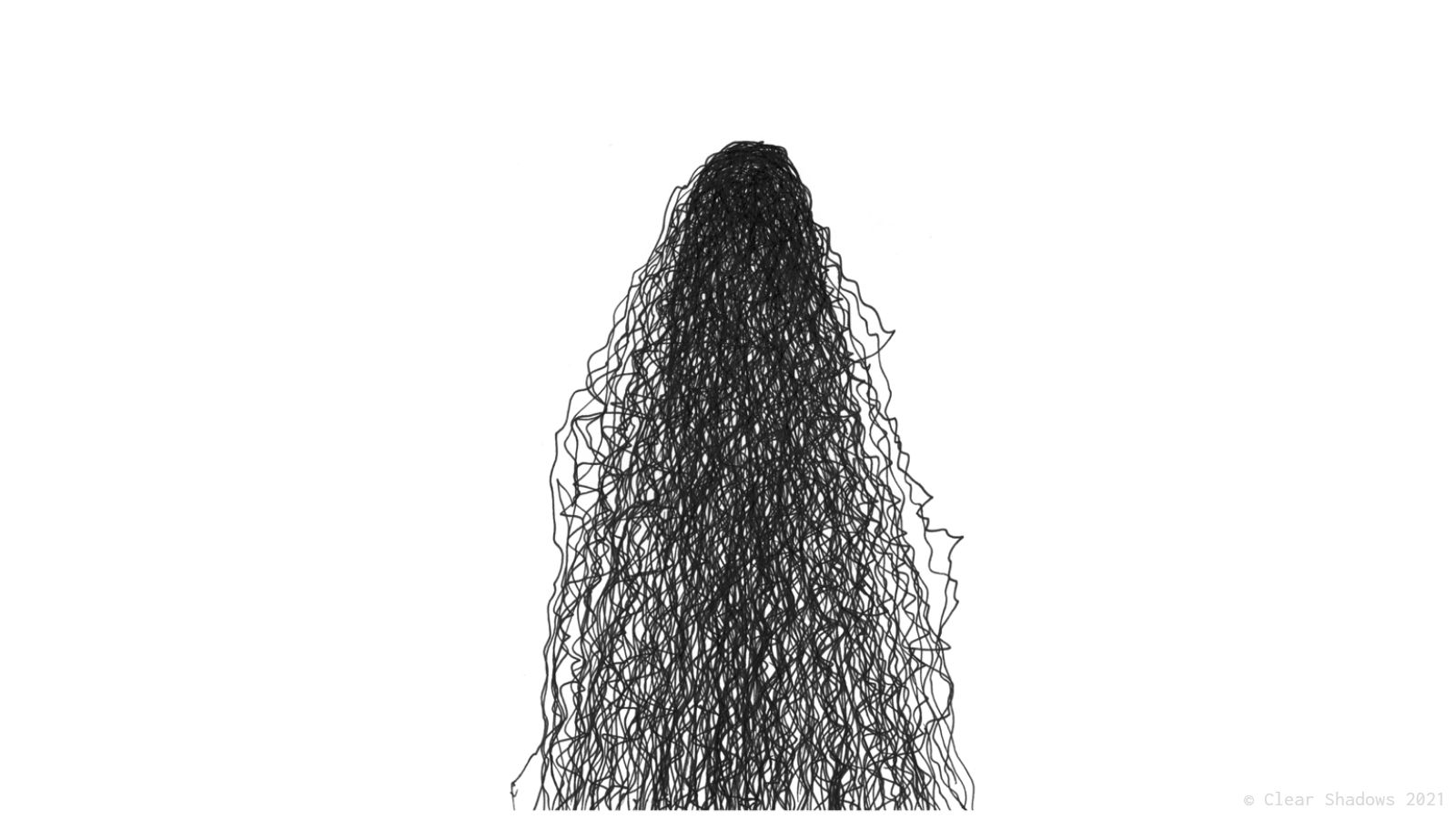
One tier of teenagers may feel depressed after having checked their favorite social network which is just the perfect place for perfect people sometimes with perfect hairs. This hairy bride is also echoing and inspired by a real brownian motion where particules are colliding randomly.
Drawing & engraving on plexiglass – 30×20 cm
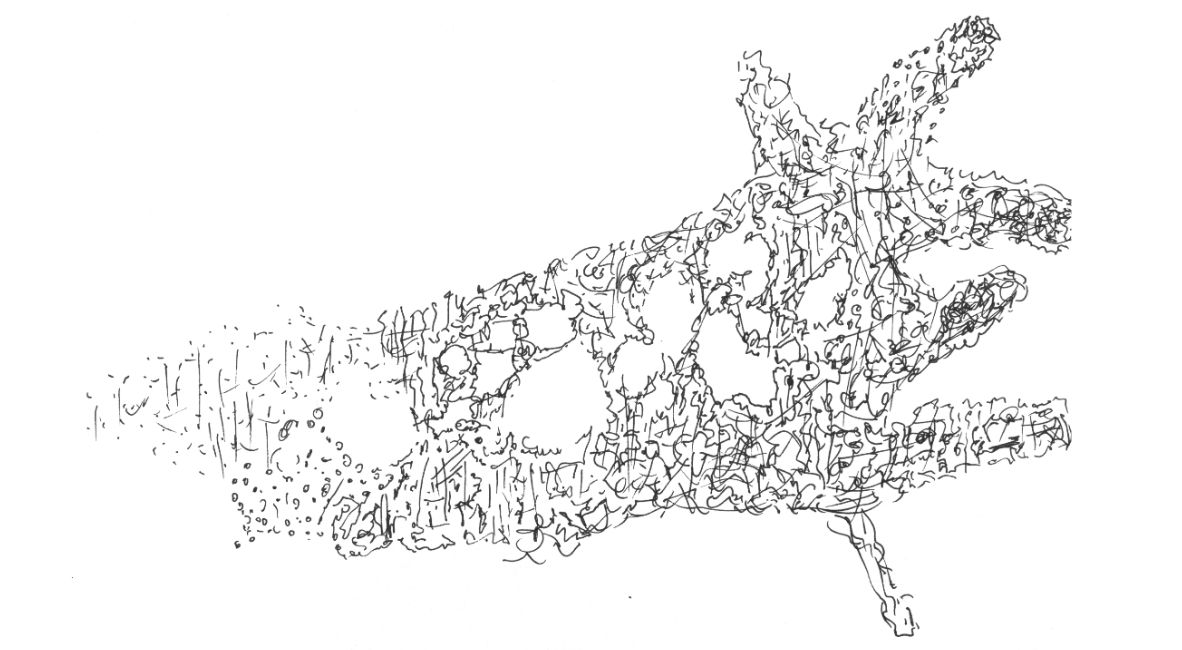
Amoeba x Hand
Drawing – 30×20 cm
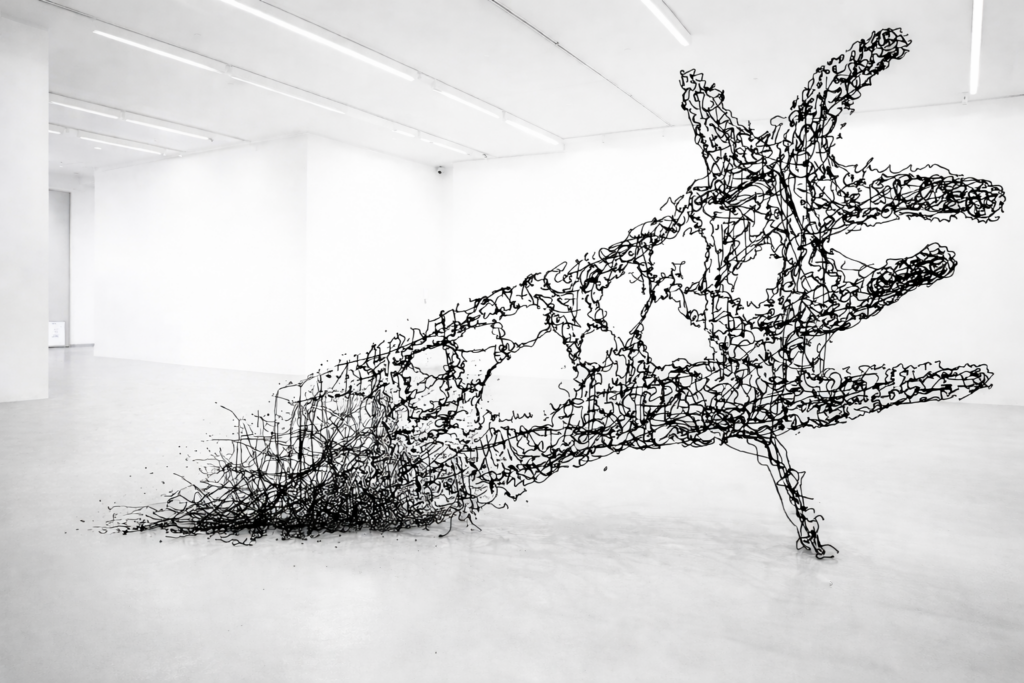
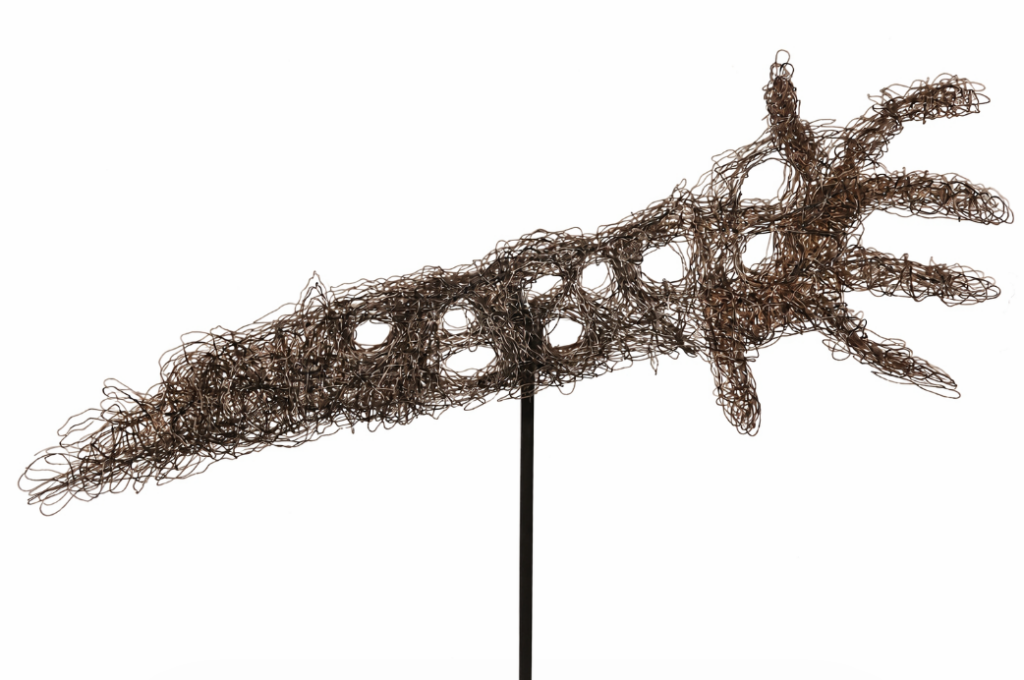
En 1965, aux États-Unis, l’amoeba Naegleria fowleri fit les gros titres : une entité microscopique, invisible à l’œil nu, capable de remonter les nerfs olfactifs jusqu’au cerveau pour le consommer, littéralement. En quelques jours, elle détruisait la matière cérébrale, provoquant des décès brutaux, une trentaine cette année-là. Une horreur biologique.
Aujourd’hui, cette figure revient — métaphoriquement — sous une forme bien plus sophistiquée : services numériques “gratuits”, scroll infini, notifications en rafale. Ce ne sont plus les eaux tièdes de lacs stagnants qui abritent la menace, mais nos poches, nos flux, nos interfaces. L’ennemi n’a plus de membrane : il est codé, designé, optimisé pour capter notre bande passante mentale.
Les plateformes qui ont permis l’essor d’internet ne connectent pas — elles consomment. Elles creusent le cortex à coup de récompenses aléatoires, de stimuli visuels, de cycles d’engagement. Ce n’est plus une amibe : c’est une architecture comportementale. Une nouvelle espèce parasitaire, invisible et acceptée. Le cerveau ne fond plus par infection, mais par dissociation, surcharge et distraction constante.
—
In 1965 in the U.S. there were a dangerous Amoeba bacteria that eat brains and caused more than 30 deaths. Arise of internet is made possible thanks to brain bandwith eater services.