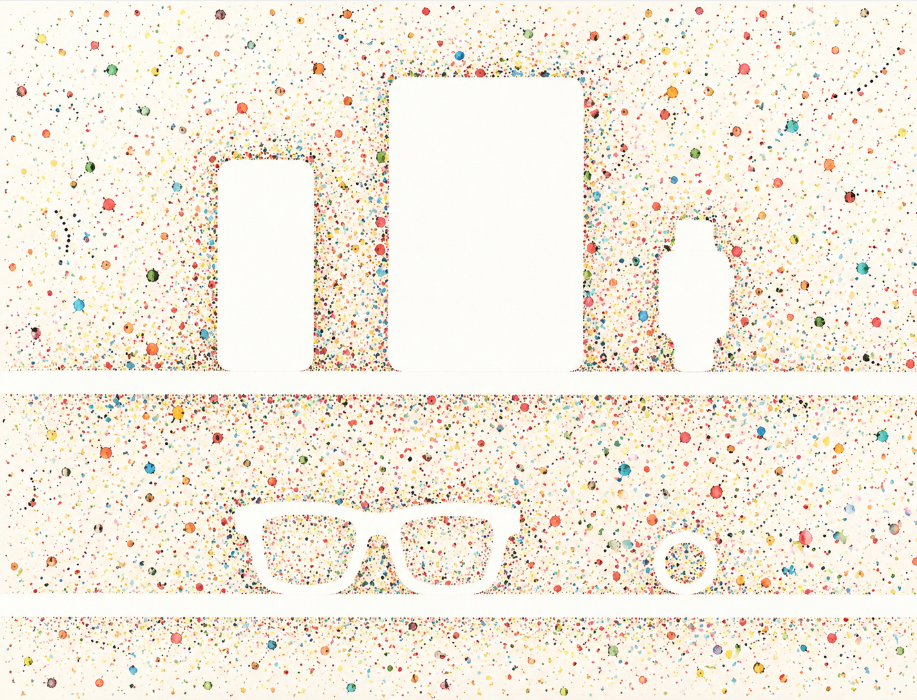
Téléphone, smartphone, tablette, montre connectée, bague connectée, lunettes connectées : rien n’est représenté, sinon leur disparition. À leur place demeurent des réserves blanches, découpées dans une effervescence de points, de bulles, de projections et de trajectoires colorées. La couleur semble joyeuse, presque festive, mais elle décrit un état d’agitation continue : notifications, gestes répétés, réflexes conditionnés, impulsions minuscules. Les objets qui promettaient la connexion deviennent ici des absences, comme si leur fonction avait fini par absorber leur forme. Autour d’eux, tout circule, pulse, rebondit, s’accumule, sans direction véritable. Les bulles chères à Clear Shadows ne figurent pas une vitalité, mais une excitation automatique, une ronde sans centre, une dépense nerveuse. On ne regarde plus un outil, on regarde l’espace qu’il a contaminé. Le blanc des silhouettes n’est pas un repos, mais le négatif d’une présence devenue structure. La connexion ne relie plus seulement les corps : elle organise leurs réflexes, leurs attentes, leurs boucles. Cette image montre moins des objets absents qu’un monde entièrement travaillé par ce qu’ils ont rendu habituel.
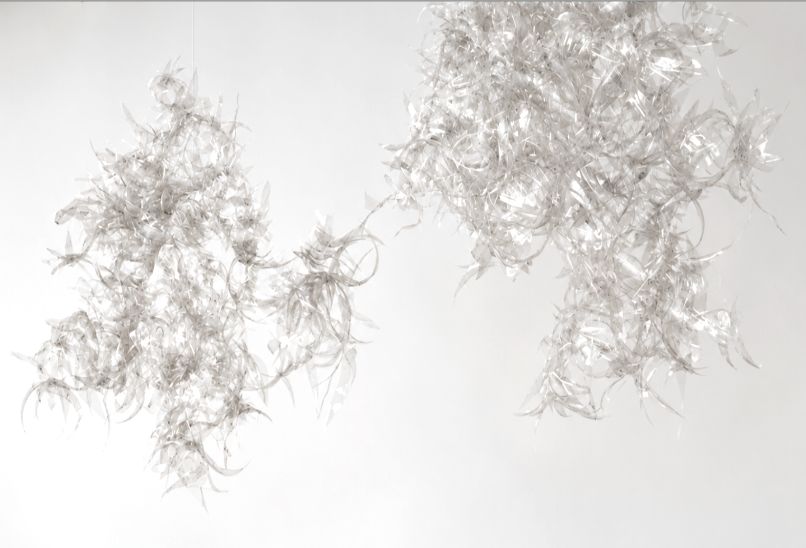
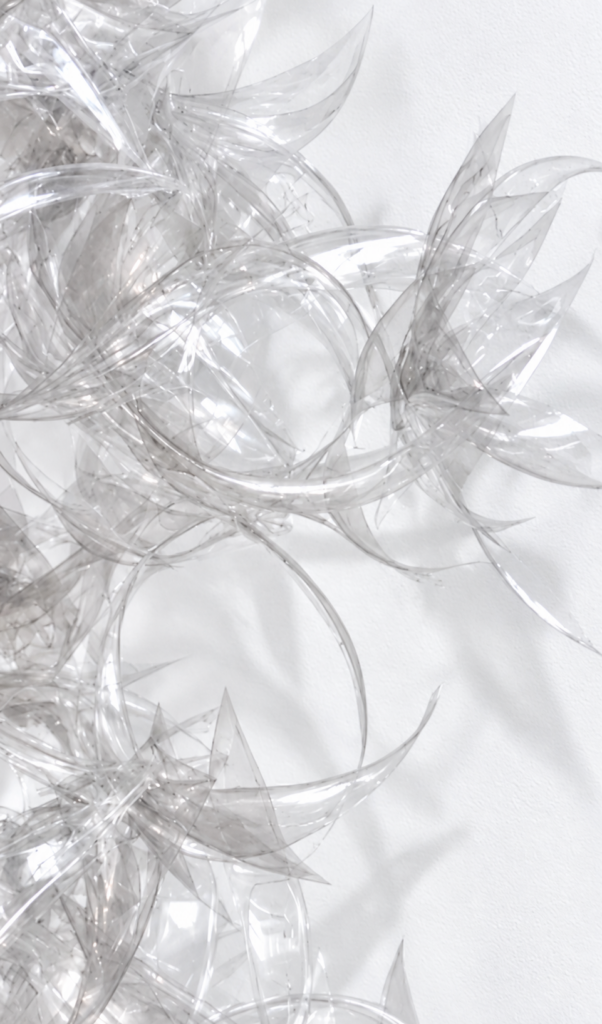
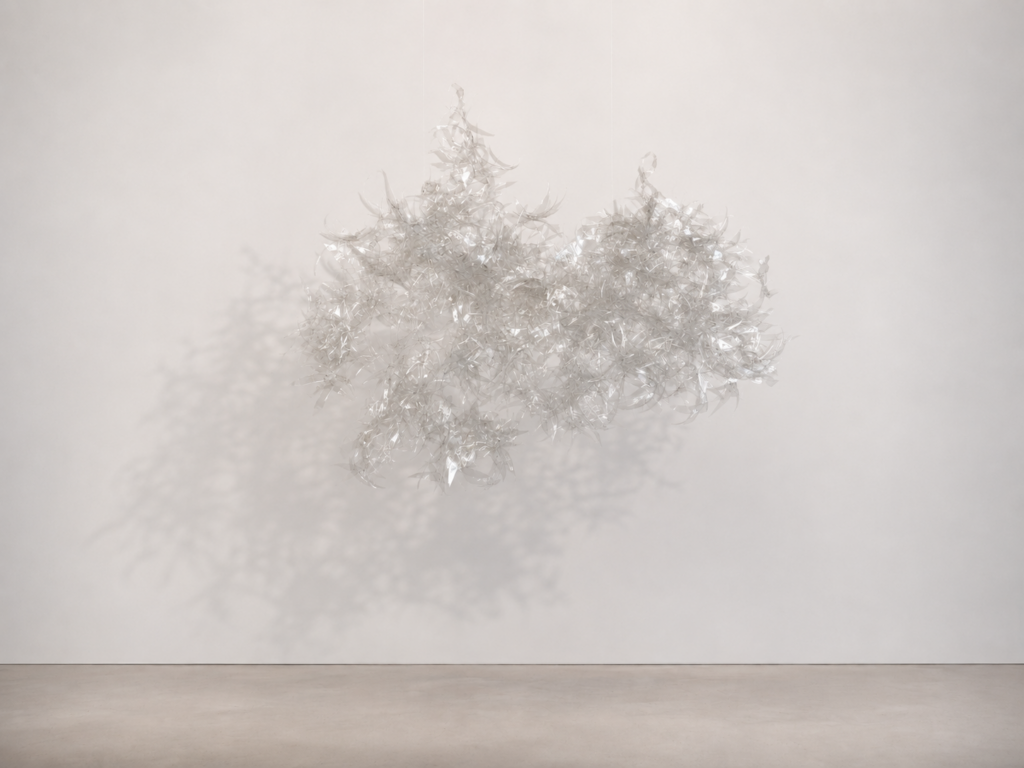
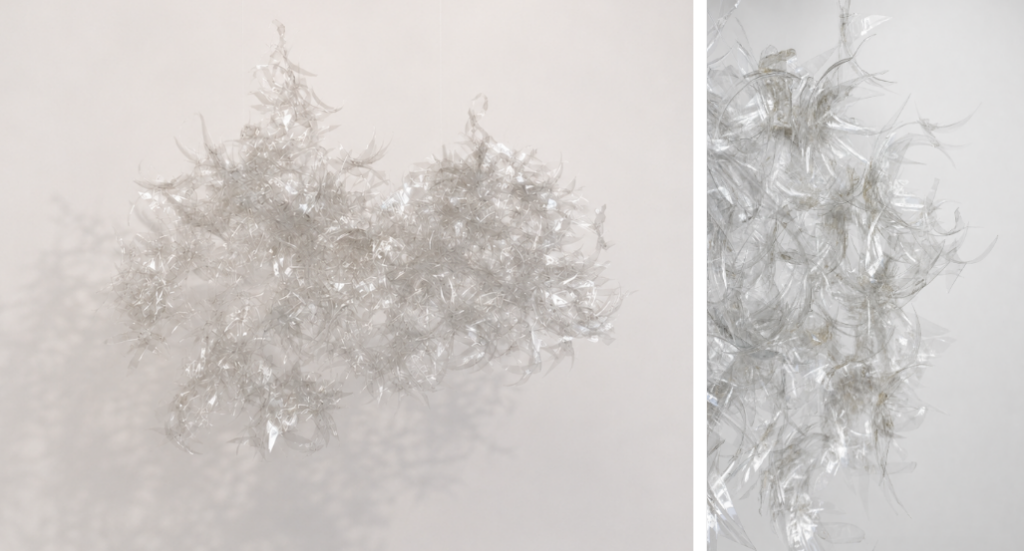
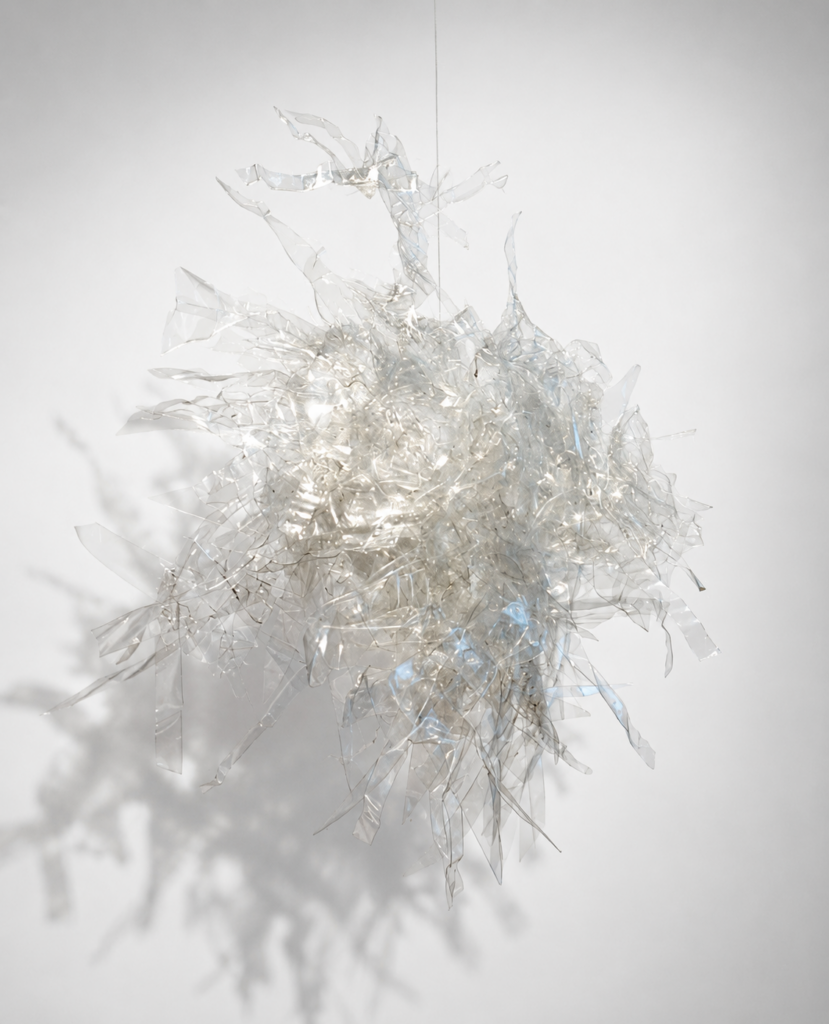
Découpées dans des bouteilles de plastique ordinaires, ces formes translucides conservent la mémoire d’un usage banal. Le contenant jetable devient ici matière de suspension. Chaque fragment a été taillé, collé, puis assemblé à la main. L’accumulation produit un volume instable, presque nuageux. Ce qui relevait du déchet acquiert une présence sensible. La transparence trouble la lecture de la masse. La légèreté visuelle contredit l’origine industrielle du matériau. L’ensemble semble flotter entre apparition et résidu. Les arêtes, les plis et les reflets captent la lumière. Ils transforment la bouteille en forme vibrante et aérienne. Suspendue dans l’espace, la sculpture détourne le vocabulaire de la pollution. Elle ne masque pas la matière plastique, elle la déplace. Le rebut devient souffle, scintillement, tension fragile. Cette élévation n’efface pourtant rien de sa provenance. Elle rappelle la prolifération silencieuse des objets consommés. Le geste d’assemblage agit alors comme une relecture critique. Rendre léger n’est pas rendre innocent. C’est montrer comment l’art peut retenir, suspendre et reconsidérer ce que notre quotidien abandonne trop vite.
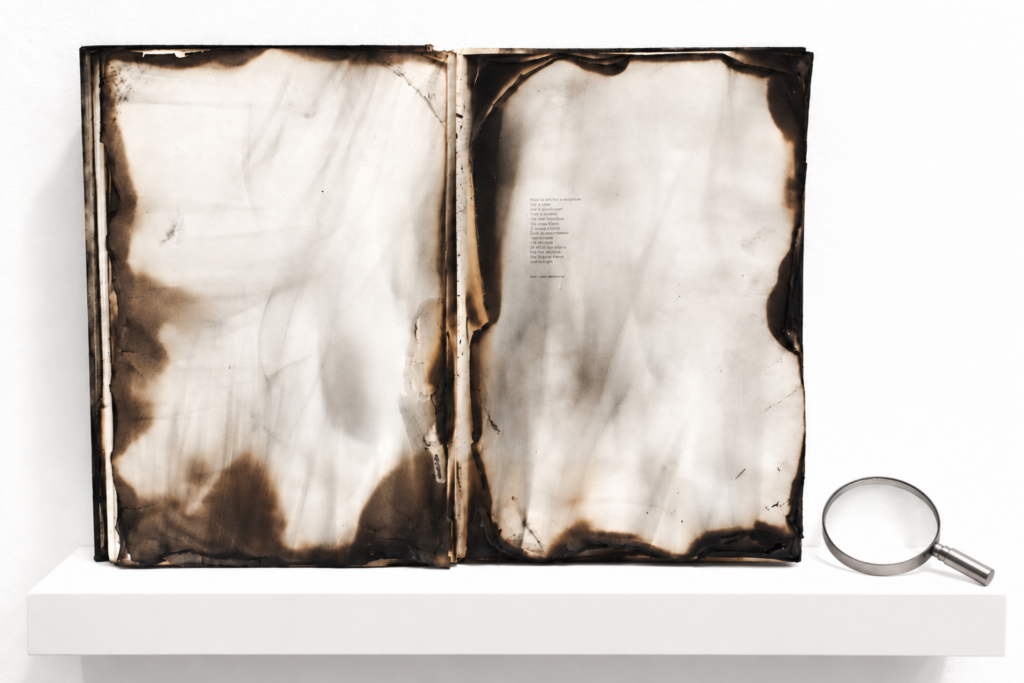
My time per day on phone x invisible usages x smoked
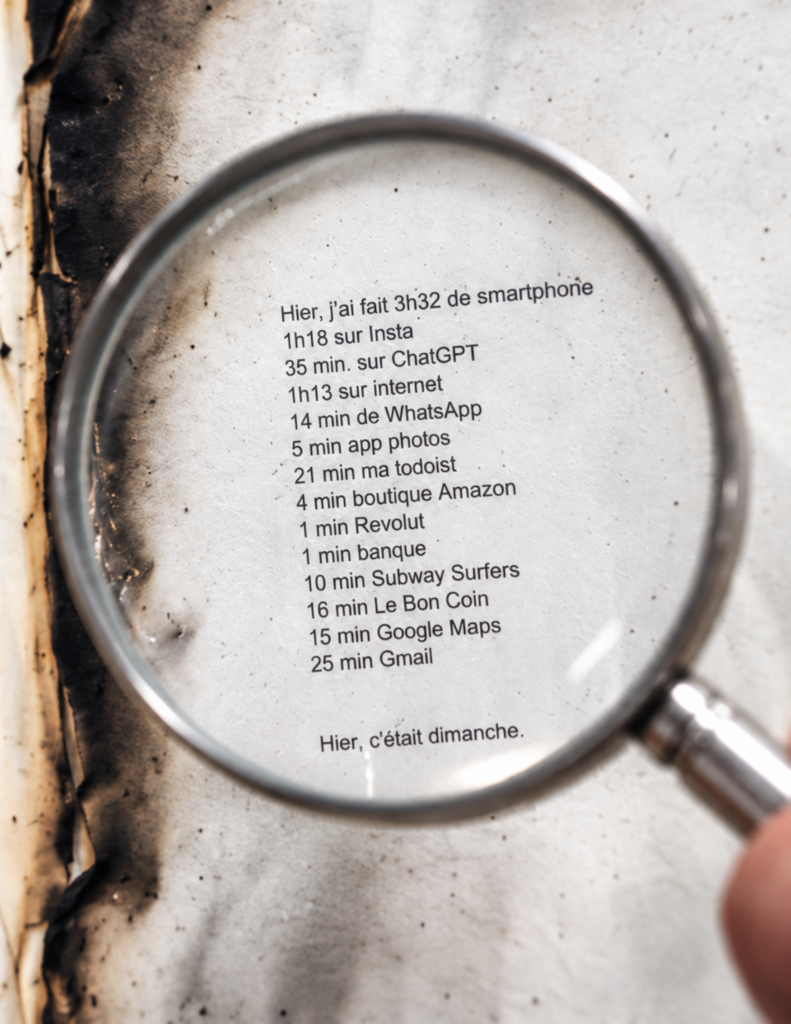
Cette pièce se présente d’abord comme une feuille presque vide, un papier blanc progressivement envahi par la suie, comme si le temps lui-même avait brûlé en silence. De loin, on ne lit rien ou presque : seulement une surface fragile, salie, enfumée, attirante par sa matière grise, par cette trace de combustion qui semble avoir consommé quelque chose d’invisible. Le texte manuscrit est volontairement réduit à une taille presque illisible, relégué au seuil de la disparition. Il faut s’approcher, prendre la loupe, accepter le geste de l’enquête, pour découvrir ce qui est inscrit : le relevé précis du temps passé par l’artiste sur son smartphone au cours d’un dimanche. Plus de cinq heures de fragments numériques, dispersés entre réseaux sociaux, messageries, plateformes, navigation, banque, achats, cartes, applications, micro-tâches et automatismes ordinaires. La journée n’est pas racontée par ses événements, mais par ses fuites. Le dimanche, supposé temps de repos, de lenteur, de famille, de lecture ou de rêverie, apparaît ici comme un territoire capturé. Chaque ligne minuscule devient l’indice d’une ponction : quelques minutes ici, une heure là, un geste machinal, une consultation rapide, un retour sans nécessité vers l’écran. L’accumulation produit une forme de perte sèche, une journée trouée par la captation de l’attention. La suie dit ce que les chiffres ne montrent pas : un temps parti en fumée, consommé sans chaleur, sans mémoire, sans véritable expérience. La loupe, attachée au cadre comme un instrument antivol, transforme le regardeur en analyste de ses propres usages. Elle oblige à regarder de près ce que l’on préfère généralement ne pas voir. Le détail agrandi ne révèle pas un secret spectaculaire, mais une banalité inquiétante : l’érosion continue du temps disponible. Temps de lecture, temps d’évasion, temps d’imagination, temps social, temps de famille, temps avec les enfants, temps avec les amis : tout ce qui aurait pu exister ailleurs semble avoir été déplacé vers les infrastructures de l’attention. La feuille noircie conserve la trace d’un dimanche ordinaire devenu document de dépossession. Le smartphone n’apparaît pas, pourtant il organise toute la scène. Il est présent dans les chiffres, dans les noms des plateformes, dans les gestes répétés, dans cette poussière noire qui recouvre peu à peu la page. La pièce ne moralise pas l’usage, elle en matérialise le coût invisible : une combustion lente de la disponibilité intérieure. Le total, obtenu par OCR suite à une perte du document source est faux, mal retranscrit par la machine, comme pour minimiser cette perte de temps. Par ailleurs, les fournisseurs d’IA achètent des livres par millions pour entrainer les IA, puis les brûlent.
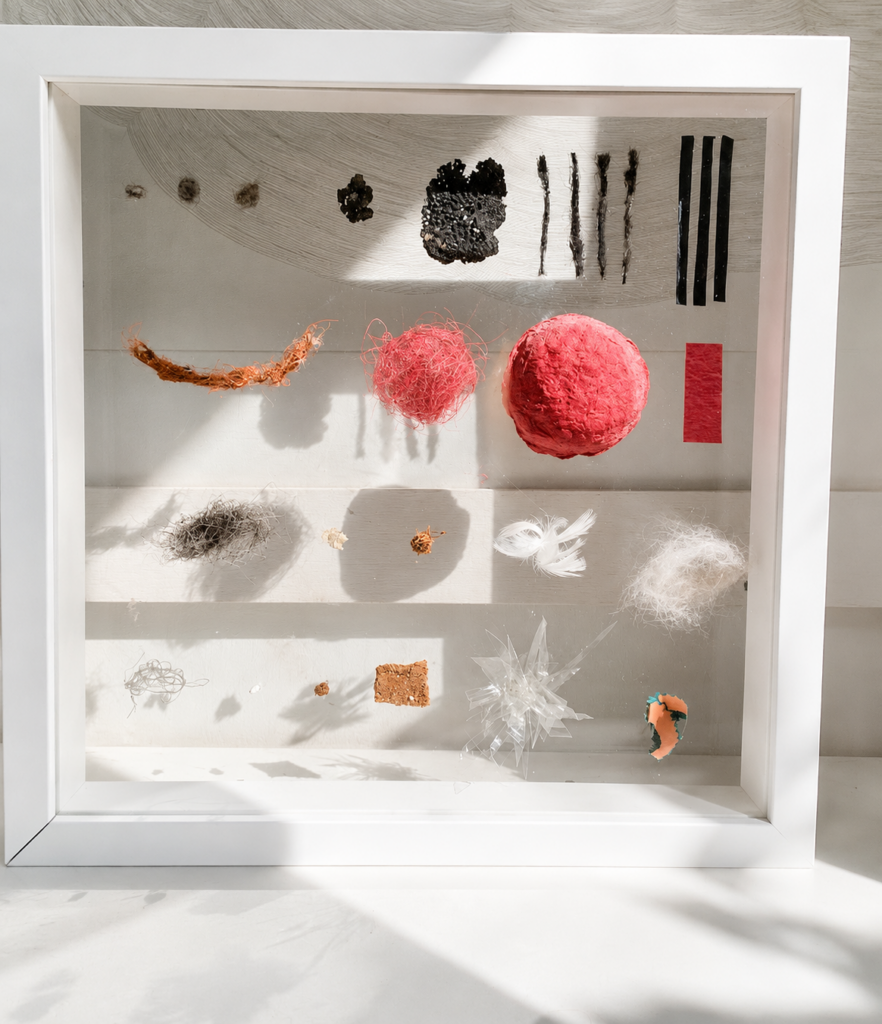
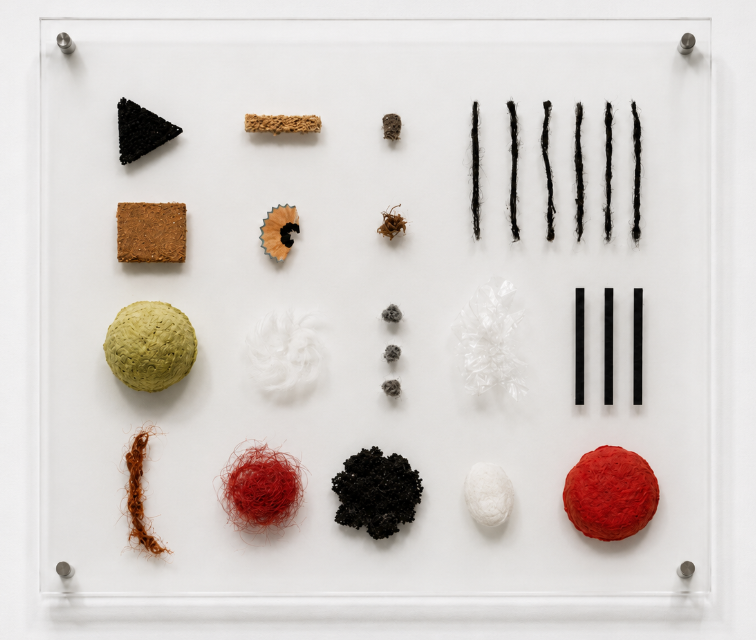
Cette pièce rassemble ce que l’habitat rejette sans jamais vraiment toujours l’expulser : poussière domestique, cheveux, poils d’animaux, fibres textiles de la machine à laver, fibres de tapis, poussières plastiques, poussière de bois aggloméré, miettes du grille pain, résidus de café, plumes de duvet, poussière de plante, fragments de papier, taille de crayon, reste de savon et résidus issus de la poubelle jaune…..Chaque élément est pauvre, minuscule, presque honteux, mais son alignement sur plexiglas et sa recoloration volontaire parfois, le déplace vers une forme de classification froide presque esthétique. Ce qui devait disparaître dans l’aspirateur, la poubelle ou le chiffon devient ici matière d’observation. La présentation évoque une planche entomologique, mais il ne s’agit plus d’insectes rares : ce sont les restes ordinaires de nos gestes, de nos objets, de nos corps et de nos consommations. L’intérieur domestique apparaît comme un écosystème de dépôts, un paysage pulvérisé où cohabitent le vivant, l’industriel et le synthétique. Les cheveux et les poils rappellent la présence des corps ; les fibres textiles et de tapis disent l’usure lente des surfaces ; la poussière plastique et les résidus de poubelle jaune prolongent la vie invisible des emballages ; le bois aggloméré, les miettes, le café, la plante et le crayon témoignent d’une activité quotidienne réduite à ses particules. Rien n’est spectaculaire, et c’est précisément cette absence de spectacle qui rend l’image dérangeante. Le plexiglas protège autant qu’il accuse : il fige ces déchets minuscules dans une vitrine propre, presque scientifique, comme si notre habitat produisait en continu ses propres archives. La grille impose une discipline à ce qui d’ordinaire échappe au regard. Elle transforme le désordre domestique en inventaire, le rebut en spécimen, la saleté en donnée. Ce classement met à nu une vérité simple : vivre, consommer, écrire, manger, s’habiller, nettoyer, c’est aussi produire sans cesse des traces matérielles. La maison n’est pas seulement un refuge ; c’est une machine lente à fabriquer des poussières.
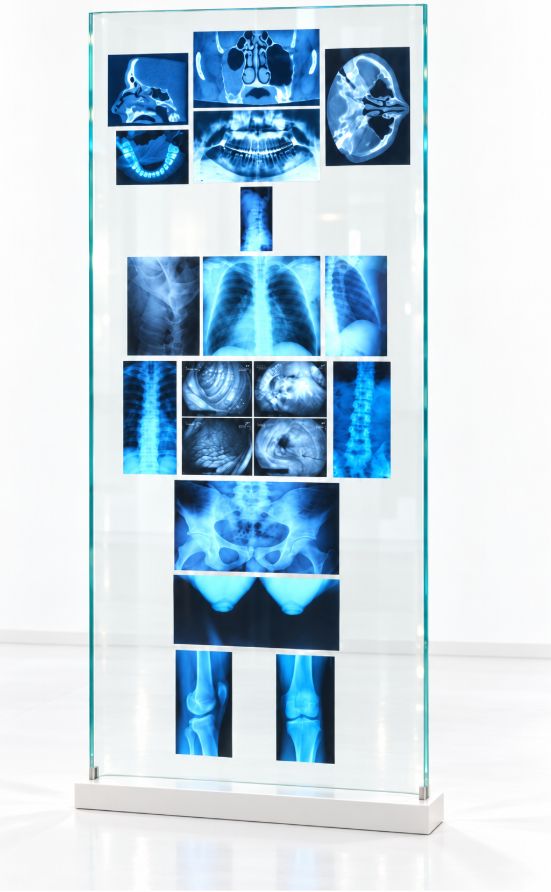
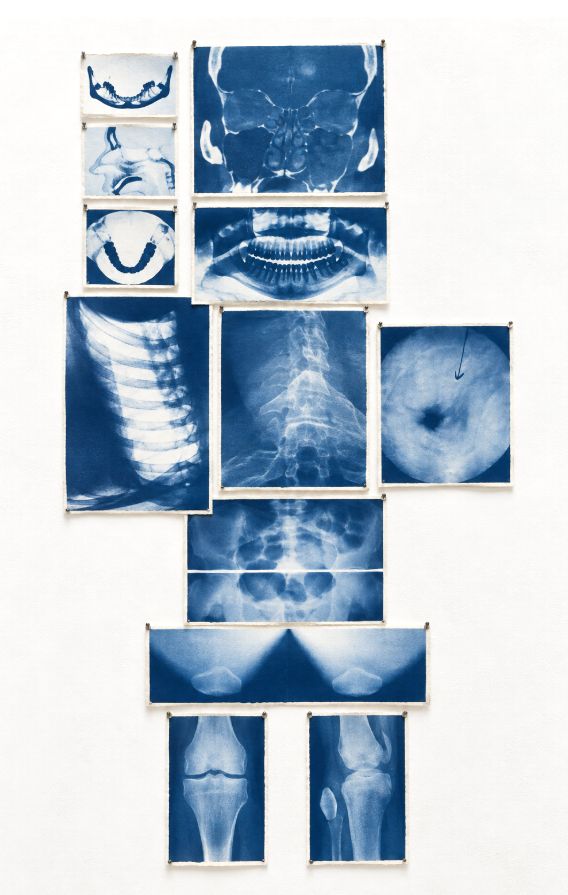
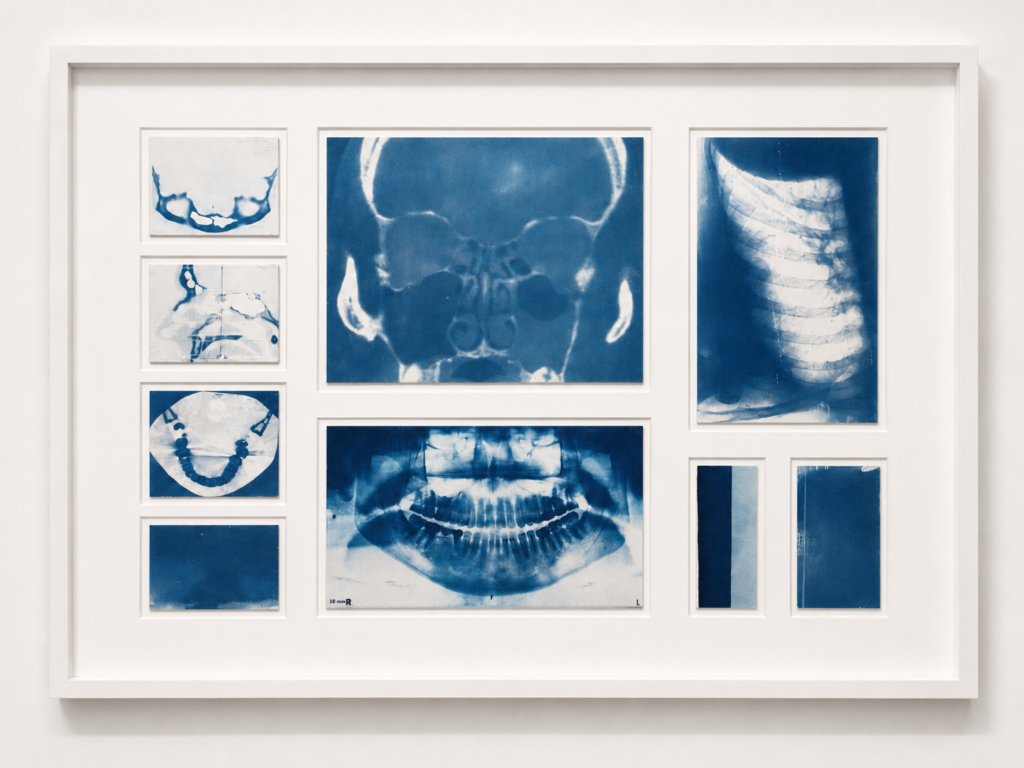
Cette composition rassemble des cyanotypes réalisés à partir de radiographies de mon propre corps. Crâne, mâchoire, dents, côtes, fragments osseux : ce qui relève habituellement du dossier médical devient ici une surface exposée. L’image ne montre plus le visage social, mais son envers clinique, l’intérieur rendu visible, l’intime converti en document. À l’époque des réseaux sociaux, l’exposition de soi ne s’arrête plus à la peau : elle glisse vers les données, les profils, les habitudes, les signaux biologiques, les traces que nous laissons derrière nous. Le corps n’est plus seulement photographié, il est lu, découpé, archivé, interprété. Les radiographies deviennent alors des autoportraits sans visage, des images où l’identité ne passe plus par l’expression, mais par l’infrastructure physique qui nous soutient. Le cyanotype ajoute à cette révélation une forme de distance : le bleu transforme la donnée médicale en image fragile, presque spectrale, comme si le corps apparaissait déjà sous la forme d’une archive ancienne. Le passe-partout et le cadre blanc organisent ces fragments comme une planche anatomique, mais cette taxinomie reste profondément personnelle. Chaque élément semble classé, isolé, rendu propre, alors qu’il provient d’une zone vulnérable : dents, sinus, cage thoracique, mâchoire, architecture interne. L’image interroge ce moment où le corps humain devient une surface d’analyse disponible. Un lecteur averti sait désormais que les intelligences artificielles apprennent à lire ces images médicales avec une précision parfois supérieure à celle des praticiens. Certaines recherches suggèrent même que leurs réponses peuvent être perçues comme plus empathiques que celles de médecins humains. Ce renversement trouble déplace la radiographie : elle n’est plus seulement un outil de diagnostic, mais un territoire d’interprétation automatisée. Ce qui était autrefois confié au regard médical entre désormais dans une chaîne plus vaste de calcul, de comparaison et de prédiction. L’intime devient lisible par des systèmes qui ne connaissent ni la douleur, ni la peur, ni l’histoire du patient. Dans cette série, le corps se présente donc comme une donnée exposée, offerte au regard humain autant qu’au regard machinique. Le bleu cyanotype conserve pourtant une part de résistance : il ralentit la lecture, brouille la froideur du scan, réintroduit de la matière, du temps, de l’accident. Ce corps montré de l’intérieur ne livre pas une vérité totale ; il rappelle au contraire que toute image médicale est aussi une image de pouvoir. Elle révèle, classe, rassure, inquiète, mais ne dit jamais entièrement ce qu’est une vie.
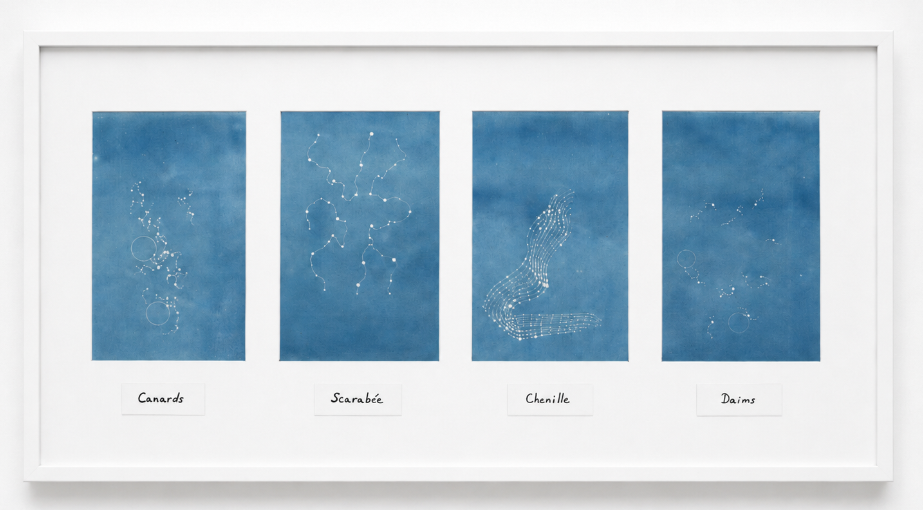
Ces cyanotypes enregistrent des flux de mouvement animal, non comme des scènes spectaculaires, mais comme des traces fragiles du vivant en action. Chaque image fixe ce qui, d’ordinaire, disparaît aussitôt qu’il a eu lieu : un déplacement, une hésitation, une fuite, une vibration du corps dans l’espace. Les canards et les canetons tournent autour d’une mère immobile, presque solaire, dont la stabilité devient le centre invisible d’une agitation douce. Le scarabée, lui, ne compose pas une forme : il lutte, il se débat, il cherche à se désenfouir, et son effort laisse une cartographie nerveuse, presque désespérée. La chenille inscrit une ligne plus lente, plus sinueuse, suspendue à l’attente d’un passage humain sur lequel elle pourrait s’accrocher. Les daims d’élevage produisent une trace plus inquiète : ils scrutent, reculent, bougent frénétiquement, mais leur mouvement contient déjà la possibilité d’une échappée. Présentées comme une galerie d’entomologie, ces images reprennent les codes du classement scientifique, mais elles ne classent pas des corps morts : elles exposent des intensités de vie. Le cartel nomme l’espèce, tandis que le cyanotype révèle ce que le nom ne peut pas contenir : le trouble, l’instinct, la peur, l’orientation, la pulsation. Rien ici n’est utile, productif ou mesurable au sens industriel du terme. Ces mouvements ne nourrissent aucune base de données, n’optimisent aucun comportement, ne servent aucune machine. Ils existent seulement parce qu’un animal a bougé, parce qu’un corps a réagi, parce qu’une présence a traversé un fragment du monde. La série donne ainsi une valeur à ce qui échappe d’habitude à toute capture : les micro-événements du vivant, les trajectoires sans rendement, les gestes sans destination claire. Le cyanotype devient moins une image qu’une empreinte temporelle, une manière de graver l’infime avant son effacement. Dans cette collection de flux, on oppose à la logique de l’automatisation une attention lente, presque archaïque, portée aux signes minuscules de la vie. Le vivant y apparaît dans sa beauté propre : imprévisible, inutile, vulnérable, irréductible.
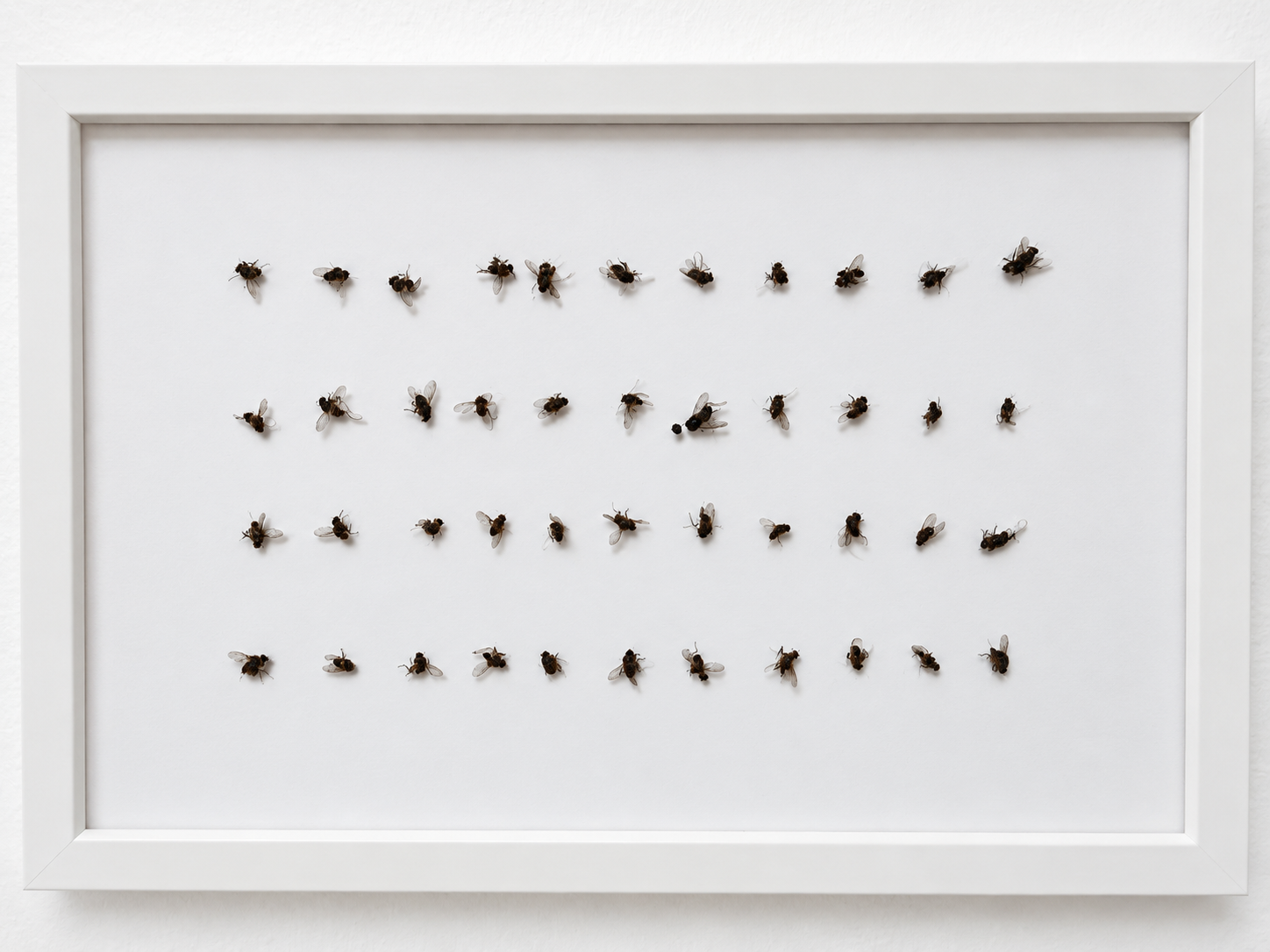
Cette pièce réunit 44 drosophiles prises dans une plaque de plexiglas, comme autant de traces minuscules d’un désastre ordinaire. Le chiffre n’est pas anecdotique : il renvoie aux 44 % de fruits et légumes qui périssent avant d’être mangés. La drosophile apparaît ici comme l’indice biologique de cette perte, l’insecte qui arrive quand l’aliment a déjà basculé dans la décomposition. Elle n’est pas représentée, elle est là, physiquement présente, arrêtée dans la matière. Son corps minuscule devient le témoin direct d’un système alimentaire qui produit, transporte, stocke, expose, puis jette. L’alignement évoque les vitrines d’entomologie, les collections scientifiques, le classement patient du vivant. Mais cette rigueur est immédiatement contredite par l’état des insectes. Les drosophiles sont écrasées, déplacées, salies, comme happées par une vitesse qui les dépasse. Elles semblent avoir été percutées, projetées, réduites à des impacts noirs sur une surface blanche. Le tableau fonctionne alors comme une collision entre deux langages : celui de la science et celui de l’accident. Le plexiglas enferme les corps, les fige, les conserve, mais il ne les sauve pas. Il transforme le rebut organique en archive froide, transparente, presque administrative. Chaque insecte devient une unité de perte, une donnée, un résidu comptable d’un gâchis invisible. La grille accentue cette lecture : elle ordonne ce qui, dans le réel, relève de la fermentation, du débordement, de la pourriture. Elle donne une apparence rationnelle à un phénomène profondément irrationnel. Ce ne sont pas seulement des mouches de fruits, mais les marqueurs d’une chaîne entière où l’abondance produit mécaniquement du déchet. Leur petitesse oblige à regarder de près, à s’approcher de ce que l’on préfère habituellement repousser. La pièce fait entrer dans l’espace de la galerie un signe pauvre, sale, presque honteux : l’insecte de cuisine, l’indice du fruit oublié. Le nombre 44 transforme cette présence en accusation silencieuse. Ce qui est écrasé ici, ce n’est pas seulement la drosophile, c’est la valeur même du vivant dans une économie de la surproduction.
AI Process x Kanban stickers x Human work disappearance
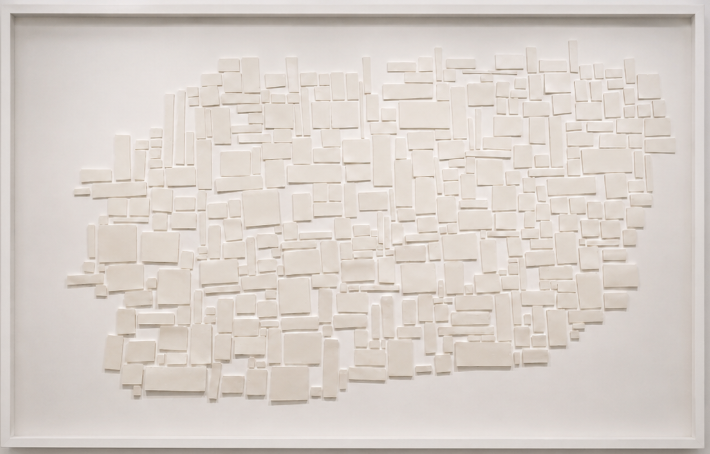
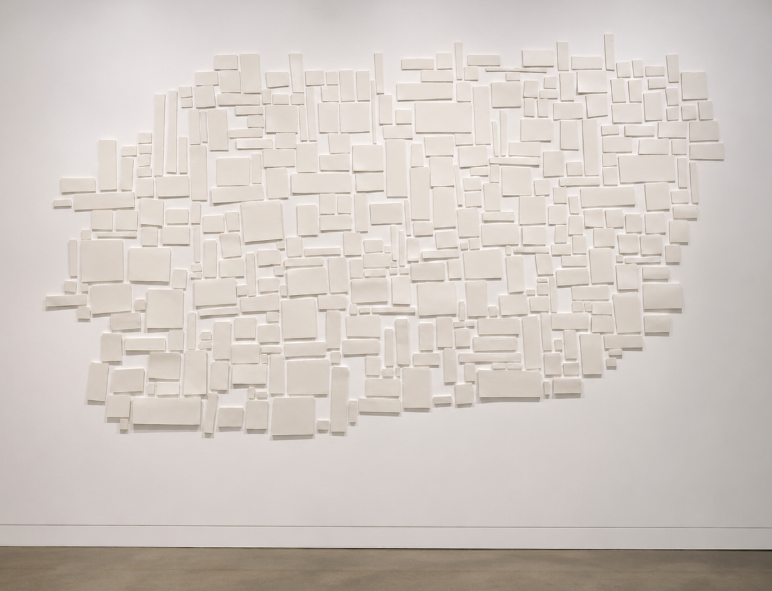
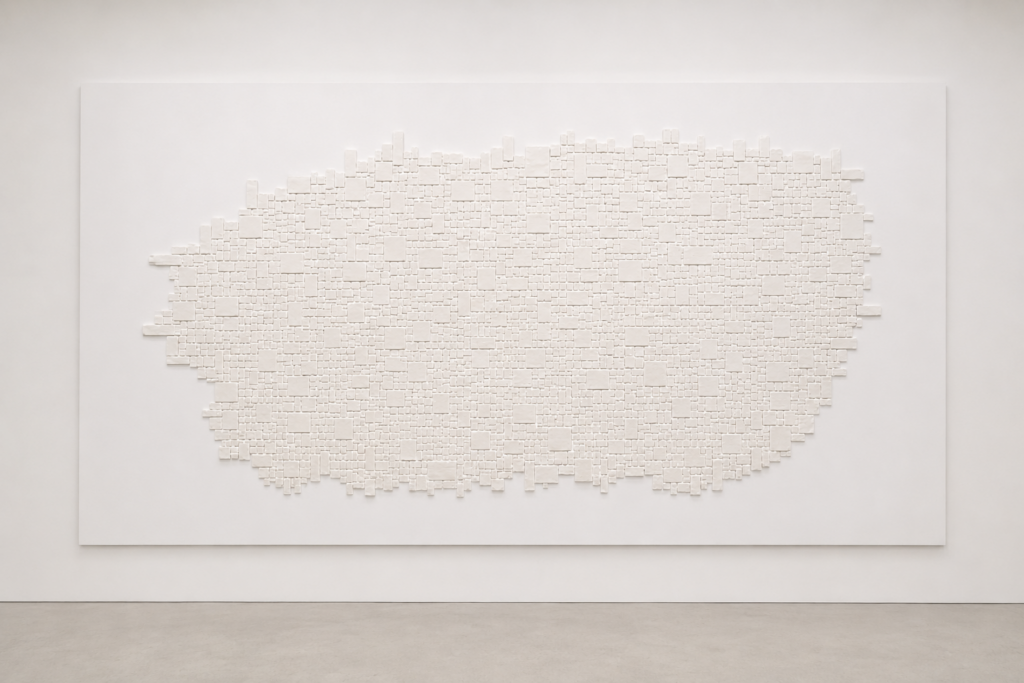
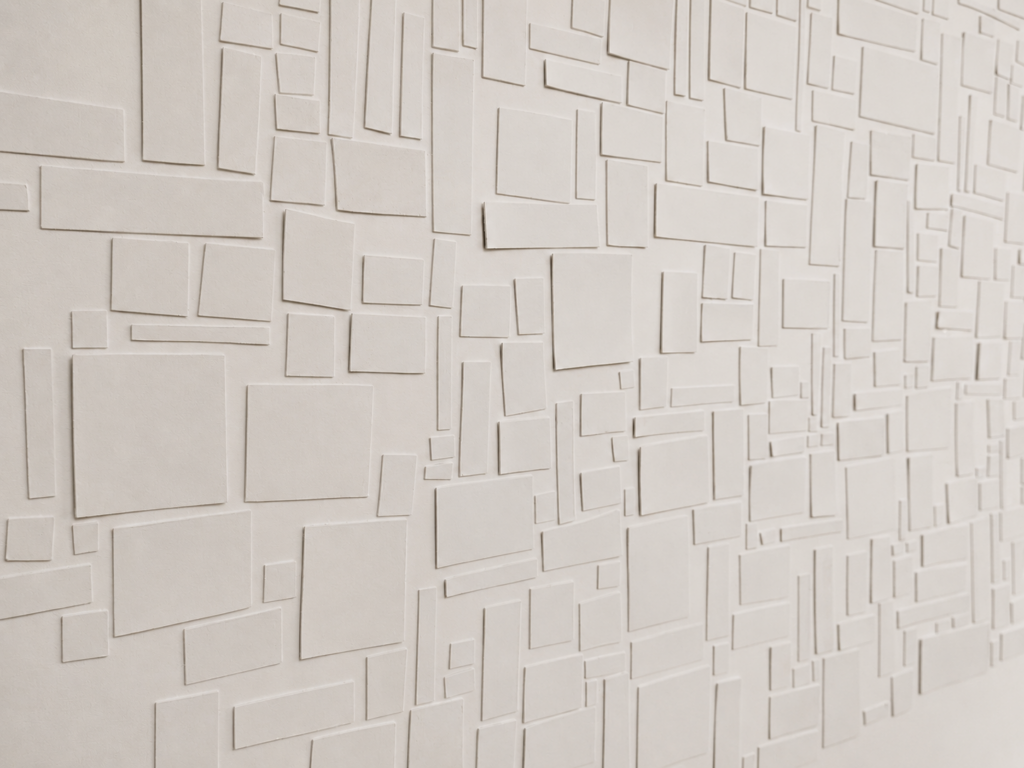
Cette pièce est construite à partir de chutes de cartels et de papiers destinés à la poubelle, récupérés avant leur disparition matérielle. Les fragments ont été découpés, triés, classés selon sept formats différents, comme une petite réserve de données physiques. Chaque morceau devient une unité minimale, presque une case, presque une tâche. L’artiste a ensuite demandé à une intelligence artificielle de produire un algorithme capable de choisir deux paramètres simples : la taille du fragment et son orientation, verticale ou horizontale. Pendant les trois premiers quarts de la composition, le collage suit donc les instructions précises de la machine. Le geste humain est réduit à l’exécution : prendre, encoller, positionner, appuyer, recommencer. La décision disparaît presque entièrement au profit d’un protocole extérieur, froid, arbitraire, mais présenté comme rationnel. Lorsque certaines tailles venaient à manquer, l’algorithme était recalibré, comme dans une chaîne de production qui s’adapte à la pénurie sans jamais remettre en cause le principe du système. Au début, des trous apparaissent dans la composition. Ils ne sont pas corrigés, car lorsque la machine décide, l’exécutant n’a plus le droit de combler ce qui dérange l’œil. L’image accepte donc ses manques, ses absurdités, ses zones incomplètes, comme les conséquences visibles d’une obéissance au process. Par moments, l’attente de la réponse algorithmique devient trop longue. L’artiste désobéit alors, prend une décision lui-même, colle un fragment sans autorisation, rompt discrètement la chaîne de commande. Cette désobéissance n’est pas spectaculaire : elle est minuscule, presque invisible, mais elle réintroduit une présence humaine dans un dispositif qui cherchait à l’effacer. Le travail devient volontairement pénible. Les grands morceaux vont vite, les petits ralentissent tout, collent aux doigts, imposent une attention répétitive, presque absurde. Chaque petit fragment concentre la fatigue des tâches minuscules que le numérique délègue encore aux humains. La pièce évoque ainsi l’abrutissement de nombreux métiers contemporains, notamment dans le digital : remplir des cases, suivre des procédures, valider des étapes, obéir à des interfaces. L’humain n’y pense plus vraiment ; il applique. Il devient le bras manuel d’une machine qui calcule, hiérarchise, distribue et ordonne. Mais l’image raconte aussi ce qui échappe au contrôle. En entreprise, certains utilisent déjà l’intelligence artificielle malgré les interdictions, contournent les règles, automatisent leur propre travail, délèguent en secret ce qu’on leur demande encore de faire. La désobéissance devient alors ambiguë : paresse, survie, résistance, optimisation ou anticipation du remplacement à venir. Cette pièce est dédiée à tous ceux dont le travail consiste encore à exécuter des tâches répétitives, à nourrir des systèmes, à manipuler des données ou des objets selon des consignes venues d’ailleurs. Elle parle de ces emplois dont la pérennité est désormais menacée par l’intelligence artificielle, puis par la robotisation qui finira par prendre aussi les gestes matériels. À la fin, épuisé par le protocole, l’artiste abandonne la machine et termine seul le dernier quart de la composition. Il remplit davantage les vides, corrige instinctivement les déséquilibres, cherche peut-être une forme plus agréable, moins mécanique. Pourtant, il devient difficile de distinguer ce qui a été dicté par l’algorithme et ce qui relève de la main humaine. Cette confusion est le cœur de la pièce : à partir de quel moment l’obéissance ressemble-t-elle à une décision, et à partir de quel moment la décision humaine n’est-elle plus qu’un automatisme intériorisé ? Le collage matérialise un point de bascule dans la société du travail, là où la machine ne remplace pas seulement les métiers, mais commence à dicter les gestes, les rythmes, les choix et les renoncements.
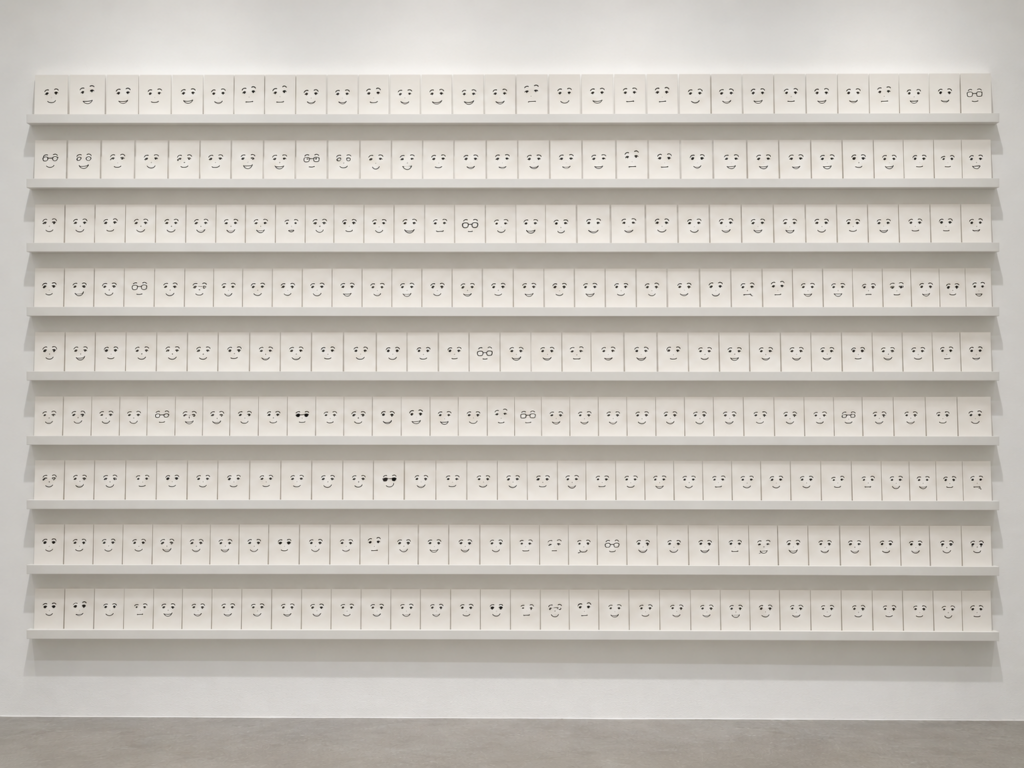
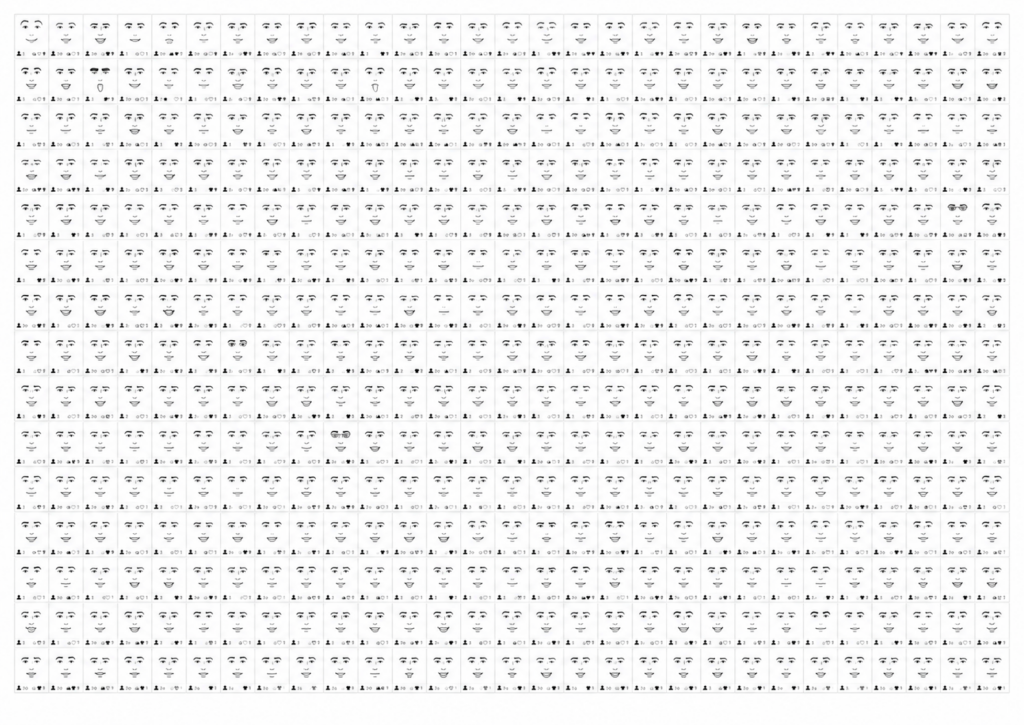
Superselfie rassemble dix ans de selfies, de mes selfies, dix ans d’images produites non pour regarder le monde, mais pour y inscrire sa propre présence. La série ne montre pas seulement un visage répété: elle montre la contamination progressive du réel par l’autoportrait. Les lieux touristiques, les paysages, les monuments, les images, les sculptures, les moments supposés être vécus deviennent des arrière-plans disponibles. On ne s’y tient plus devant pour les regarder, mais pour s’y inclure, les absorber, les transformer en preuve sociale.
Sur 728 selfies, la moyenne de 2,2 personnes par image dit déjà que l’autoportrait n’est jamais seul. Les autres s’invitent, volontairement ou accidentellement, dans le cadre. Ils contaminent l’image, comme le selfie contamine à son tour l’espace public. Cent soixante-quinze images comportent un beau paysage en arrière-plan, 108 montrent des lunettes de soleil, 96 une chemise,105 avec l’air fatigué, 64 une casquette ou un chapeau, 235 où l’on voit clairement mes dents, 465 avec mes rides, 22 une langue tirée, trois seulement un masque. Chaque détail devient une donnée, chaque posture un motif, chaque accessoire un indice de comportement.
Dans les musées, devant les monuments, au bord des paysages, l’accès aux images et aux lieux est devenu instable. Les corps s’interposent, les bras se tendent, les écrans se lèvent. L’image à voir disparaît derrière l’image de soi à produire. Le selfie organise une nouvelle économie de l’attention: l’instant n’est plus pleinement vécu, il est immédiatement converti en contenu partageable. Superselfie observe cette bascule avec froideur: le souvenir n’est plus ce qui reste d’une expérience, mais ce qui a été fabriqué pour être montré aux autres.
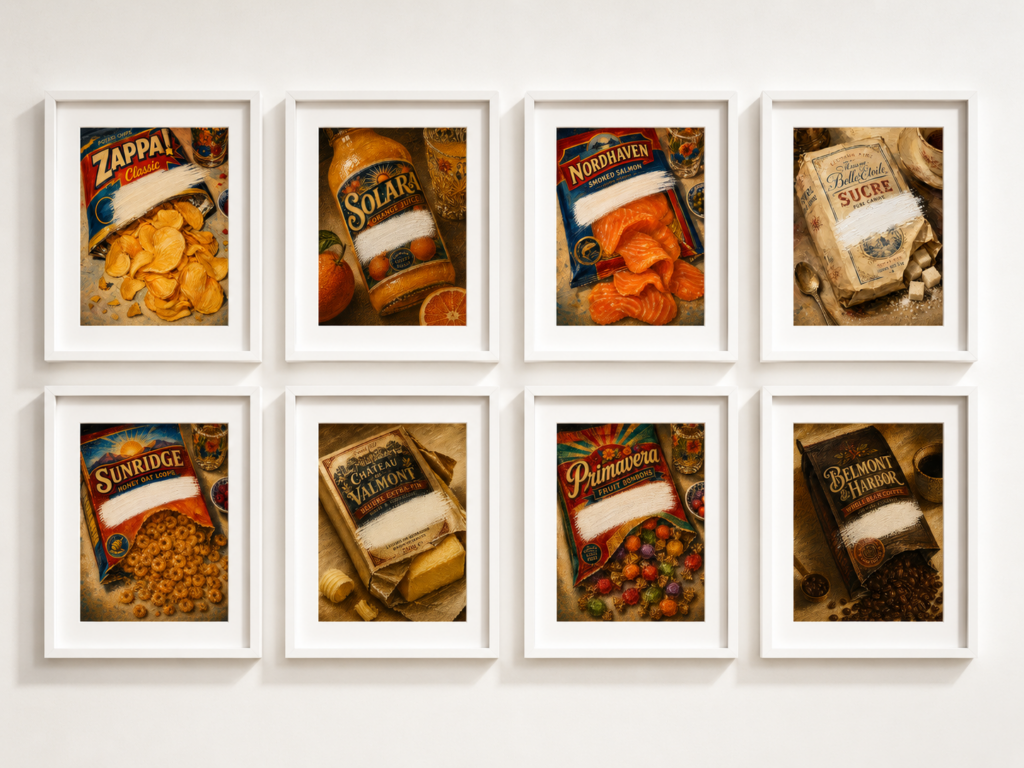
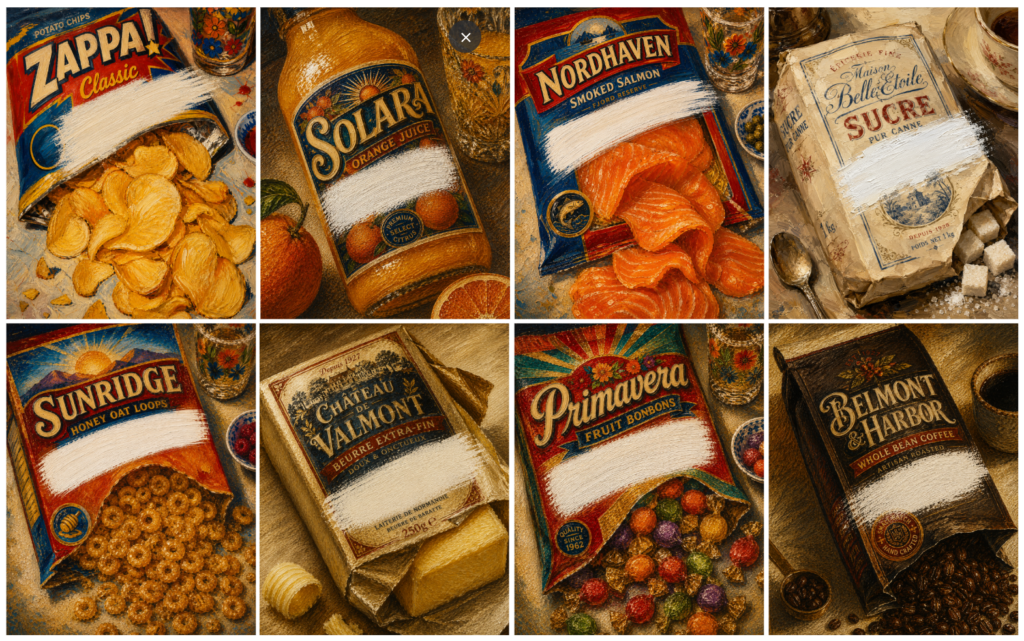
Cette image part d’un geste devenu presque invisible dans les rayons : le rétrécissement discret des quantités alimentaires, sans réduction équivalente du prix. Après la crise du COVID, puis l’inflation, de nombreux industriels ont ajusté leurs marges non pas en affichant frontalement une hausse, mais en diminuant le contenu des paquets. Le phénomène, connu sous le nom de shrinkflation, transforme l’emballage en zone de dissimulation. Tout y demeure familier : couleurs saturées, typographies généreuses, promesse d’abondance, vocabulaire de tradition, de qualité, de plaisir. Pourtant, quelque chose manque déjà. La trace blanche déposée sur chaque paquet efface environ 10 à 20 % de sa surface, comme une mesure visuelle de ce qui disparaît du produit lui-même. Elle ne masque pas totalement l’image : elle laisse deviner, elle trouble, elle rature sans supprimer. Ce geste pictural agit comme une contre-étiquette, une révélation brutale posée sur le langage marketing. Là où l’industrie maquille le retrait par le design, la peinture rend la perte visible. Les paquets semblent encore pleins, séduisants, presque festifs, mais leur surface est entamée, amputée, contredite par cette bande claire. L’image met en tension la gourmandise, la nostalgie publicitaire et la violence douce d’une économie qui retire sans dire. Elle rejoint les luttes menées dans plusieurs pays contre la vie chère, l’opacité des prix et la manipulation des perceptions. Ici, le blanc n’est pas un vide décoratif : c’est la part manquante, la quantité absorbée, la confiance grignotée.
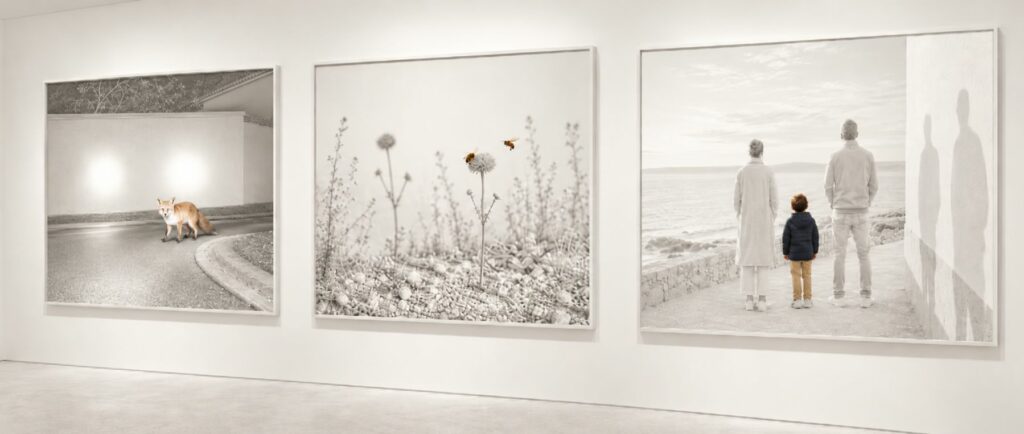
Un renard s’approche des habitations parce que son territoire recule. Il ne vient pas vers l’homme, il est poussé hors de son monde. La route remplace le sous-bois, les phares remplacent la lune, le mur blanc d’une maison remplace l’horizon. L’animal est ébloui, vulnérable, déjà pris dans une scène d’accident possible. Son ombre manque, comme si le réel commençait à l’effacer avant même sa mort. Ailleurs, deux adultes et leur enfant regardent la mer depuis une corniche. Le soleil rasant projette les corps sur un mur blanc, mais l’enfant, lui, ne laisse aucune ombre. La scène reste calme, presque belle, et c’est précisément ce calme qui inquiète. La disparition ne surgit pas comme une catastrophe visible, elle se glisse dans un détail que l’on pourrait ne pas voir. Sur une fleur, des abeilles devraient être là, ou l’ont peut-être été. Leur absence devient une anomalie silencieuse, un vide minuscule au cœur du vivant. Elles ne font plus masse, ne bourdonnent plus, ne signalent plus la continuité fragile entre la fleur, le fruit, la saison et la nourriture. Le renard, l’enfant, les abeilles forment des présences menacées, des manières de disparaître sous nos yeux. L’animal est chassé de son habitat, l’enfantement décline dans nombre de sociétés, les pollinisateurs s’effacent du paysage. Ce que nous ne regardons plus cesse peu à peu d’exister pour nous. Nous avançons à grande vitesse vers un monde qui s’habitue à la perte, qui normalise l’absence, qui transforme l’extinction en simple détail d’image. Notre incapacité à être affectés par cette disparition semble croissante . Sans enfance, sans nature, sans biodiversité, ce n’est plus seulement le monde vivant qui recule, c’est notre propre possibilité d’habiter encore la Terre.
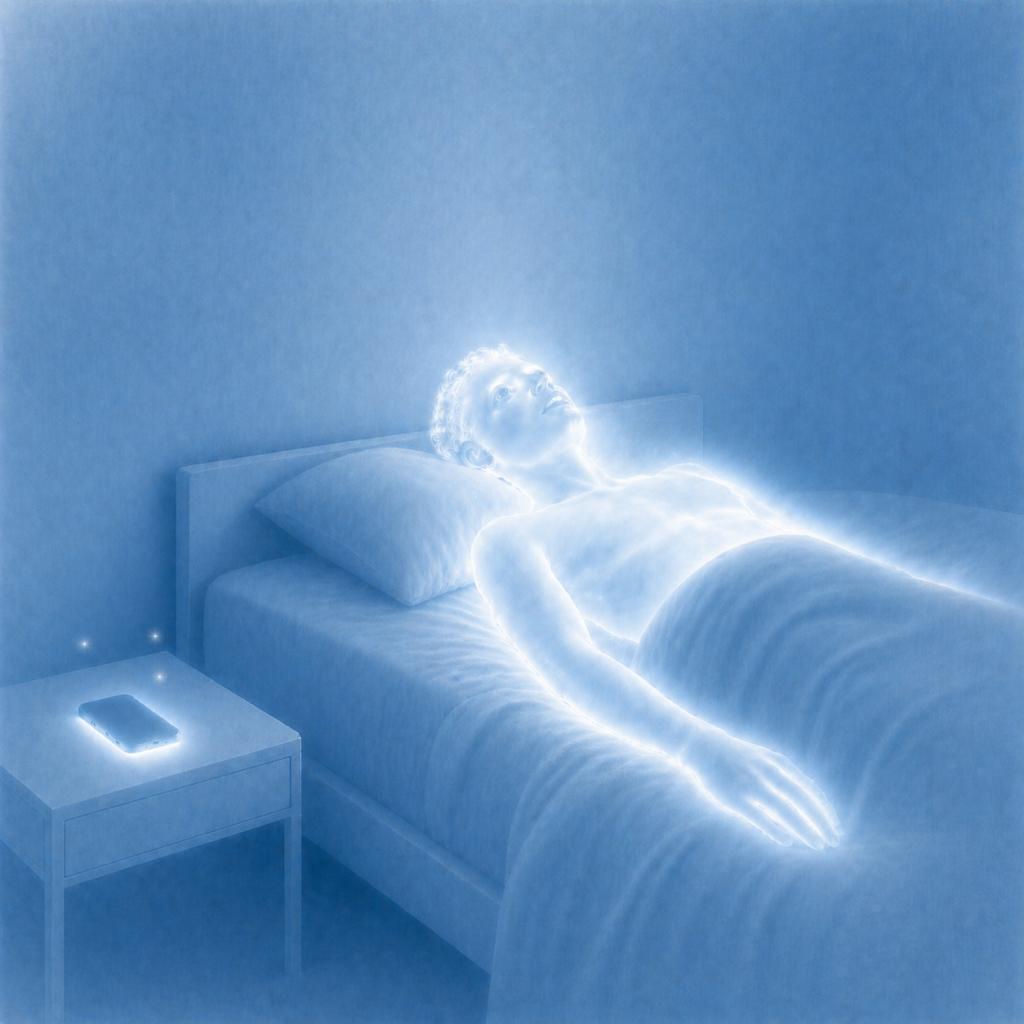
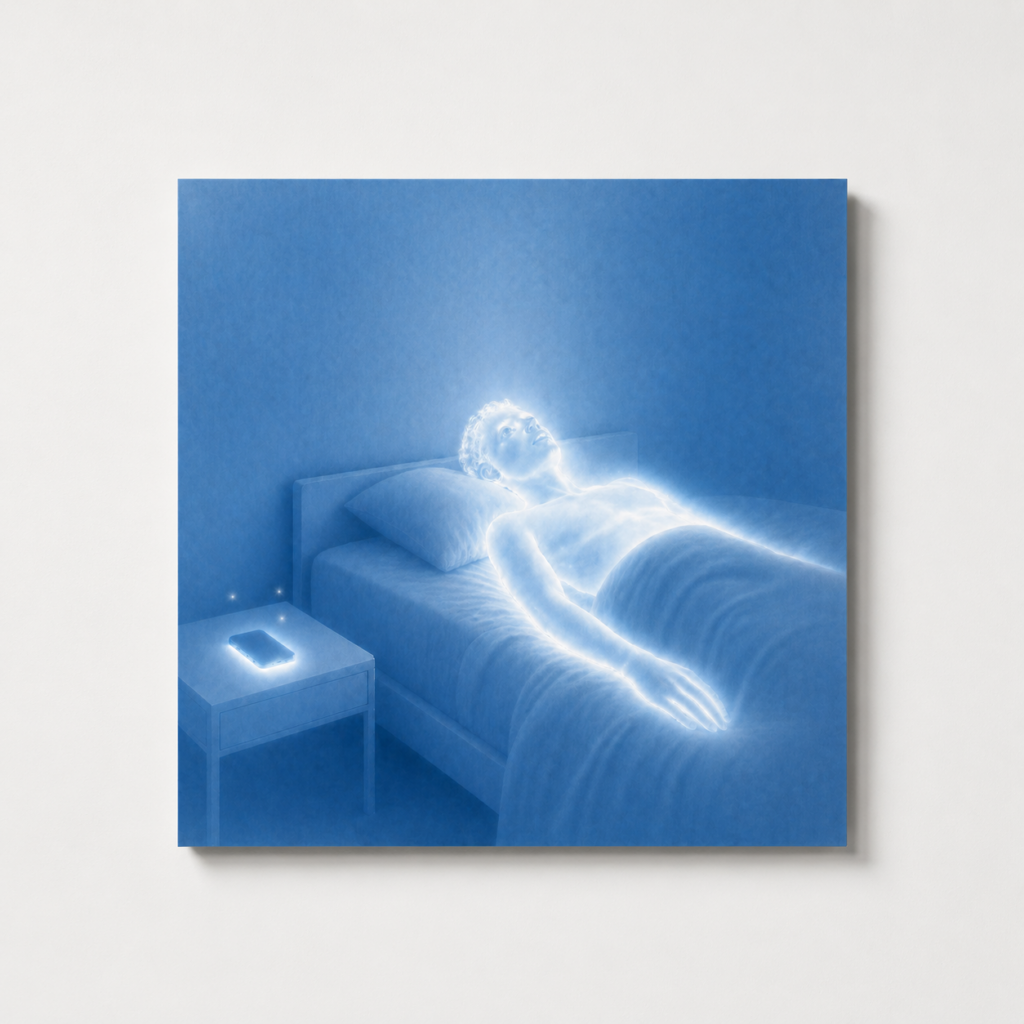
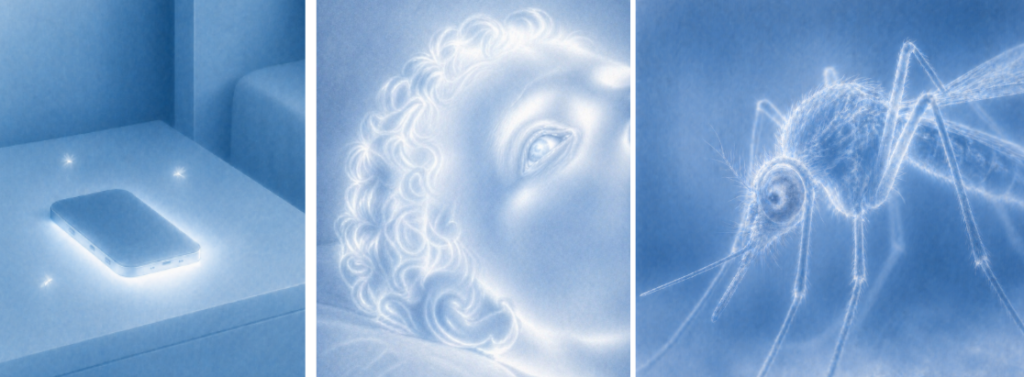
Dans cette image de la série My Life, le téléphone n’éclaire presque plus. Il repose face contre la table de chevet, comme un objet momentanément vaincu, retourné contre la surface, privé de son image. Une courte victoire. Mais sous lui subsiste un halo mince, une fuite lumineuse, un reste de signal, comme si l’appareil continuait à agir même lorsqu’il ne se montre plus. La nuit n’est donc jamais complètement rendue à elle-même. Elle reste contaminée, traversée, occupée par une présence technique. Le corps, lui, a pris le relais. Allongé dans son lit, les yeux ouverts, il ne dort pas vraiment. Il devrait récupérer, s’abandonner, disparaître quelques heures du monde, quitter la tension sociale, productive et numérique de la journée. Au contraire, il irradie. Toute l’énergie absorbée par l’écran semble être passée en lui, comme si l’appareil avait déposé dans le système nerveux une lumière impossible à éteindre. Le téléphone a phagocyté nos nuits, nos vies, nos seuils de repos. Une part immense des dormeurs se réveille désormais pour consulter messages, alertes, notifications, fragments de présence et preuves minuscules d’existence sociale. Le sommeil devient discontinu, troué, négocié, toujours disponible. Chez les adolescents, cette capture nocturne prolonge les troubles de l’attention, l’agitation cognitive, l’anxiété de manquer quelque chose, l’impossibilité de décrocher. Il n’y a plus de vraie obscurité, plus de vraie coupure, plus de silence intérieur. La chambre, autrefois lieu de retrait, devient un espace de veille forcée, un poste de surveillance intime, traversé par une pleine lune permanente. En mode négatif, l’humain n’est plus simplement éclairé par le téléphone : il devient lui-même la lumière malade du dispositif. Il rayonne, mais d’une lumière bleue, artificielle, froide, abîmante. Cette clarté ne révèle rien, elle consume. Elle ne veille pas sur le corps, elle l’empêche de s’abandonner. Elle isole le personnage dans une solitude clinique, presque spectrale, où la connexion continue remplace la présence réelle. La désocialisation n’apparaît pas ici comme un retrait visible, mais comme une saturation intérieure. Le corps reste là, dans le lit, entouré de moustiques leurrés par la lumière et qui ne l’empêchent même plus de dormir, immobile, mais il n’est plus au repos. Il est habité par le flux, par l’attente, par la trace lumineuse de ce qui l’a capté. À force d’être connecté, le personnage devient l’ombre lumineuse de lui-même.
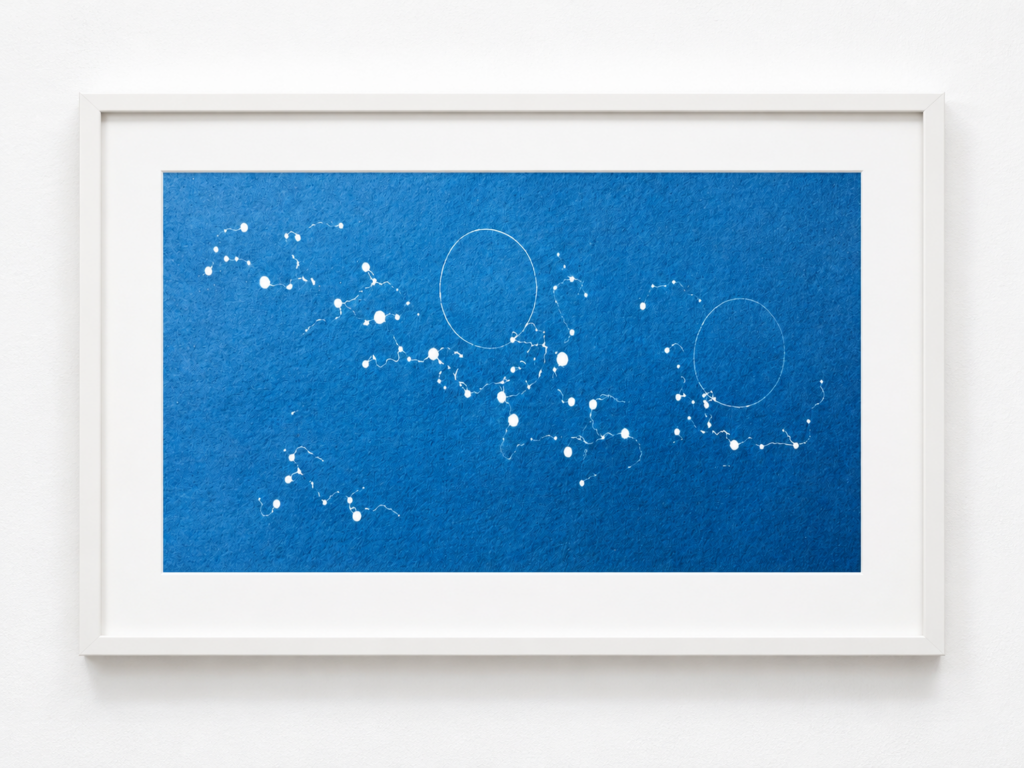
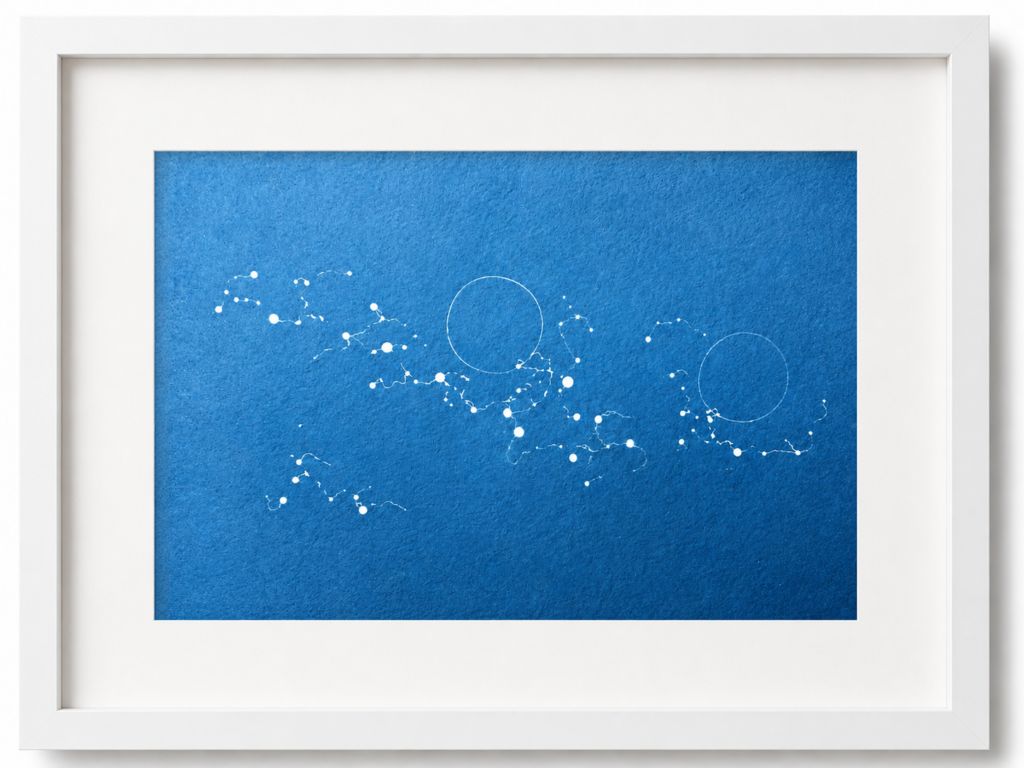
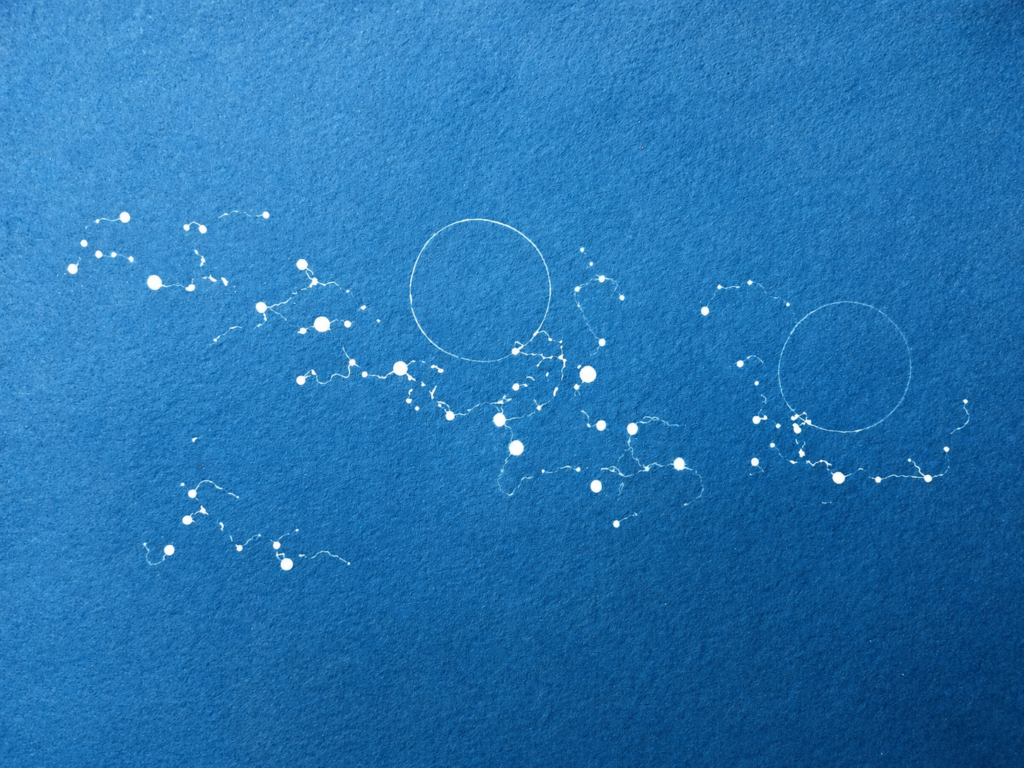
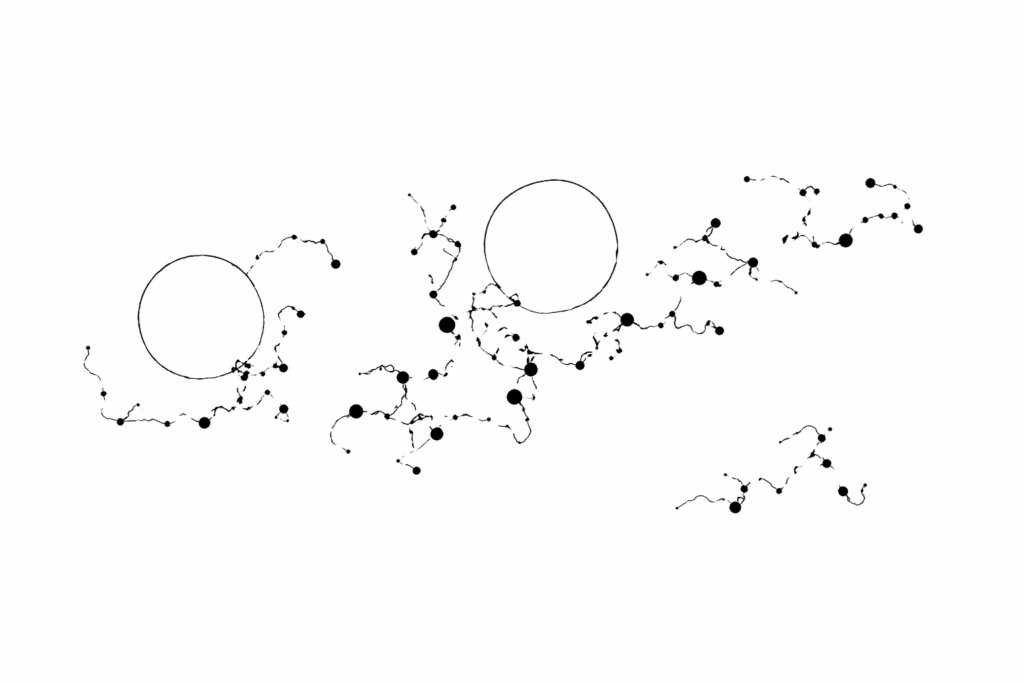
Six canetons mangent autour de leurs mères immobiles. Les corps ont disparu, il ne reste que la trace minimale de leurs déplacements, une écriture fragile faite de lignes, de retours, de petites dérives et d’arrêts. Les points noirs marquent les pauses, les instants où la tête reste au sol, où le bec insiste, cherche, prélève. Le mouvement, filmé puis retranscrit sur le papier, paraît aléatoire, mais il ne s’éloigne presque jamais du centre maternel : une liberté courte, circulaire, tenue par la surveillance silencieuse des mères. L’image ne montre pas la scène, elle en extrait le comportement. Elle transforme un moment banal, presque invisible, en cartographie de l’élan vital : manger, suivre, s’écarter un peu, revenir. Personne ne regarde vraiment cela, sauf les enfants. La beauté élémentaire d’un vivant qui se déploie sans spectacle, dans un périmètre minuscule, avec une obstination douce.
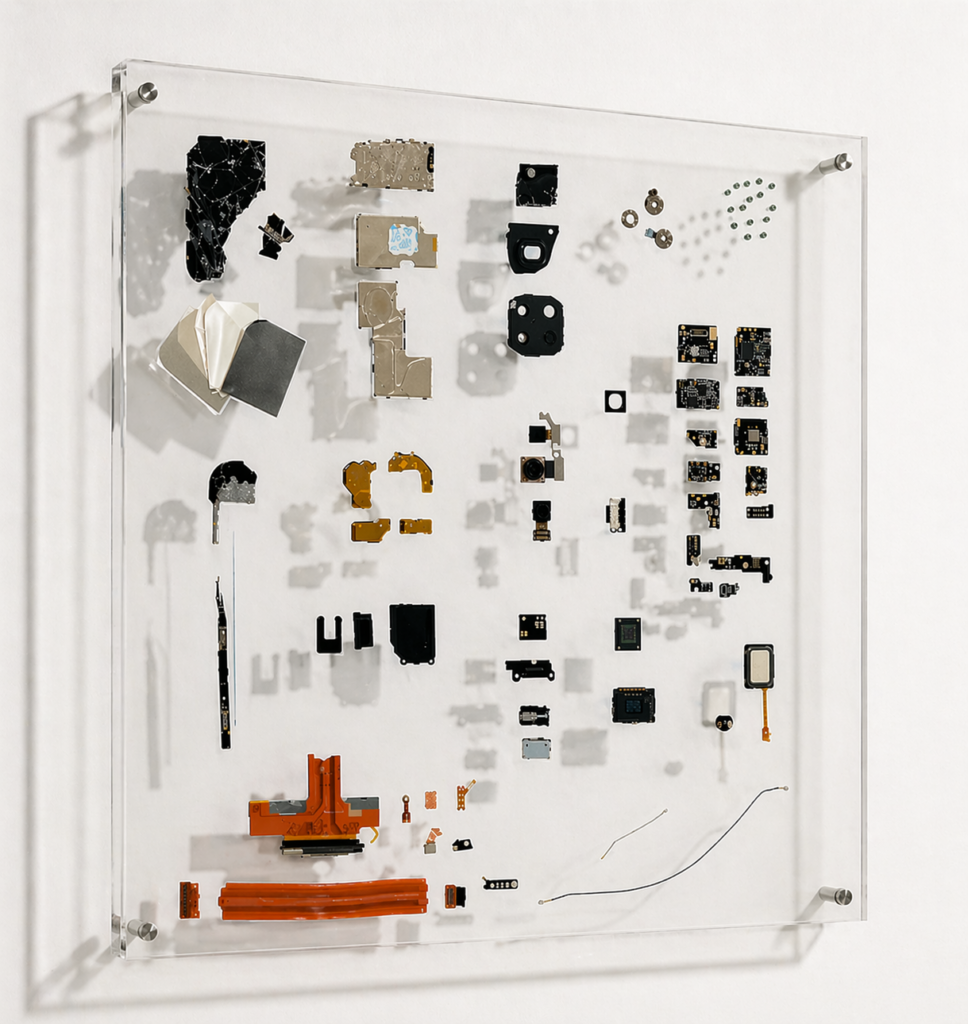
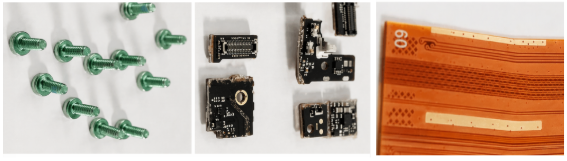
Téléphone ouvert, disséqué, étalé sans logique de réparation mais comme une mise à plat d’un corps technique. Chaque fragment est classé par type de composant, non pour expliquer, mais pour révéler une organisation cachée. Cartes mères et filles, centre nerveux d’une machine devenue intime. Composants électroniques miniatures, invisibles à l’usage, essentiels au fonctionnement. L’optique, regard froid qui capte et archive sans mémoire. Les fils, lignes de circulation, veines sèches d’un système fermé. Les raccords, points de jonction où transitent les flux. Le feuilletage de l’écran, surface lisse devenue strate, peau démontée. Le vibreur, signal primaire, rappel physique d’une présence distante. Les micros, captation permanente, écoute diffuse. Tout est exposé, mais rien ne se livre vraiment. Une boîte noire rendue visible, mais toujours incompréhensible dans sa totalité. Objet tenu chaque jour, connu par usage, inconnu par structure. Et derrière cette précision, une matérialité lourde, terres rares, eau, plastiques, extraction, transformation, chaîne industrielle. Une empreinte écologique diffuse, invisible dans l’objet fini mais massive dans ses conditions d’existence. Une anatomie technique qui renvoie à notre propre dépendance.
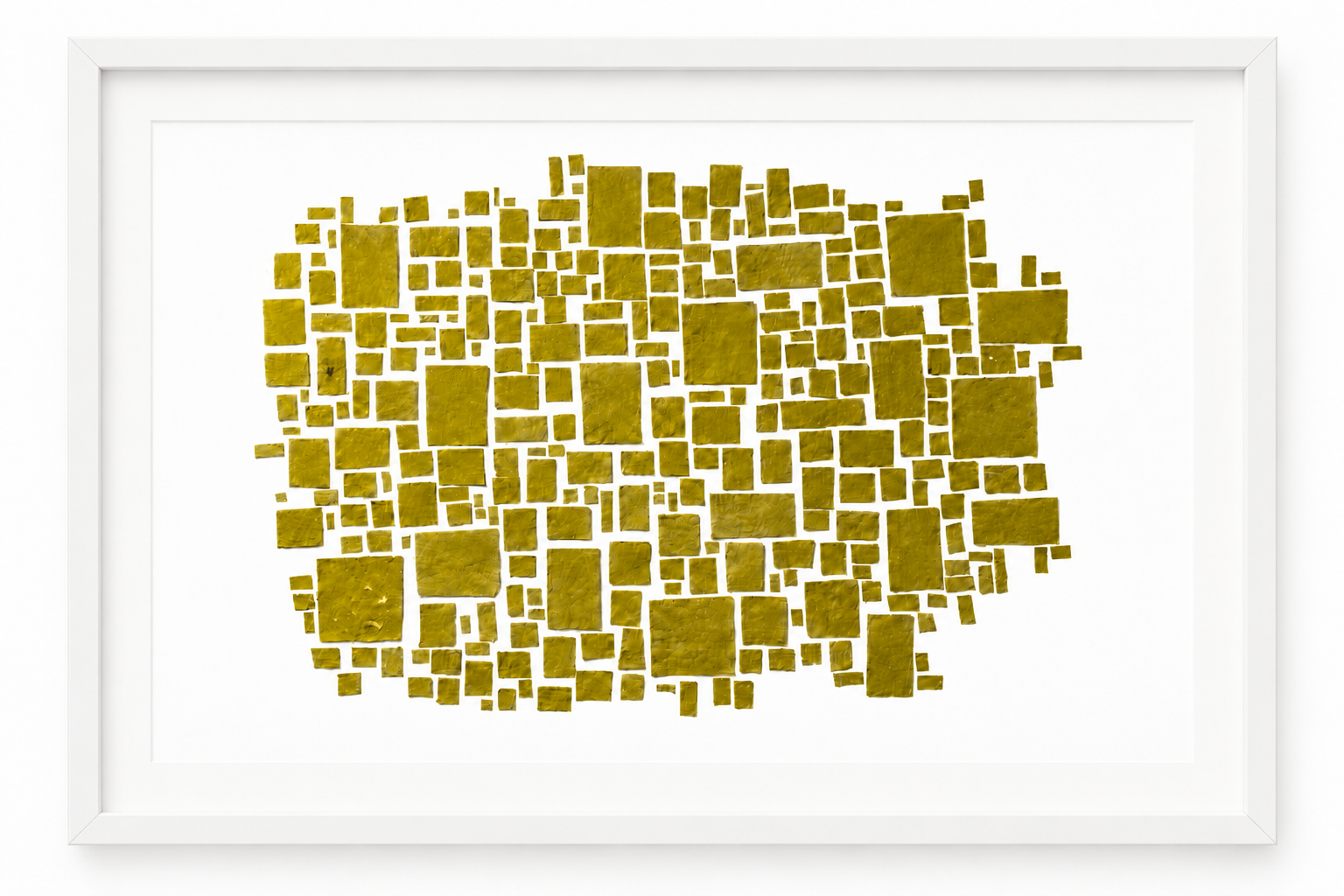
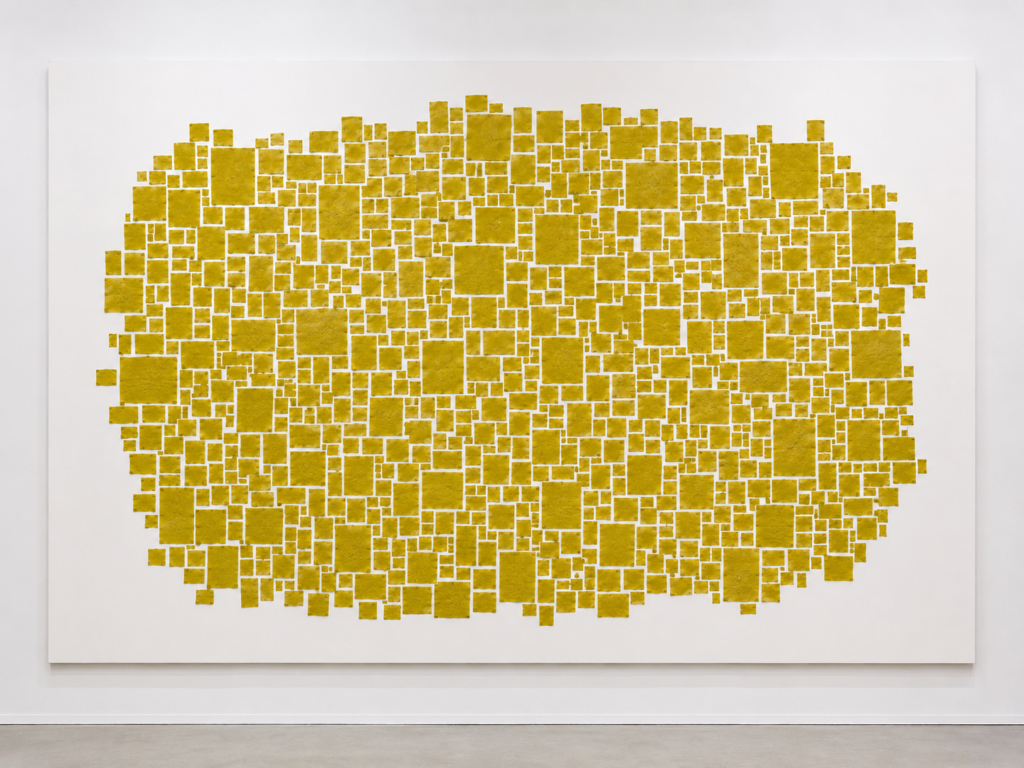
My own recycled yellow bin paper x Industrial yellow ink x My life bin cubage
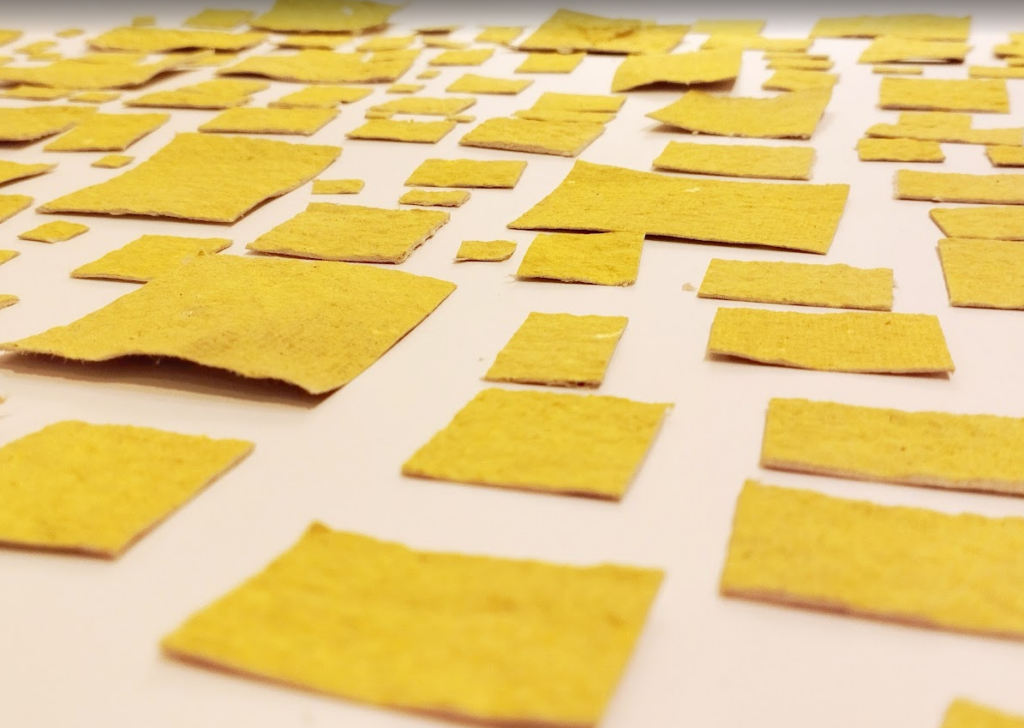
À partir de sa propre poubelle jaune, l’artiste récupère, broie, transforme puis recompose la matière même de ce qui devait disparaître. Le déchet ménager recyclable cesse ici d’être un flux abstrait pour devenir surface, densité, trace, presque peau. Enduit d’une encre fluo industrielle, ce papier fabriqué à la main conserve une ambiguïté volontaire, entre geste pauvre et couleur de signalétique, entre récupération domestique et imaginaire productiviste. La pièce naît d’une question simple et vertigineuse, combien de tonnes de consommables un individu peut-il produire, utiliser, intégrer puis rejeter dans les poubelles jaunes au cours d’une vie entière. L’estimation avancée approche les 9 tonnes. Les différents formats rectangulaires donnent forme à cette masse invisible. Chacun agit comme l’équivalent proportionnel d’une poubelle jaune, démultipliée jusqu’à faire apparaître l’ampleur réelle de ce volume. Cette image prolonge une première recherche dans laquelle l’artiste photographiait ses propres poubelles jaunes avant de demander à une intelligence artificielle d’en reconstruire la logique visuelle à l’échelle de ces 9 tonnes théoriques. Le passage du sac photographié au papier recyclé, puis du rebut au module abstrait, déplace le regard. Ce qui relevait du banal, du quotidien, du presque rien, devient ici mesure d’une vie consommée par ses propres restes.
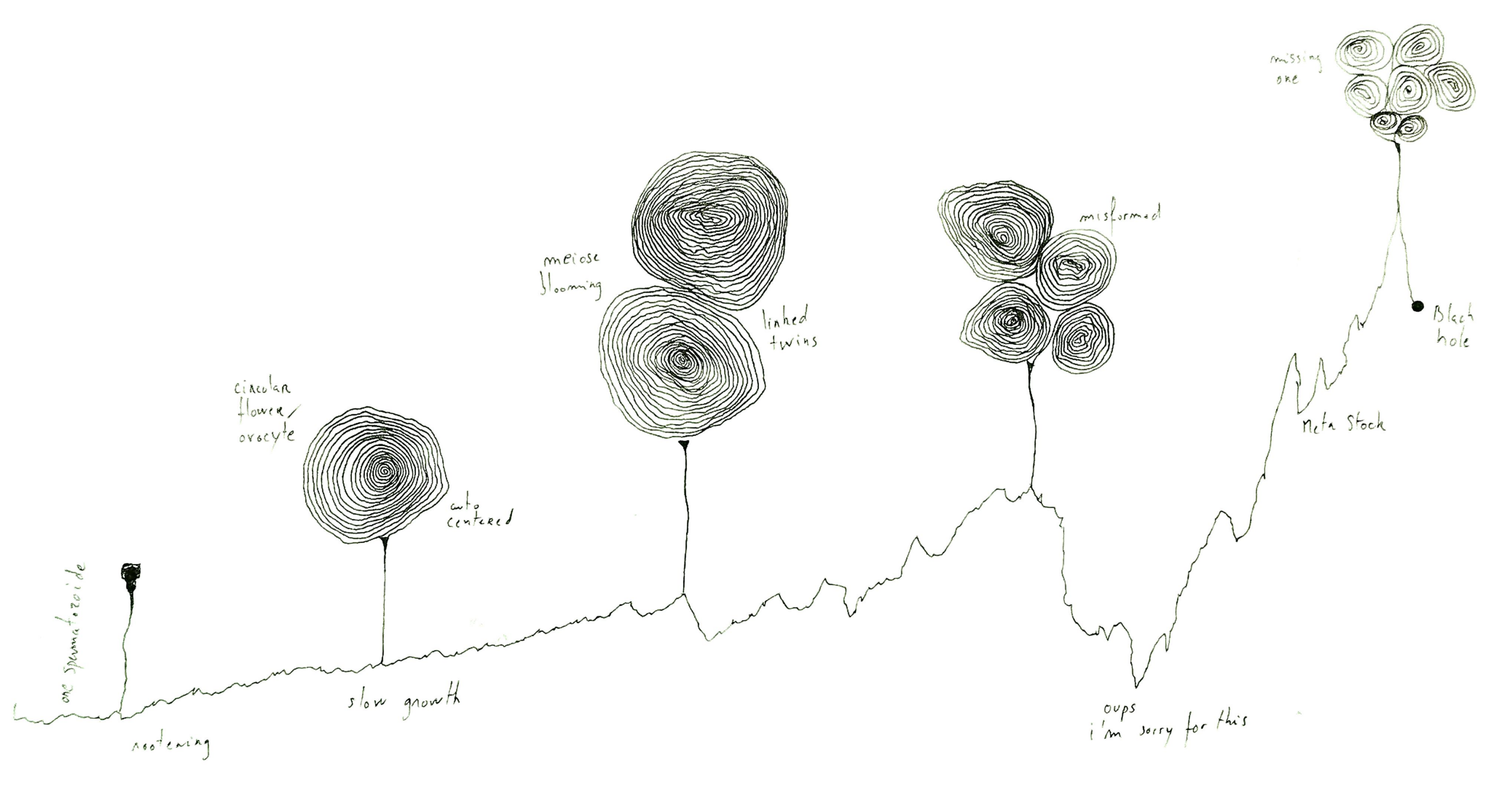
Cette image met en tension deux régimes de croissance que tout semble opposer, celui du vivant et celui de la valorisation financière. La courbe du titre Meta, anciennement Facebook, y est rejouée comme une poussée organique, presque cellulaire, où la logique boursière emprunte les formes de la reproduction, de la division et de la mutation. À partir d’un spermatozoïde isolé, d’un ovocyte, d’une méiose puis de floraisons successives, la ligne économique devient cycle biologique, comme si l’expansion d’une plateforme mondiale relevait d’un développement naturel, inévitable, presque embryonnaire. Mais cette assimilation déraille peu à peu. Les fleurs grossissent, se dédoublent, se déforment, perdent leur centre, deviennent excroissances, anomalies, hybridations douteuses. Ce qui semblait relever de la croissance finit par évoquer la dérive, l’emballement et la monstruosité. Le dessin confronte ainsi l’imaginaire lisse de la performance technologique à une autre lecture, plus organique et plus inquiétante, où la promesse de développement contient déjà sa propre altération. Dans l’univers de Clear Shadows, la croissance n’est jamais neutre, elle est toujours aussi une capture, une mutation des formes, un basculement du vivant vers un système qui prolifère jusqu’à produire des figures instables, presque pathologiques.
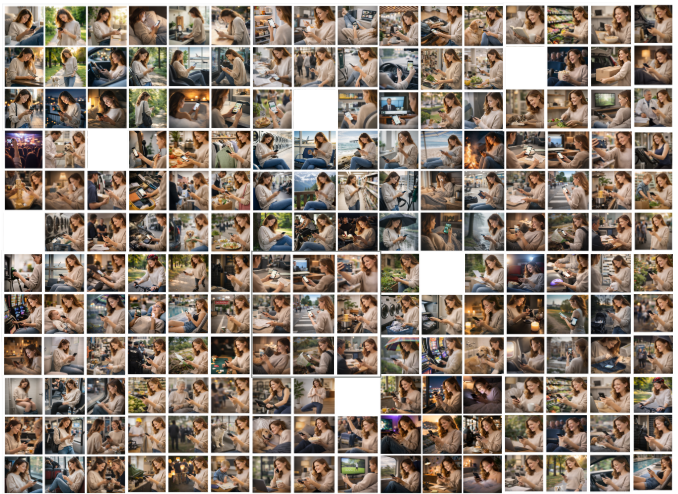
Phone unlock x Mobile x Loneliness Cette image composée de 186 photographies montre toujours la même femme, saisie à des moments différents de sa journée, de sa semaine, de son année, mais enfermée dans une posture presque unique, celle de la consultation. Le téléphone y devient l’axe invisible de l’existence, l’objet qui capte, découpe et réécrit le temps vécu. L’habillement identique renforce l’effet de standardisation, comme si les jours, les lieux, les saisons et les circonstances n’étaient plus que des variantes secondaires d’un même geste répété. Les autres présences, lorsqu’elles apparaissent, sont floutées, reléguées à l’arrière-plan d’une vie dont le centre n’est plus le monde mais l’écran. Cette répétition visuelle fait basculer la scène intime dans une forme d’aliénation douce, banale, presque socialement admise. Selon une étude, le mobile serait consulté en moyenne 186 fois par jour, et ce chiffre donne ici sa structure à l’image, transformant la statistique en matière sensible. Ce qui affleure alors, ce sont tous les moments manqués, tous les fragments de réel absorbés par une attention déportée ailleurs. À force de micro-consultations, la vie se morcelle, se dilue, s’appauvrit, jusqu’à produire cet état de saturation mentale que l’on nomme aujourd’hui brain rot. Derrière la fluidité des usages numériques se dessine une existence calibrée, standardisée, où l’individu ne semble plus habiter pleinement sa propre vie mais exécuter, sans fin, le protocole de son époque. Quelques carrés blancs représentent les zones sans écran de déconnexion.
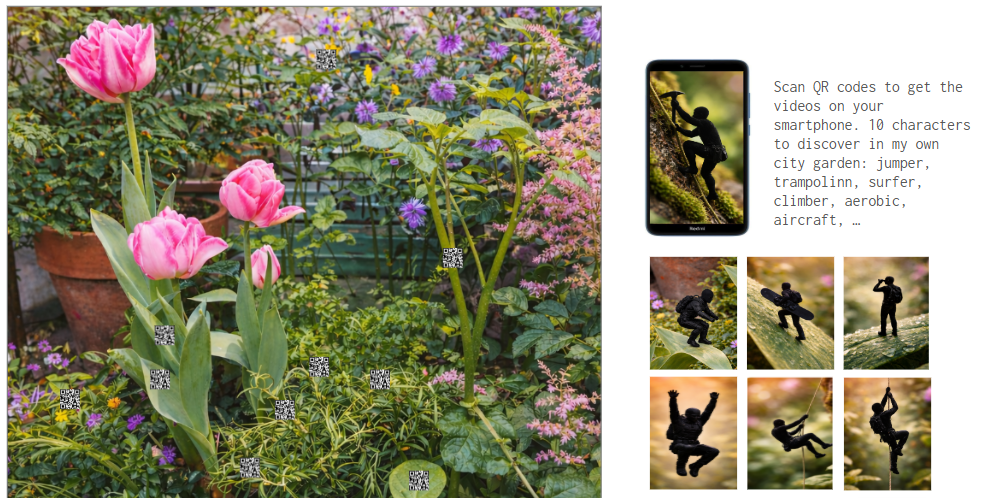
Cette installation prend pour point de départ une photographie d’un jardin de ville en pleine floraison (le jardin de l’artiste), espace dense, domestiqué, presque saturé de vie, où dix QR codes sont disséminés comme des balises discrètes dans le végétal. En les scannant, le regard bascule d’un paysage fixe vers une série de micro-vidéos IA où apparaissent des personnages noirs, minuscules, à peine plus grands que des fourmis, agités dans des boucles d’actions sans fin, dans 10 activités. On y voit des sauteur, marcheurs, grimpeurs, figures d’aérobic (calqué sur le corps de l’artiste), un surfeur, un ULM, …autant de gestes d’effort, de déplacement, de tension, de suspension ou de reprise. À cette échelle, l’humain perd toute centralité, devient signal, parasite, silhouette, presque poussière animée au milieu d’une nature qui le dépasse. Le QR code agit ici comme un seuil, un accès technologique qui prétend ouvrir l’image mais qui révèle surtout un enfermement dans des cycles répétitifs, nerveux, épuisants. Chaque séquence semble lancer un mouvement vers un ailleurs, alors qu’elle reconduit toujours au même point, comme si l’activité contemporaine n’était plus qu’une agitation circulaire sans issue claire. Dans ce jardin contraint par la ville, l’installation fait se rencontrer la floraison, l’humidité, la croissance, avec la compulsion moderne du corps performant, connecté, occupé. La fascination pour l’effort physique y apparaît moins comme une conquête que comme un symptôme, une manière de remplir le vide par le geste, la répétition, la dépense. Face à l’épaisseur du vivant, ces corps noirs miniaturisés rappellent aussi l’humilité de l’homme, sa fragilité, sa petite taille réelle dans un monde qu’il cherche pourtant sans cesse à cadrer, organiser, activer. L’ensemble compose ainsi un jardin augmenté et troublé, où la nature, la ville, l’écran et le mouvement forment une même scène de boucle, de recherche, d’épuisement et de recommencement.
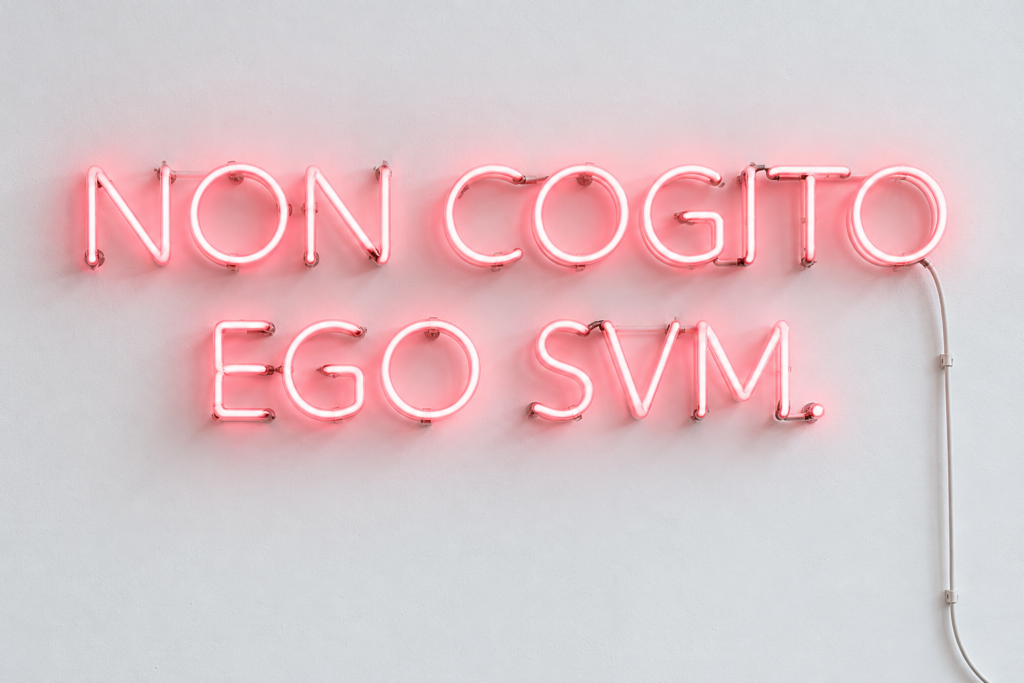
Le choix du néon s’impose comme une évidence après l’hésitation initiale avec la pierre. Là où la pierre tombale aurait figé la phrase dans une temporalité longue, presque archéologique, le néon l’inscrit dans l’immédiateté, dans le flux, dans le langage visuel contemporain. Il appartient à la ville, à la publicité, aux vitrines, aux signaux qui captent l’attention sans effort. Il ne demande pas à être lu, il s’impose.
L’inscription reprend les codes de la capitale romaine antique, rigueur des empattements, proportions maîtrisées, usage du V à la place du U. Mais cette référence à une pensée fondatrice est immédiatement détournée. Non cogito ego svm ne cherche pas la justesse grammaticale. Elle opère comme un glissement, une dégradation volontaire, presque imperceptible, qui mime l’érosion progressive des structures cognitives.
Le néon rose agit ici comme un révélateur. Couleur du désir, de la gratification immédiate, des interfaces séduisantes, il transforme une formule philosophique en slogan lumineux. La pensée devient signal. Le langage devient surface.
Ce déplacement révèle une mutation récente. Penser n’est plus central. Ce qui domine est l’entretien de soi, de son image, de son ego, de ses désirs primaires. L’individu se regarde, se met en scène, se mesure. Le collectif s’efface derrière une multitude de subjectivités exposées.
La phrase fonctionne alors comme une mise en abîme. Elle dit ce qu’elle produit. Elle existe précisément parce que les outils numériques permettent cette exposition permanente, cette répétition, cette diffusion globale. Le néon ne se contente pas d’éclairer le mur, il rejoue le fonctionnement même des plateformes, capter, séduire, retenir.
Ce qui était autrefois une affirmation de l’existence par la pensée devient ici l’aveu inverse. Une présence sans réflexion. Une existence maintenue par le flux.
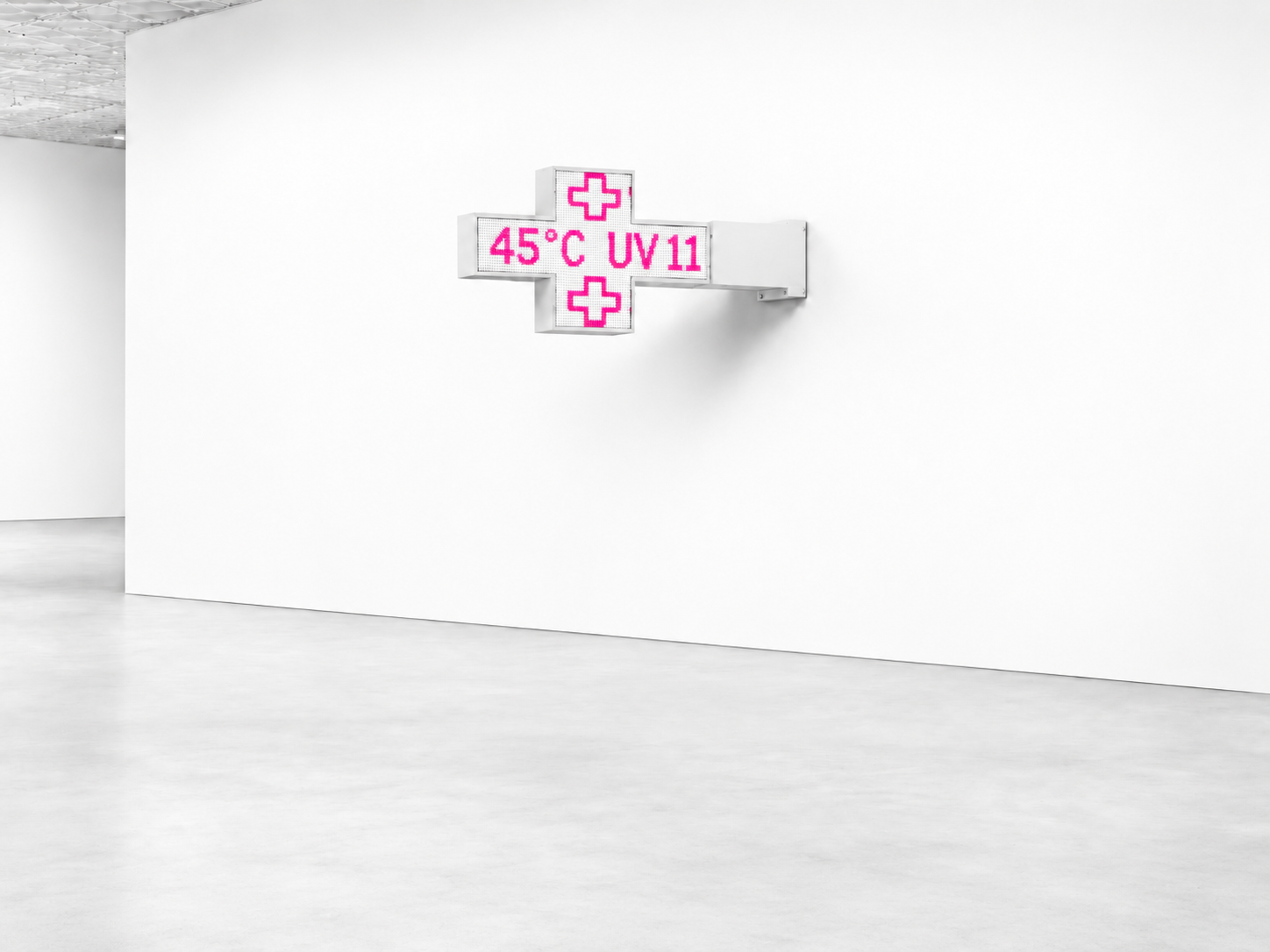
GIEC x forecasts x Pharmacy lights x global warming
Croix de pharmacie, fixée au mur, elle ne soigne rien. Elle informe. Elle déroule. Elle répète. Le vert médical devient un flux continu, un signal d’alerte qui n’interrompt jamais sa course. Les données défilent comme des constantes vitales, mais ce ne sont plus celles du corps, ce sont celles du climat.
La croix, symbole de soin, bascule vers un indicateur de dégradation. Elle ne promet plus la guérison, elle enregistre l’aggravation. Température, UV, pluies extrêmes, nuits tropicales, tout s’enchaîne sans rupture, comme une perfusion d’informations. Le message n’est pas exceptionnel, il est plausible. C’est précisément là que réside la tension.
Rien n’explose, rien ne dramatise. Tout est déjà là. Une normalité altérée, intégrée, acceptée. Le dispositif reprend les codes urbains familiers, ceux que l’on ne regarde plus. Il s’insère dans le quotidien sans résistance. Il informe comme on annonce une météo, mais cette météo ne relève plus du cycle naturel.
Le spectateur ne fait pas face à une catastrophe, mais à une continuité. Une lente dérive. Une saturation progressive des seuils. Le corps humain est absent, mais tout parle de lui. Sa peau brûlée, son effort limité, son hydratation surveillée. Un corps déjà contraint, déjà adapté.
La répétition du texte agit comme une boucle. Elle anesthésie autant qu’elle alerte. À force de défiler, l’urgence devient décor. Le regard glisse. L’esprit s’habitue. L’exception devient norme.
La planète apparaît en creux, jamais représentée, mais partout présente dans ses symptômes.
Ce n’est pas une image de fin. C’est une image d’installation. Un système déjà en place, déjà fonctionnel, déjà intégré dans nos flux d’information. La croix ne sauve plus, elle mesure l’état d’un organisme plus vaste, devenu instable.