Auteur/autrice : me

  • Light Towers

    Plastic drugs rubish x My Hand

    Photo of plastic sculpture 40 x 30 cm

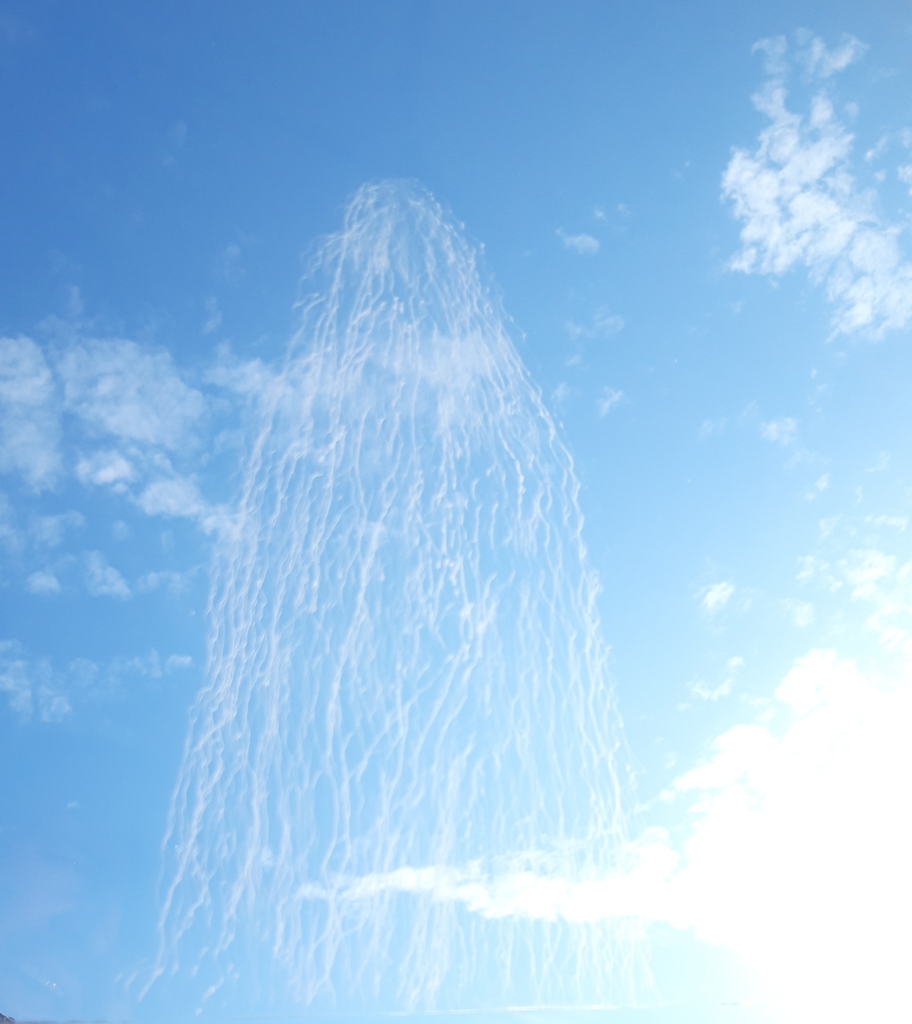
    Cette forme verticale translucide est sculptée à partir de plastiques jetés issus de présentoirs pharmaceutiques, tenue avec délicatesse — mais intentionnellement — par une main humaine. Lorsque la lumière la traverse, l’œuvre projette la silhouette d’une tour précaire, évoquant à la fois l’utopie fragile des villes de verre et l’échafaudage invisible de la consommation pharmacologique moderne.

    C’est un faux monument : construit dans une transparence synthétique, présenté comme noble — mais composé de rebuts. La main n’est pas seulement un support, elle devient aussi l’agent de la manipulation, nous rappelant que les architectures numériques et chimiques dans lesquelles nous vivons sont façonnées, empilées — et fondamentalement instables.

    Entre manipulation et contrôle, lumière et illusion, Light Towers pose la question :
    Que bâtissons-nous, et que soutenons-nous, avec les déchets que nous refusons de voir ?

    This translucent vertical form is sculpted from discarded pharmacy display plastics, held delicately—yet deliberately—by a human hand. As the light cuts through, the piece casts the silhouette of a precarious tower, evoking both the fragile utopia of glass cities and the hidden scaffolding of modern pharmacological consumption.

    It’s a false monument: built from synthetic transparency, projected as noble—but made of debris. The hand becomes not only the support, but also the agent of manipulation, reminding us how the digital and chemical architectures we inhabit are shaped, stacked, and ultimately unstable.

    Between manipulation and control, light and illusion, Light Towers asks:
    What do we build, and what do we uphold, with the rubbish we deny?

  • Enjoy your Beautiful Life

    Slogans x Top polluting brands x Drugs rubish x Transparency Shadows x My hand

    Photo 40 x 30 cm

    Cette œuvre s’approprie des fragments de plastique translucide — autrefois utilisés pour exposer des médicaments en pharmacie — et les grave de slogans d’entreprises parmi les plus polluantes ou les plus consommées au monde :
    « Taste the feeling », « Good food, good life », « For the love of it », « A better future starts at home »

    Tenues entre les doigts comme une ordonnance, ces formules marketing creuses deviennent les strates d’un nouveau monument, projeté par la lumière. Un escalier synthétique. Une échelle fragile de promesses, bâtie sur les déchets et l’illusion. Le totem du greenwhasing.

    L’œuvre dénonce la convergence insidieuse entre discours du bien-être, greenwashing corporate et dépendance pharmaceutique. La transparence du matériau feint la pureté, mais les ombres racontent une autre histoire — celle d’un bonheur commercialisé, dosé, vendu, jamais ressenti.

    Combien de « vies meilleures » faudra-t-il encore nous vendre avant que l’on réalise que ce que l’on tient entre les mains n’est que l’épave de ce qui fut vraiment à nous ?

    This piece appropriates translucent plastic fragments — once used to display drugs in pharmacies — and inscribes them with the corporate slogans of some of the world’s most polluting or mass-consumed brands:
    “Taste the feeling”, “Good food, good life”, “For the love of it”, “A better future starts at home”

    Held between fingers like a prescription, these hollow marketing phrases become the strata of a new monument, projected in light. A synthetic stairway. A fragile ladder of promises, built on waste and illusion.

    The work critiques the insidious overlap between wellness discourse, corporate greenwashing, and pharmaceutical dependency. The transparency of the material pretends purity, but the shadows tell a different story — one where commercial happiness is dosed and sold, not felt.

    How many « better lives » must be marketed before we realize we’re holding the wreckage of what was once ours?

  • Puppets

    Gold Love x Iron Puppets x Web trapp x Gafam x Dead Tree shadow

    100 x 50 cm

  • Fake True

    IA generated faces x Removed senses

    Iron sculpture|

    Suspendus dans le silence, ces masques en fil de fer évoquent des visages humains déformés — réceptacles vides, sans oreilles, sans bouche, sans yeux, originalement généré par une IA. Ils flottent tels des fantômes numériques, hantant l’espace par une absence troublante d’identité et de perception. Chaque forme rappelle le bruit génératif de l’intelligence artificielle tentant de simuler l’humain sans jamais en saisir l’essence.

    Ces « visages » ne sont ni vrais ni faux, mais des composites dérangeants, nés d’ensembles d’entraînement et d’abstraction. Leurs sens manquants témoignent d’un monde où la donnée remplace l’expérience, où l’expression devient un écho sans origine. Ou le digital remplace l’humain.

    Le spectateur se retrouve face à un miroir… qui ne reflète plus rien.

    Suspended in silence, these wireframe masks evoke distorted human faces—empty vessels devoid of ears, mouths, or eyes. They float like digital phantoms, haunting the space with an eerie absence of identity and perception. Each form recalls the generative noise of artificial intelligence attempting to simulate the human without ever grasping its essence. These “faces” are neither real nor false, but unsettling composites born from training sets and abstraction. Their missing senses speak to a world where data replaces experience, and expression becomes an echo without origin. The viewer confronts a mirror that does not reflect.

  • City of Lights

    Skyline version

    Manhattan version (glass)

    Plastic Rubish x SkyLine x Shadows

    Plastic sculpture 50 x 100 x 20 cm
    Cette ligne d’horizon n’est pas faite d’acier ni d’ambition, mais de plateaux plastiques de médicaments jetés, soigneusement agencés et éclairés pour imiter la grandeur d’une ville moderne.

    Chaque fragment translucide projette une ombre haute — verticale, stérile, répétitive — formant des tours fantomatiques qui rappellent les silhouettes des quartiers financiers ou des pôles technologiques, ou des tours de serveurs, mais ne sont en réalité que des coquilles vides issues de la surconsommation. La prétendue transparence y est de mise.

    Ce sont des villes nées du déchet, non de la croissance. L’infrastructure même de nos vies — de la santé à l’espoir — se dessine à travers ce que nous jetons, ce que nous oublions, ce que nous surmédicalisons.
    Derrière chaque skyline lumineux se profile une silhouette plus sombre, celle de notre dépendance au bien-être, à la technologie, à la vitesse — le tout enveloppé dans l’illusion du progrès.

    Et si nos villes n’étaient que des distorsions de lumière, construites sur le vide, projetées par nos propres mains ?

    This skyline isn’t built of steel or ambition, but of discarded plastic drug trays, carefully arranged and lit to mimic the grandeur of a modern city.

    Each translucent fragment throws a tall shadow — vertical, sterile, and repetitive — forming ghostly towers that recall the silhouettes of financial districts and tech hubs, but are, in fact, empty shells of overconsumption.

    These are cities born from waste, not growth. The very infrastructure of our lives — from health to hope — is shaped by what we throw away, what we forget, and what we over-medicate.
    Behind every glowing skyline is a darker silhouette, cast by our addiction to well-being, tech, and speed, wrapped in the illusion of progress.
    What if our cities were just light distortions, built on emptiness, projected from our own hands?

  • Cookies

    Bee alveolus x Gold x Cookies

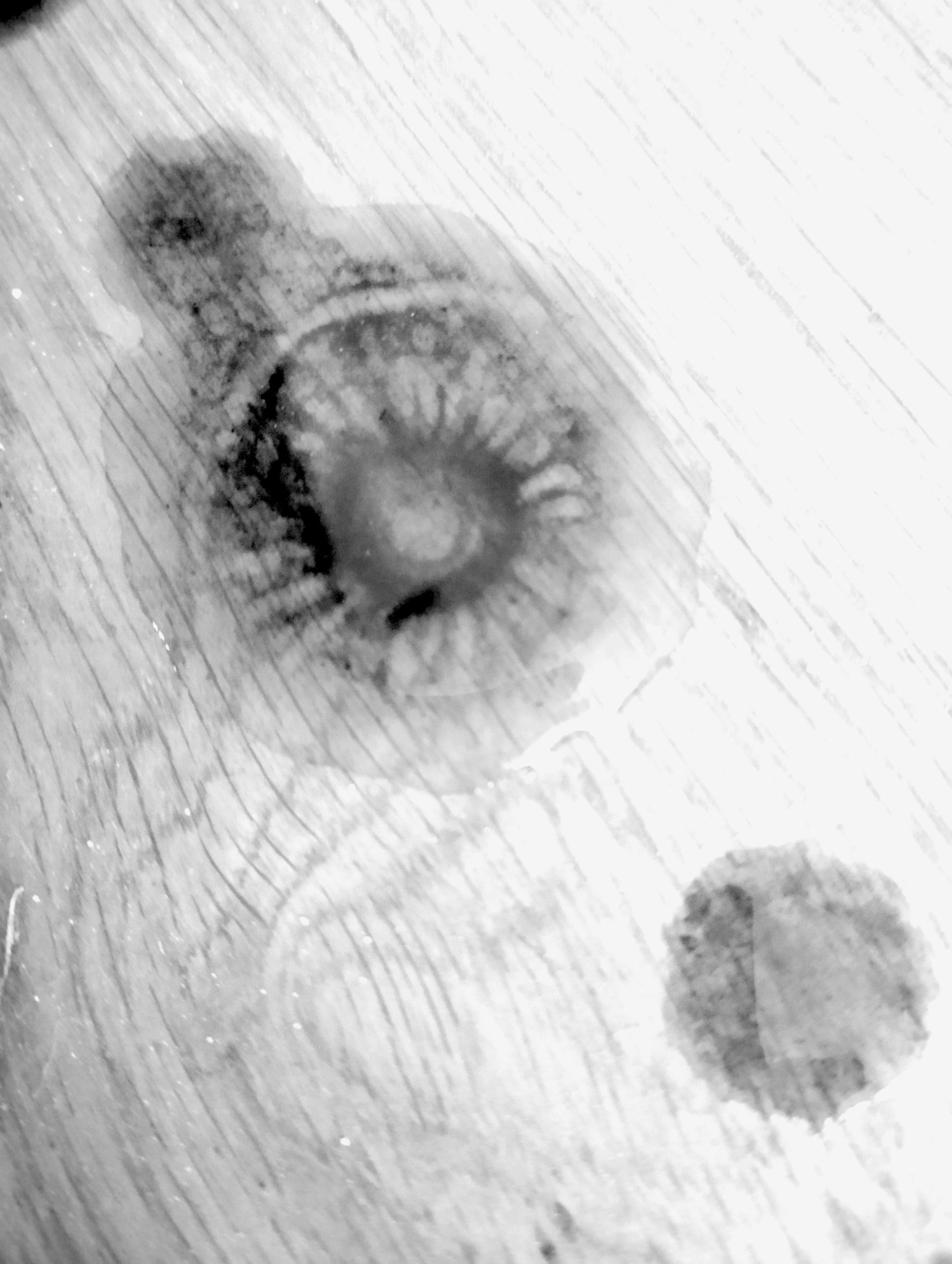
    Here, the word “cookies” appears as an intrusion on a structure that evokes something alive: a bee’s honeycomb, a hive, or an organic tissue. The word seems almost burned into the surface—charred, invasive, foreign to the natural texture of the material. The effect is unsettling: technology imposing itself on the living, draining and colonizing it. Behind the seemingly innocent term lies the greed of the digital world: to harvest, to record, to predict. The cardboard-like, fibrous support suggests packaging, waste, a leftover from a commercial exchange—or perhaps the husk of an organism emptied of its essence. The hive is no longer a metaphor for community, but the devastated territory of soft surveillance.

  • The duck

    Gold x Unicorn x Wood x Metal x Shadow

    Suspendue entre fragilité et imposture, cette sculpture en fil métallique esquisse une forme instable, oscillant entre un canard disloqué et une figure mythologique fantasmée. À première vue, rien ne tient vraiment, les lignes s’emmêlent, hésitent, trébuchent presque. Et pourtant, sous un éclairage précis, l’ombre projetée sur le mur se redresse, s’étire et devient licorne. Une silhouette parfaite, puissante, désirable. Mais cette licorne n’existe pas. Elle n’est qu’une projection, une construction optique, un récit fabriqué. La matière réelle, elle, reste chaotique, fragile, presque grotesque. Le fil doré évoque la valeur, le prestige, les milliards promis, mais il ne produit qu’un enchevêtrement incertain, incapable de se stabiliser. Cette tension entre l’objet et son ombre révèle un mécanisme bien connu, celui de la narration des start-up contemporaines, où l’on promet des licornes pour mieux masquer des structures précaires, des modèles bancals, des trajectoires souvent boiteuses. Le canard est là, en creux, dans la forme réelle, maladroite, terrestre, presque ridicule. La licorne, elle, appartient au mur, à la lumière, au regard. Elle est ce que l’on montre, ce que l’on vend, ce que l’on veut faire croire. Comme dans l’ensemble du projet Clear Shadows, l’image agit comme un révélateur d’une réalité dissimulée, mettant en tension illusion et matérialité, promesse et effondrement silencieux . Ici, l’innovation devient une ombre, et le réel, un nœud.

    Suspended between fragility and absurdity, this wire sculpture oscillates between the outline of a duck and the silhouette of a unicorn—a hybrid, indecisive figure. The duck, banal and earthly, meets the unicorn, fetishized symbol of success in the startup world. Here, the so-called “unicorn” is a tangled, chaotic structure: delicate yet deceptive, grounded in a wooden base that mimics the rustic or natural, but ultimately remains disconnected from reality. The golden wire mimics value, prestige, but the form collapses into confusion. It’s the parody of innovation, the grotesque of hype: the myth of limitless success anchored in a precarious balance.

  • The Clock

    Clock x life cycle x mobile phone

    The clock s’inscrit dans une logique de capture du quotidien par l’écran, une mécanique silencieuse où chaque moment de la journée se trouve absorbé, cadré, puis redistribué par le mobile. Le matin commence dans la lumière froide du téléphone, premier geste, premier regard, avant même le réel. L’individu s’y projette immédiatement, planifie, consulte, répond, s’inscrit déjà dans un flux qui ne lui appartient plus entièrement. À midi, le geste se prolonge, commander, choisir, valider, tout passe par l’interface, réduisant l’expérience à une succession d’actions optimisées. Dans les transports, le corps est présent mais l’attention ailleurs, captée, fragmentée, aspirée par l’écran. Le regard se baisse, les postures se ferment, les gestes deviennent répétitifs, presque automatiques. La journée s’écoule ainsi, découpée, rythmée, administrée par des signaux invisibles, notifications, rappels, sollicitations permanentes. Le temps ne se vit plus, il se consulte. Chaque instant est indexé, anticipé, parfois même remplacé par son équivalent numérique. Il reste peu de place pour l’imprévu, pour l’errance, pour ce qui échappe au cadre. The clock matérialise cette tension, une vie chronométrée, contenue dans une structure rigide où chaque segment semble assigné à une fonction. L’espace vide devient alors aussi important que les lignes, révélant ce qui disparaît, le hors-champ, le non-mesurable. Ce qui n’est pas prévu n’existe presque plus, ou seulement à travers l’écran qui le valide. L’individu se retrouve ainsi dans une boucle continue, entre contrôle et dépendance, où le temps n’est plus un flux mais une grille.

    A minimalist circle, dissected and cadenced like a clock, where each hour is no longer a number but a movement of the body. The figure, barely outlined, fragments into angular postures that repeat a modern ritual: waking, commuting, working, scrolling. The smartphone, omnipresent, becomes the silent axis around which the day turns. The drawing does not show the passage of time—it embodies its mechanical absurdity. The precision of the lines contrasts with the alienation they depict: an existence reduced to routine, tracked and controlled by invisible metrics. The gesture is both universal and intimate—a choreography of constraint.

  • As usual

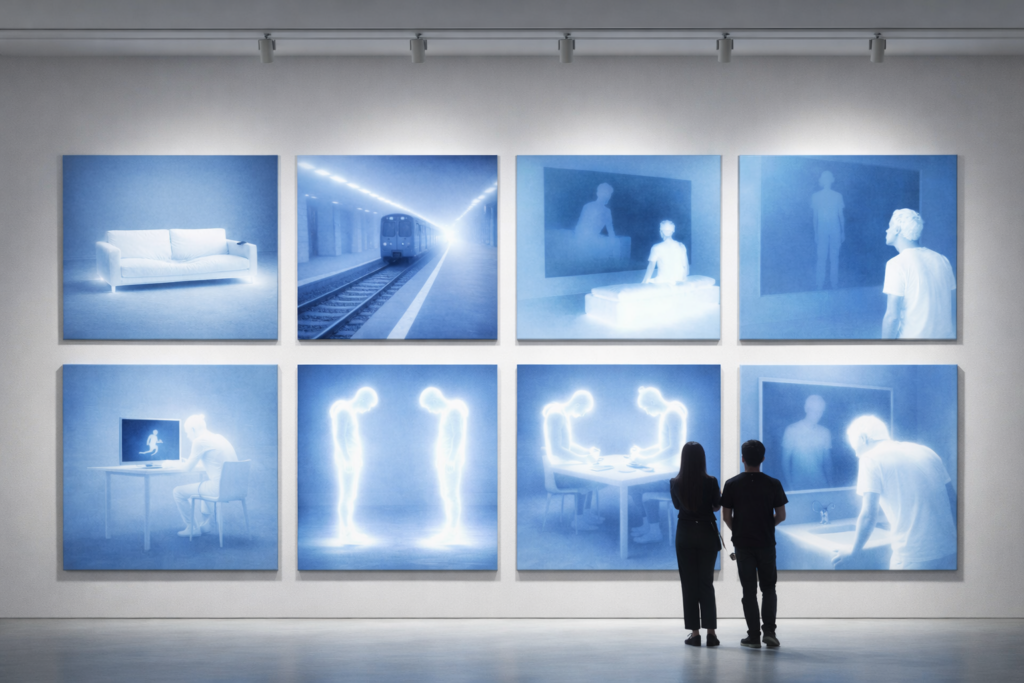
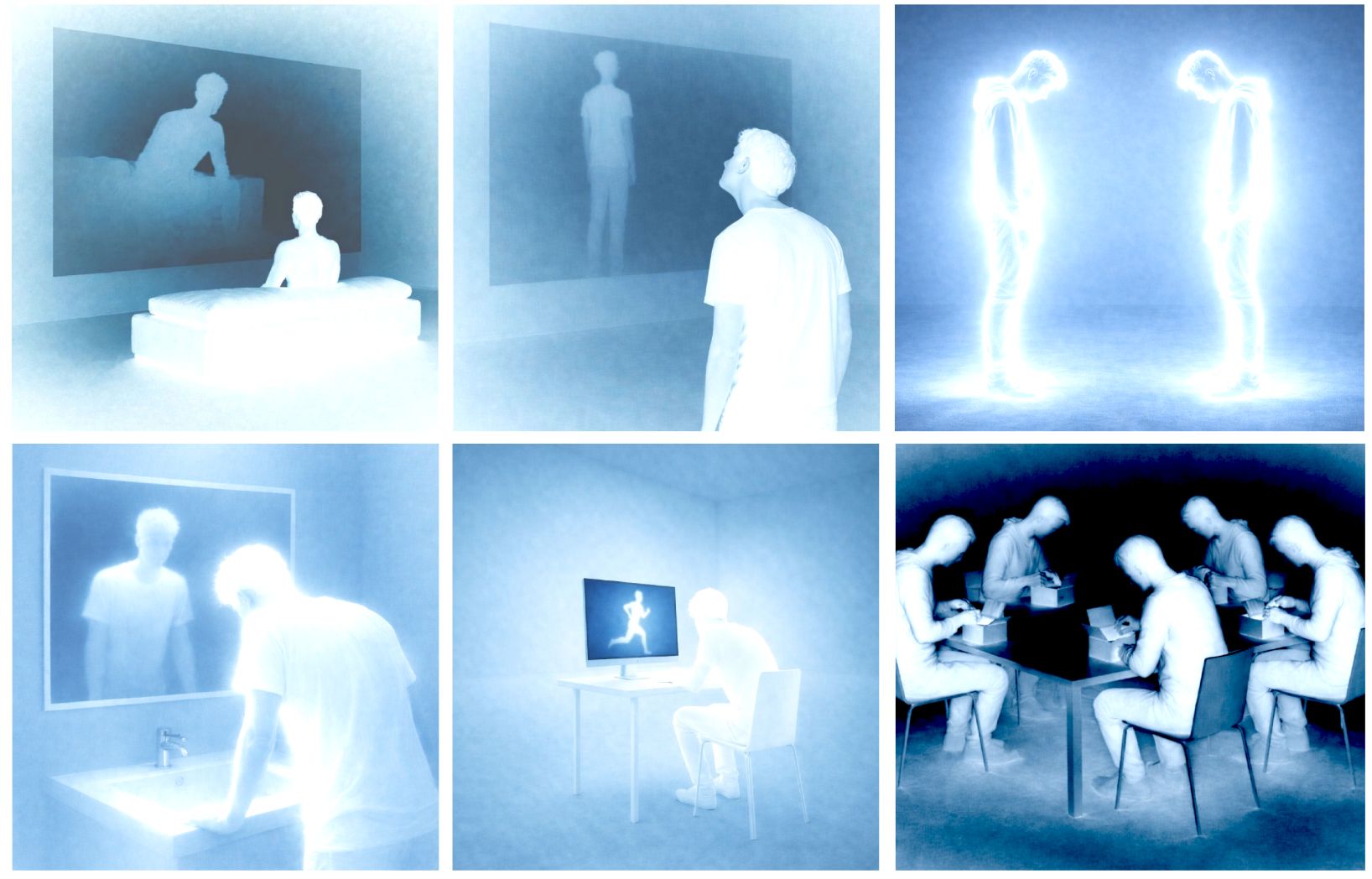
    A stripped-down visual loop. The life cycle of a modern connected human — sketched in its most essential mechanics. Four minimal postures, rigid and cold, that could belong to anyone: standing, sitting, commuting, lying. The presence of a device — phone or laptop — never fades, clinging like an extension of the hand or spine.

    Here, the machine does not dominate by force but by repetition. The movements are automated, the transitions seamless. There is no beginning, no climax, no relief.

    The final posture is the most disturbing: the body reclines horizontally, still tethered to the screen. Is it sleep? Or something terminal? The ambiguity hangs in the silence. It is the moment when function, fatigue and disappearance become indistinguishable.

  • Summer is coming

    Squirrel noises x Pollen x Burning Sun x x-Rays x Solar activity

    Burning pollen, solar debris, invisible particles and solar radiation captured in a hallucinatory blur.
    The sound is erratic and jerky—reminiscent of squirrels on amphetamines, stuttering cartoon rodents from a lost VHS.
    This video seems to stage a micro-apocalypse: a sensory collapse where soft natural elements (floating pollen) are transformed into digitalised x-rays under the violence of a primordial sun.
    Between sunstroke and signal noise, the work evokes the overstimulation of contemporary digital environments, where everything vibrates, heats, accelerates.
    No place for silence, no shadows—only an ultraviolet barrage, comical and devastating.
    It’s not light anymore. It’s pressure. For the future. This also refers to the destruction of sun natural protection that men destroy progressively with environmental passive destruction

  • Sun is beyond the cloud

    Clouds x Random walking x No water x No sun

  • Flooded

    Flood x Trees x Funfair

  • Spiderman

    Broken screens x neural network

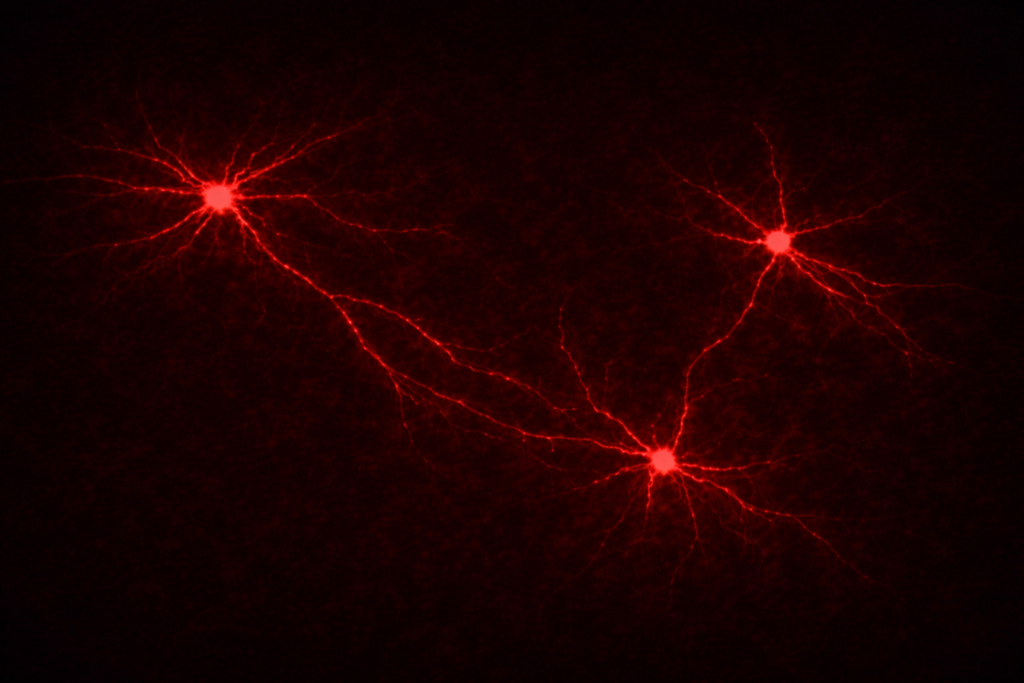
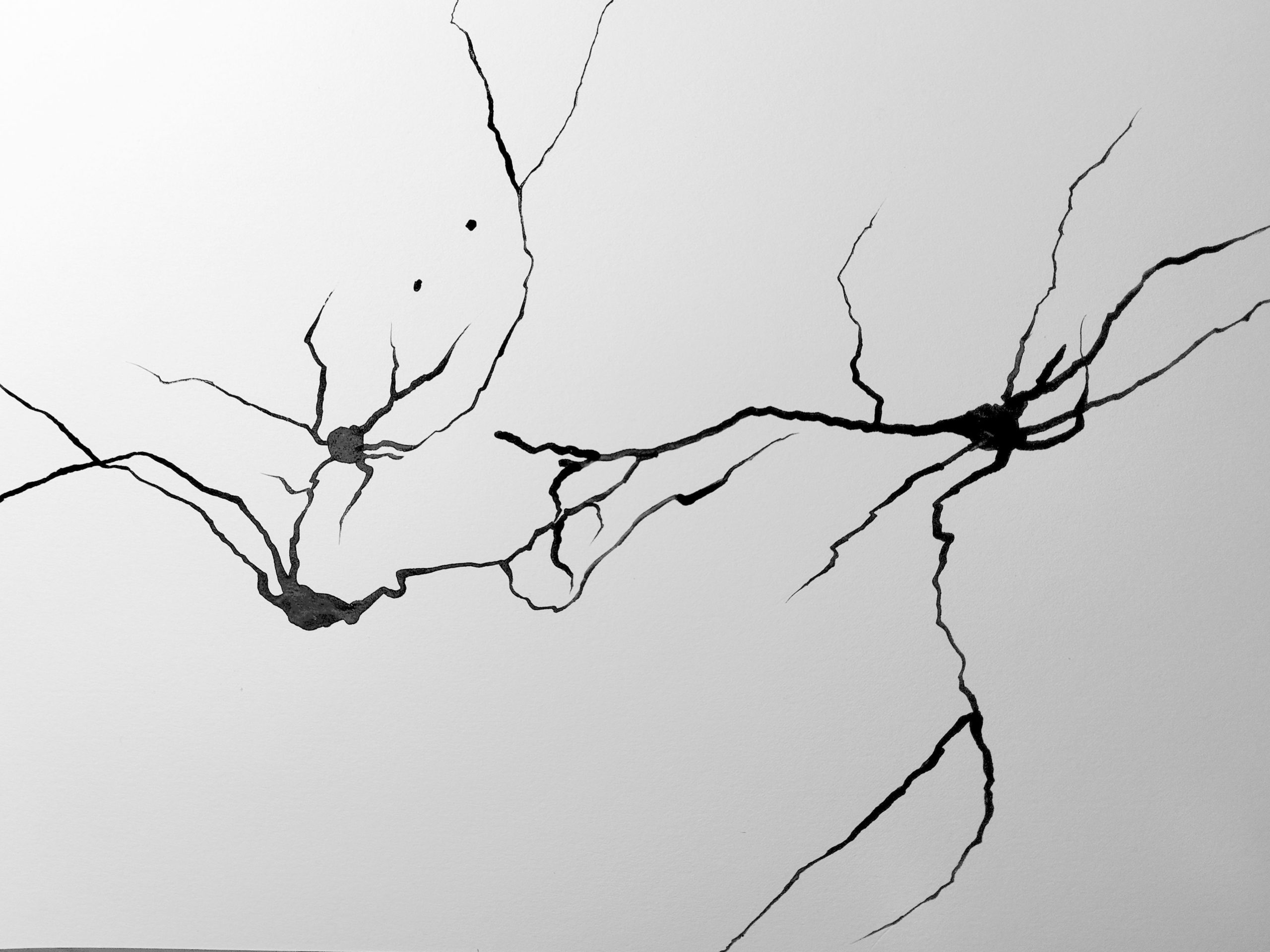
    A web of fractures mimicking a nervous system, or maybe the inverse — nerves mimicking the breaks in our machines. This figure is composed from three actual broken smartphone screens, reassembled into the silhouette of a human head and torso, spidering from a dense wound in the chest.

    The cracks become neurons. The neurons become vulnerability. The device, once a window to the world, now becomes a shattered mirror. The reference to Spiderman is neither heroic nor nostalgic — it’s anatomical, visceral. The power isn’t superhuman; it’s damage, perfectly mapped.

    There is no repair here, only exposure.

  • Gluetton

    Scrolling addicted hands x binary sentence x Monster face

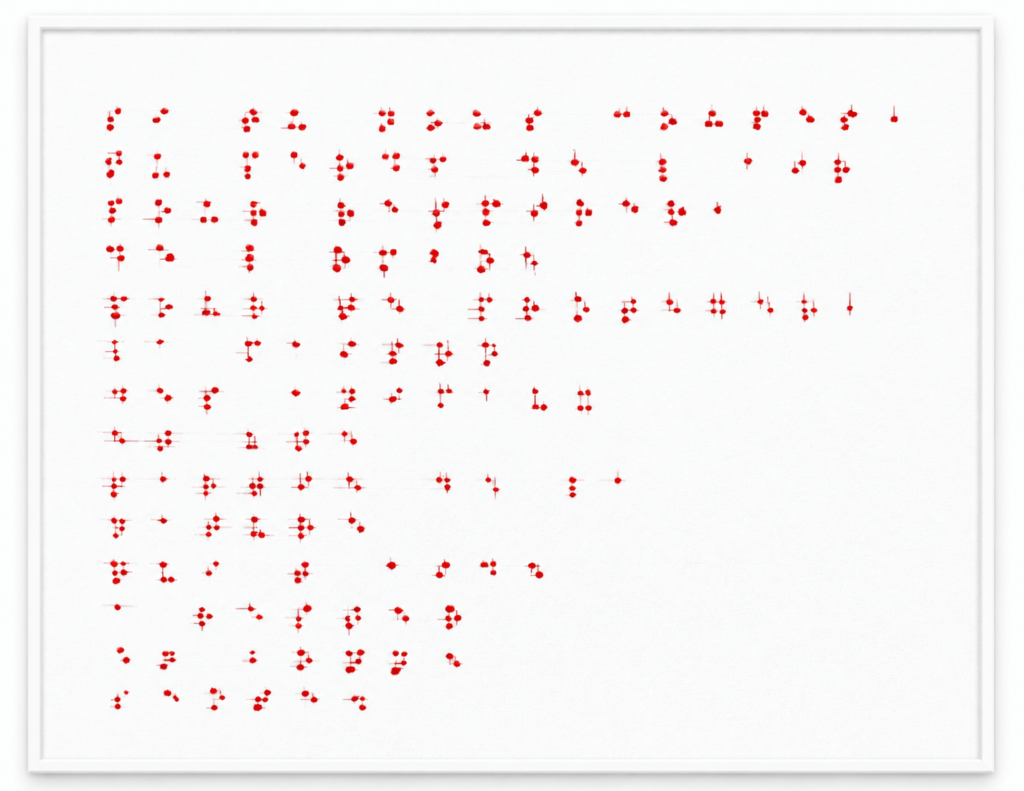
    Two hands, symmetrically mirrored, rise and fall in an endless scroll—at once mechanical, monstrous, and intimate. This looping gesture, captured from the artist’s own body, is overlaid with a curtain of binary code: an unreadable confession, a punishment encrypted. Beneath the digits, a form emerges—a face, or perhaps a beast born from habit and repetition.

    In Gluetton, the fingers become organs of addiction, wired for frictionless compulsion. Recent medical studies are evoked: scrolling injuries, early-onset joint degeneration, a digital-age arthritis born not from labor, but from endless consumption.

    This is the portrait of a new user-species—part mammal, part machine, part captive. The name Gluetton fuses gluttony and glue: a creature stuck in its own hunger. It feeds on feeds. And it cannot stop

  • Puppets

    Antics x social network codes

  • Hutches

    Servers x NYC x liberty x Z. x Sorrow x Tears

    Digital drawing on paper 20 x 30cm
    La skyline de Manhattan — tranchante, dense, iconique — se révèle être tout autre chose : une forteresse de serveurs de données, verticalement froide, uniformément chiffrée. Sous chaque tour, des larmes numériques tombent, calquées sur l’onde sonore d’un enregistrement réel : la voix de Z affirmant, comme un mantra, que tout ce qu’il fait est « pour le bien du monde ».

    Au centre, à peine visible mais reconnaissable entre toutes, la Statue de la Liberté est teintée de rose vif — non plus symbole d’émancipation, mais leurre au cœur du contrôle. L’œuvre détourne la grandeur architecturale de New York en un diagramme carcéral, où chaque gratte-ciel devient cellule, cage de données, entrepôt monétisé de fragments de vie.

    Hutches n’est pas une vue urbaine, c’est une machine à confessions, une cartographie de l’effondrement de la liberté en idéologie.
    Les larmes ne tombent pas seulement des bâtiments.
    Elles tombent de la croyance elle-même.

    NYC x Z. auto persuasion audio recording x Data servers x Statue of liberty

    The skyline of Manhattan—sharp, dense, iconic—reveals itself as something else: a fortress of data servers, coldly vertical, uniformly encrypted. Beneath each tower, digital tears fall, echoing the waveform of a real audio clip: Z’s recorded justification that everything he does is “for the good of the world.”

    At the center, barely visible yet unmistakable, stands the Statue of Liberty, colored in bright pink—no longer a symbol of freedom, but a decoy amid control. The piece transforms New York’s architectural grandeur into a carceral diagram, where each skyscraper becomes a hutche, a cage of data, a monetized storage of lives.

    Hutches is not just a cityscape—it is a confession machine, mapping the collapse of liberty into ideology. The tears don’t just fall from the buildings.
    They fall from belief itself.

  • Uberlazied

    Old greek x Couch x Laziness economy

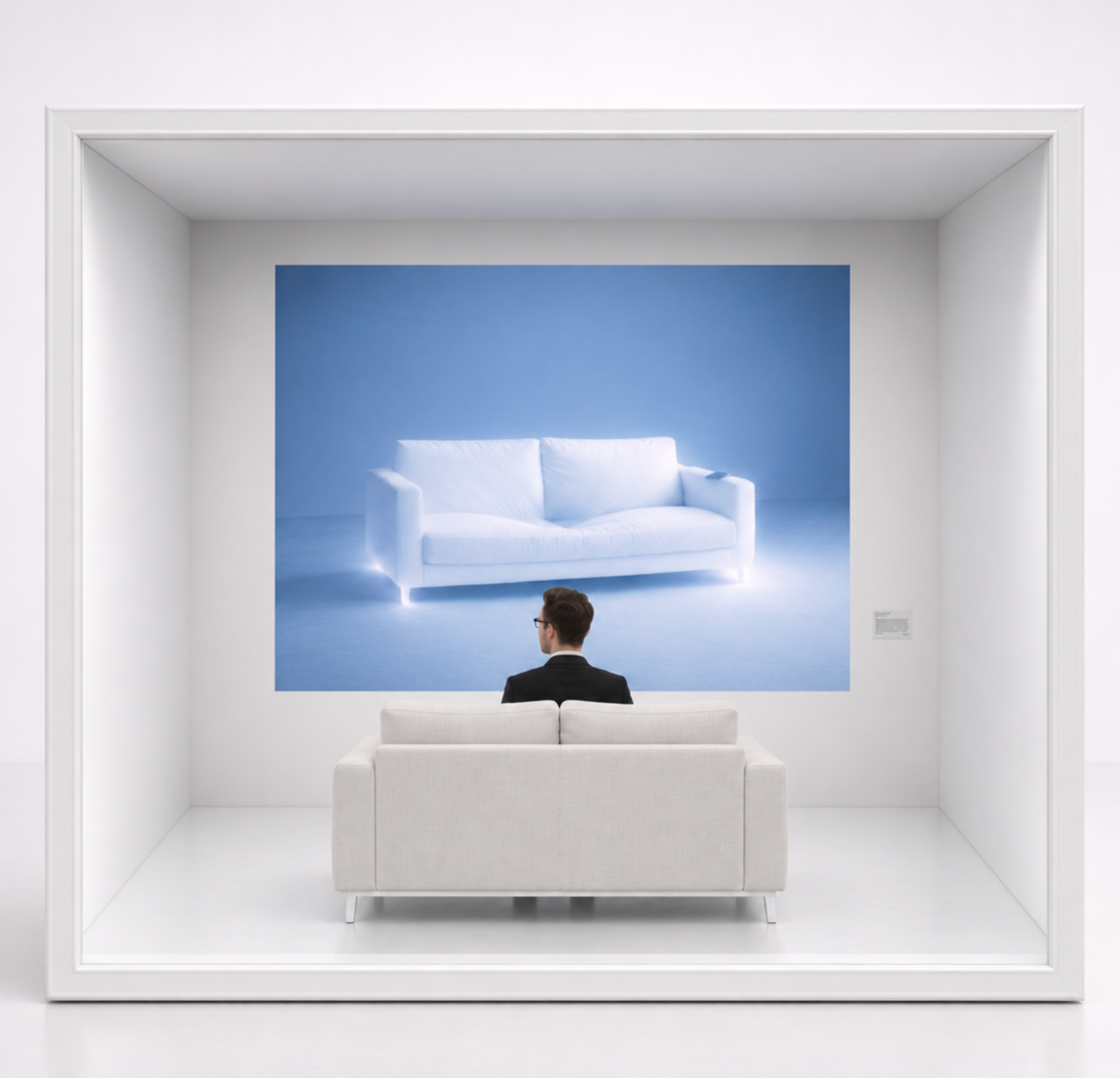
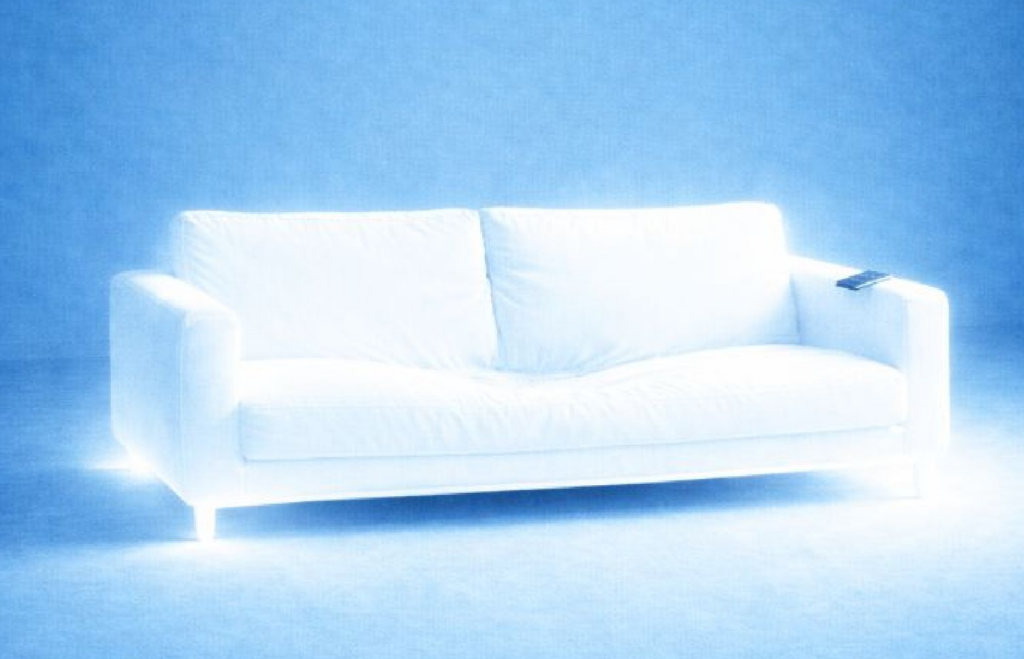
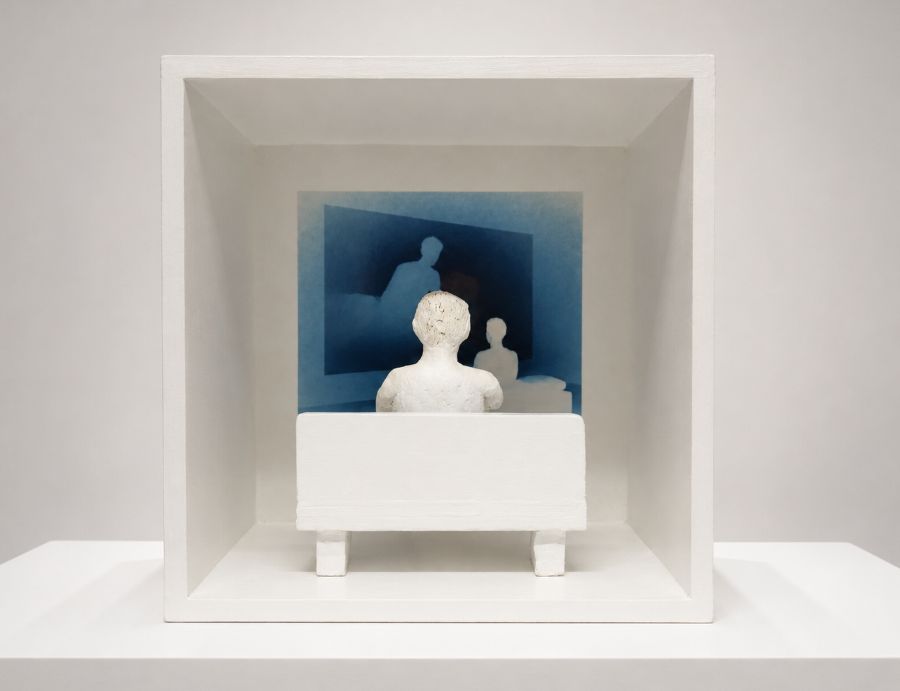
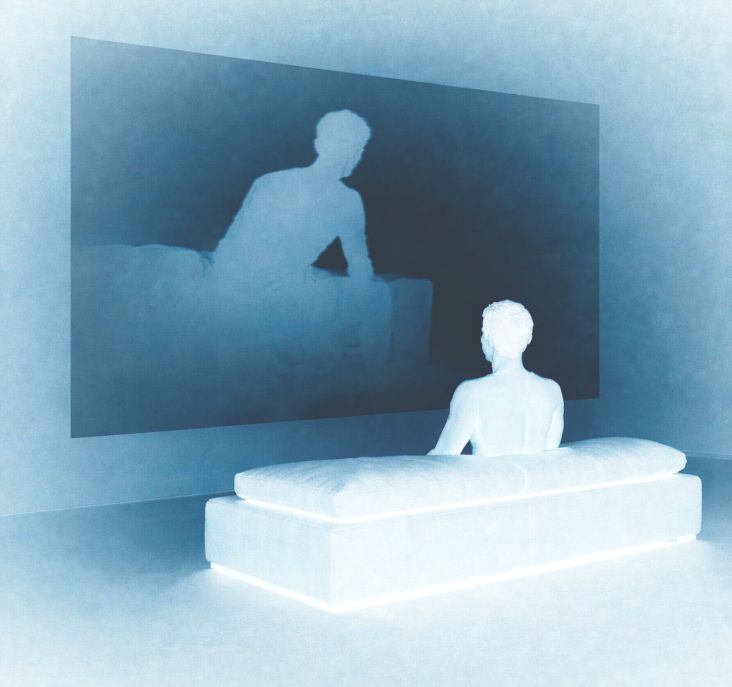
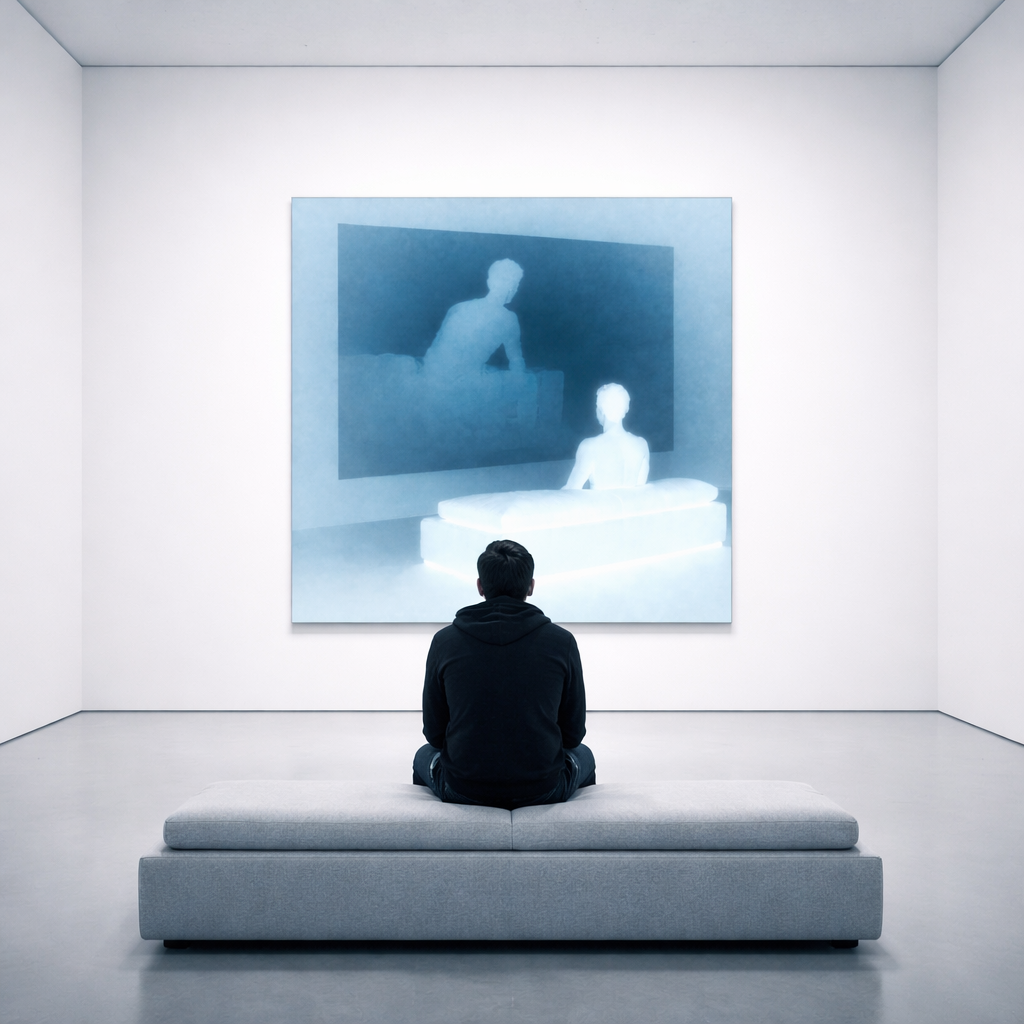
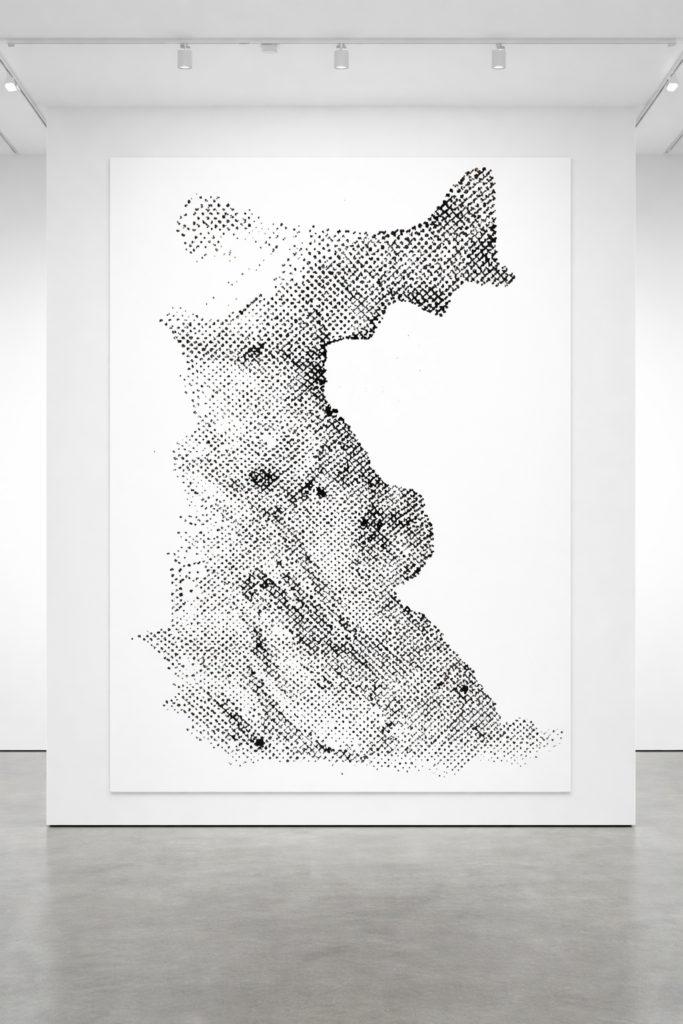
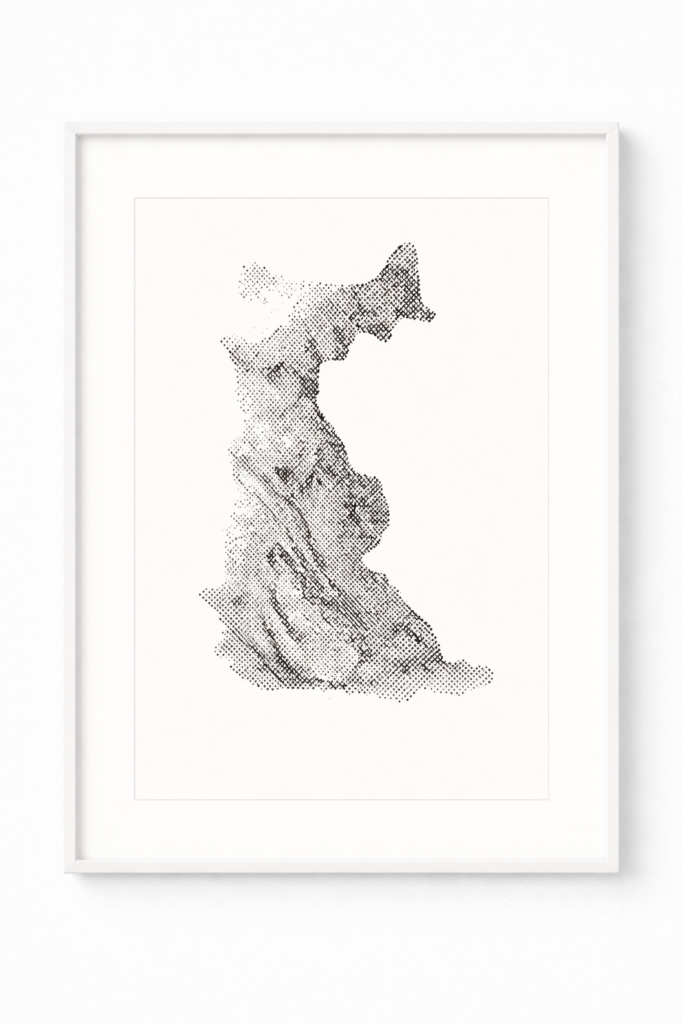
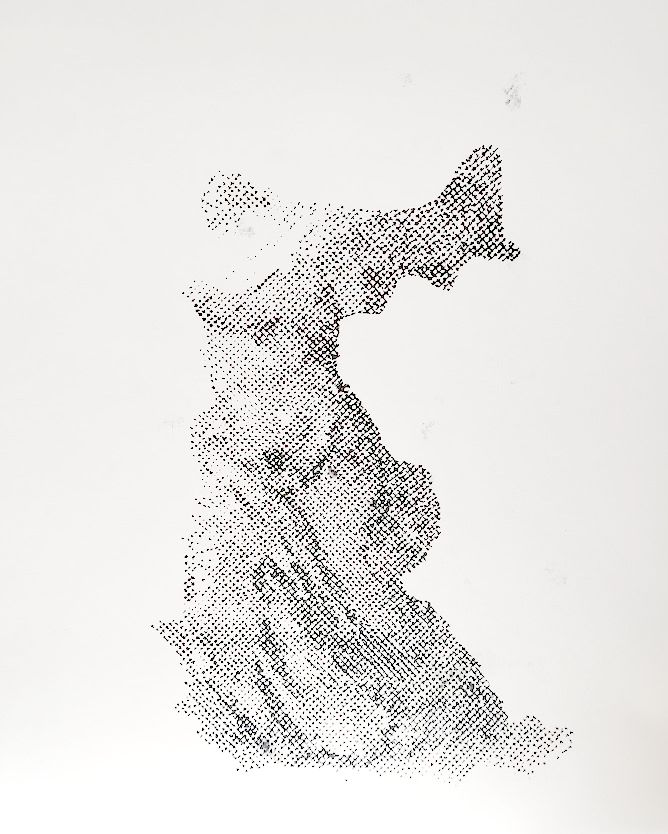
    Un corps néoclassique, idéalisé et lisse, repose sur un trône synthétique : le canapé. La virilité de la Grèce antique rencontre le confort de l’économie des plateformes. Ce n’est pas un héros au repos, c’est un monument à la passivité, façonné par l’hyper-efficacité et la sur-assistance. Tout est blanc. Tout est silencieux. La statue ne parle pas, ne bouge pas, n’a besoin de rien. L’homme « ubérisé par la paresse » n’est plus un penseur ni un guerrier, seulement un utilisateur, optimisé, immobile, esthétiquement stérile. La tension naît de cette contradiction : des muscles divins, sculptés pour l’action, pétrifiés par le confort. C’est le client parfait de l’économie de la paresse. Celui qui scrolle au lieu de chercher, qui commande au lieu de se déplacer, qui clique au lieu d’agir. Les géants du numérique n’ont aucun intérêt à l’éveiller. Son inertie est leur modèle économique. Tant qu’il reste assis, il produit : des données, de l’engagement, de l’argent. Un corps immobilisé, un esprit soumis, mais extrêmement rentable.

    —–
    A neoclassical body, idealised and smooth, reclines on a synthetic throne: the couch.
    The virility of ancient Greece meets the comfort of the gig economy. This is not a hero resting—it’s a monument to passivity, shaped by hyper-efficiency and over-servicing.
    Everything is white. Everything is silent. The statue doesn’t speak, doesn’t move, doesn’t need to.
    The ‘Uberlazied’ man is no longer a thinker or a warrior, just a user—optimised, idle, aesthetically sterile.
    The tension lies in this contradiction: divine muscles, sculpted for action, petrified by convenience.

    This is the perfect client of the laziness economy.
    The one who scrolls instead of searching, who orders instead of moving, who clicks instead of acting.
    The digital giants have no interest in awakening him. His inertia is their business model.
    As long as he stays seated, he produces: data, engagement, money.
    A body immobilised, a mind subdued—yet hyperprofitable.

  • Data Beats Emotion

    Audio recording Z. at American Congress x Start-up Mantra
    This work unfolds in two registers. First, as a visual transcription: the tear-shaped forms are not human sorrow, but the soundwave of Z. public apology before the U.S. Congress. No visible emotion. No rupture. Just the smooth, calculated rhythm of a voice designed not to tremble.

    Second, as a title—Data Beats Emotion—the phrase echoes a dominant mantra in the startup world. In tech culture, feelings are noise. Growth requires data: measurable, scalable, testable. Emotion is seen as inefficiency—something to simulate perhaps, but never to follow.

    By overlapping these layers, the piece reveals a tension: between affect and performance, between sincerity and computation. The tear is not real—it is rendered.
    And the apology, like the system it represents, is more a metric than a moment.

  • Underwater

    Underwater private network cables x brain

    À première vue, le dessin évoque un cerveau humain. Une masse nerveuse, fragile, parcourue d’ondes et de synapses. Les tracés semblent organiques, presque vivants. En réalité, il ne s’agit pas de neurones mais de câbles sous-marins bien réels, posés au fond des océans, qui transportent l’intégralité de nos flux numériques. Les noms inscrits, Echo, Jupiter, Grace Hopper, Curie, ne désignent pas des zones cérébrales mais des infrastructures privées, appartenant aux géants technologiques. Leur cartographie reproduit involontairement la forme d’un cortex. Les continents sont reliés comme des hémisphères. Les océans deviennent un tissu conjonctif. Ce réseau compose un système nerveux artificiel, mondial, silencieux. Ce dessin interroge l’anatomie de la connexion au XXIᵉ siècle. Qui relie qui. Qui contrôle les flux. Qui possède la pensée en circulation. L’Internet n’est pas immatériel. Il n’est pas dans un nuage. Il est physique, enfoui, cartographié, financiarisé.  Il traverse les fonds marins comme une colonne vertébrale de fibre optique.Ce n’est plus une métaphore. C’est une structure.Un cerveau non biologique, constitué de câbles, où la circulation des données remplace l’influx nerveux. Un cerveau sous l’eau.

    At first glance, the drawing appears to be a crude sketch of a human brain—nervous, pulsing, alive. But a closer look reveals a different truth: these are the real-world underwater cables that transmit global internet data, linking continents through the ocean floor.

    Names like Echo, Jupiter, Grace Hopper, and Curie trace not neurons, but corporate arteries—private infrastructure owned by tech giants, invisible yet vital. Their layout unintentionally mimics a cerebral cortex, forming a new digital nervous system, artificial yet organic in form.

    Underwater Private Network Cables questions the anatomy of connection in the 21st century. Are we still the ones thinking—or have these cables begun to think for us? It’s no longer metaphor. It’s structure.
    The internet is not in the cloud.
    It’s underwater, wired, mapped—and increasingly privatized.
    A brain not of flesh, but of fiber.