Catégorie : Green & Nature

  • Light Towers

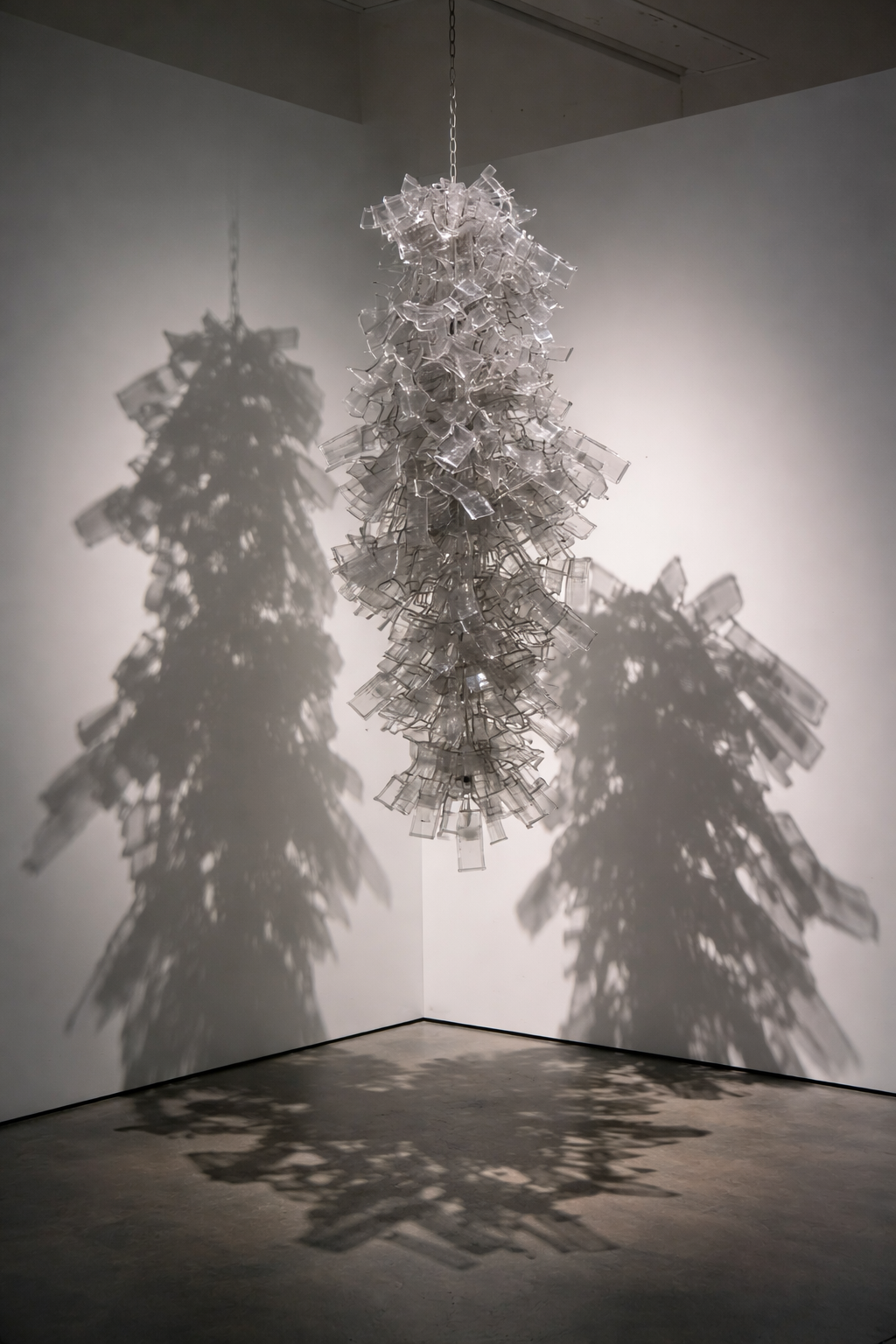
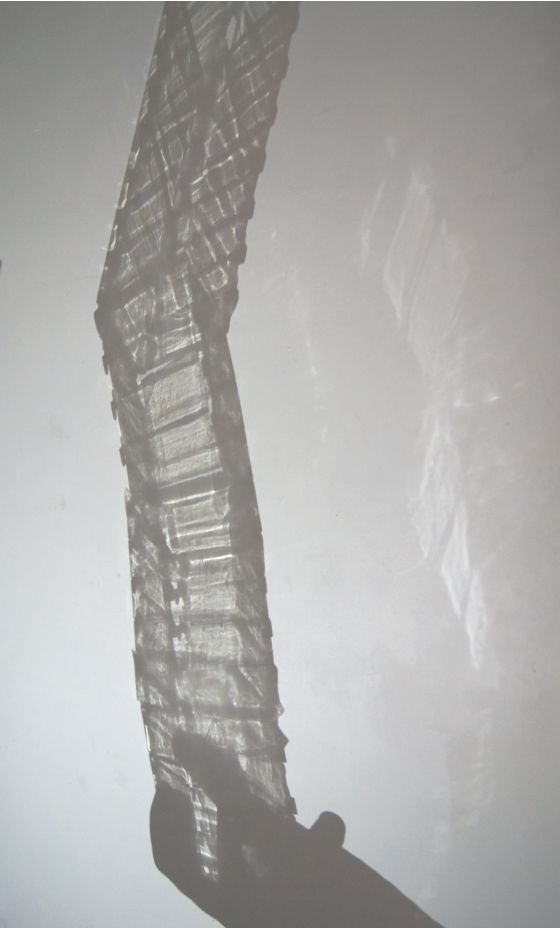
    Plastic drugs rubish x My Hand

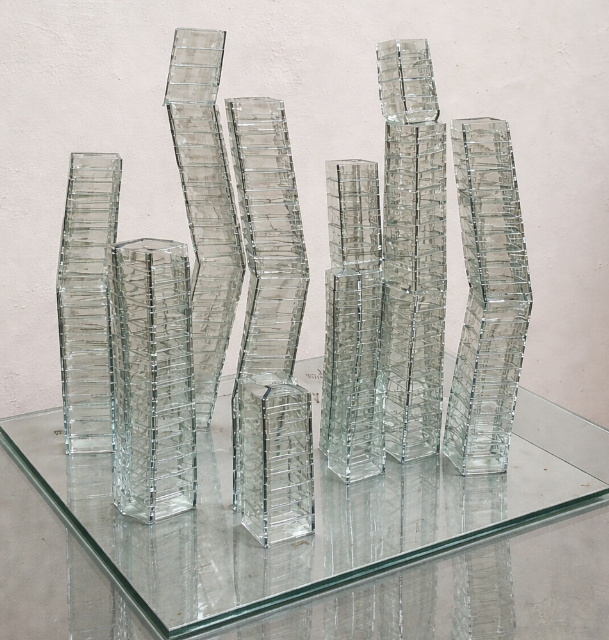
    Photo of plastic sculpture 40 x 30 cm

    Cette forme verticale translucide est sculptée à partir de plastiques jetés issus de présentoirs pharmaceutiques, tenue avec délicatesse — mais intentionnellement — par une main humaine. Lorsque la lumière la traverse, l’œuvre projette la silhouette d’une tour précaire, évoquant à la fois l’utopie fragile des villes de verre et l’échafaudage invisible de la consommation pharmacologique moderne.

    C’est un faux monument : construit dans une transparence synthétique, présenté comme noble — mais composé de rebuts. La main n’est pas seulement un support, elle devient aussi l’agent de la manipulation, nous rappelant que les architectures numériques et chimiques dans lesquelles nous vivons sont façonnées, empilées — et fondamentalement instables.

    Entre manipulation et contrôle, lumière et illusion, Light Towers pose la question :
    Que bâtissons-nous, et que soutenons-nous, avec les déchets que nous refusons de voir ?

    —

    This translucent vertical form is sculpted from discarded pharmacy display plastics, held delicately—yet deliberately—by a human hand. As the light cuts through, the piece casts the silhouette of a precarious tower, evoking both the fragile utopia of glass cities and the hidden scaffolding of modern pharmacological consumption.

    It’s a false monument: built from synthetic transparency, projected as noble—but made of debris. The hand becomes not only the support, but also the agent of manipulation, reminding us how the digital and chemical architectures we inhabit are shaped, stacked, and ultimately unstable.

    Between manipulation and control, light and illusion, Light Towers asks:
    What do we build, and what do we uphold, with the rubbish we deny?
  • Disposable Skyline

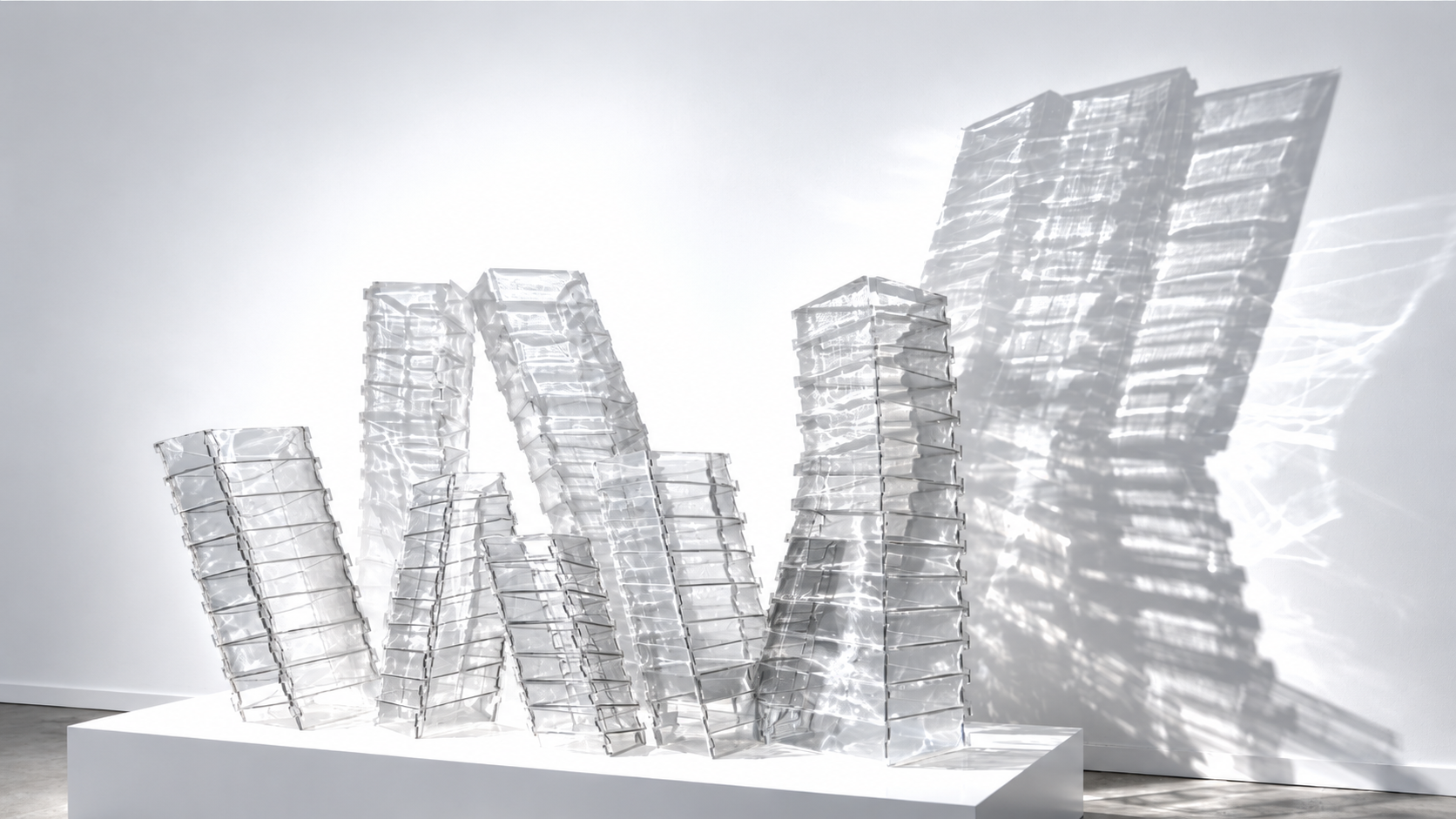
    Skyline version

    Manhattan version (glass) – in progress

    Plastic Rubish x SkyLine x Shadows

    Plastic sculpture 50 x 100 x 20 cm

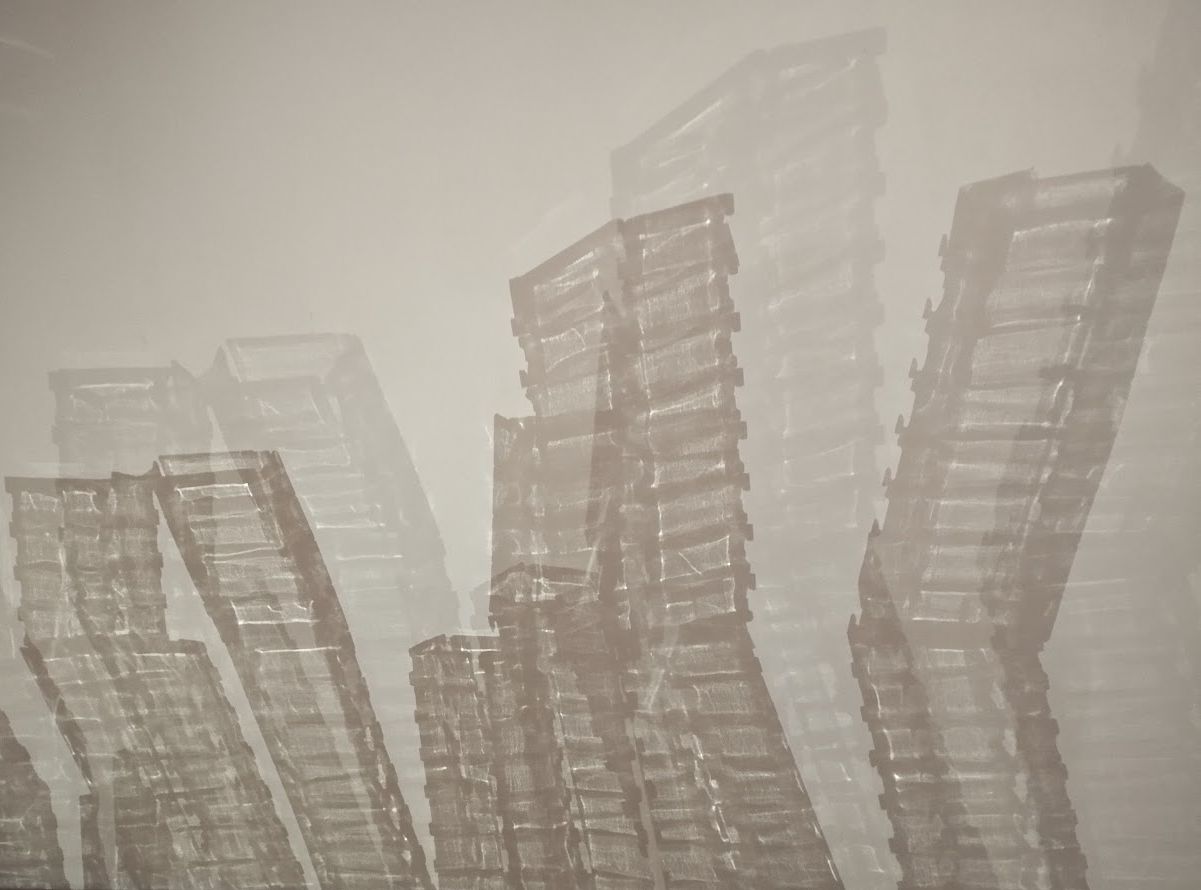
    Cette ligne d’horizon n’est pas faite d’acier ni d’ambition, mais de plateaux plastiques de médicaments jetés, soigneusement agencés et éclairés pour imiter la grandeur d’une ville moderne.

    Chaque fragment translucide projette une ombre haute — verticale, stérile, répétitive — formant des tours fantomatiques qui rappellent les silhouettes des quartiers financiers ou des pôles technologiques, ou des tours de serveurs, mais ne sont en réalité que des coquilles vides issues de la surconsommation. La prétendue transparence y est de mise.

    Ce sont des villes nées du déchet, non de la croissance. L’infrastructure même de nos vies — de la santé à l’espoir — se dessine à travers ce que nous jetons, ce que nous oublions, ce que nous surmédicalisons.
    Derrière chaque skyline lumineux se profile une silhouette plus sombre, celle de notre dépendance au bien-être, à la technologie, à la vitesse — le tout enveloppé dans l’illusion du progrès.

    Et si nos villes n’étaient que des distorsions de lumière, construites sur le vide, projetées par nos propres mains ?

    —

    This skyline isn’t built of steel or ambition, but of discarded plastic drug trays, carefully arranged and lit to mimic the grandeur of a modern city.

    Each translucent fragment throws a tall shadow — vertical, sterile, and repetitive — forming ghostly towers that recall the silhouettes of financial districts and tech hubs, but are, in fact, empty shells of overconsumption.

    These are cities born from waste, not growth. The very infrastructure of our lives — from health to hope — is shaped by what we throw away, what we forget, and what we over-medicate.
    Behind every glowing skyline is a darker silhouette, cast by our addiction to well-being, tech, and speed, wrapped in the illusion of progress.
    What if our cities were just light distortions, built on emptiness, projected from our own hands?

  • Summer is coming

    Squirrel noises x Pollen x Burning Sun x x-Rays x Solar activity

    Burning pollen, solar debris, invisible particles and solar radiation captured in a hallucinatory blur.
    The sound is erratic and jerky—reminiscent of squirrels on amphetamines, stuttering cartoon rodents from a lost VHS.
    This video seems to stage a micro-apocalypse: a sensory collapse where soft natural elements (floating pollen) are transformed into digitalised x-rays under the violence of a primordial sun.
    Between sunstroke and signal noise, the work evokes the overstimulation of contemporary digital environments, where everything vibrates, heats, accelerates.
    No place for silence, no shadows—only an ultraviolet barrage, comical and devastating.
    It’s not light anymore. It’s pressure. For the future. This also refers to the destruction of sun natural protection that men destroy progressively with environmental passive destruction

  • Sun is beyond the cloud

    Clouds x Random walking x No water x No sun

  • Flooded

    Flood x Trees x Funfair

  • Spiderman

    Broken screens x neural network

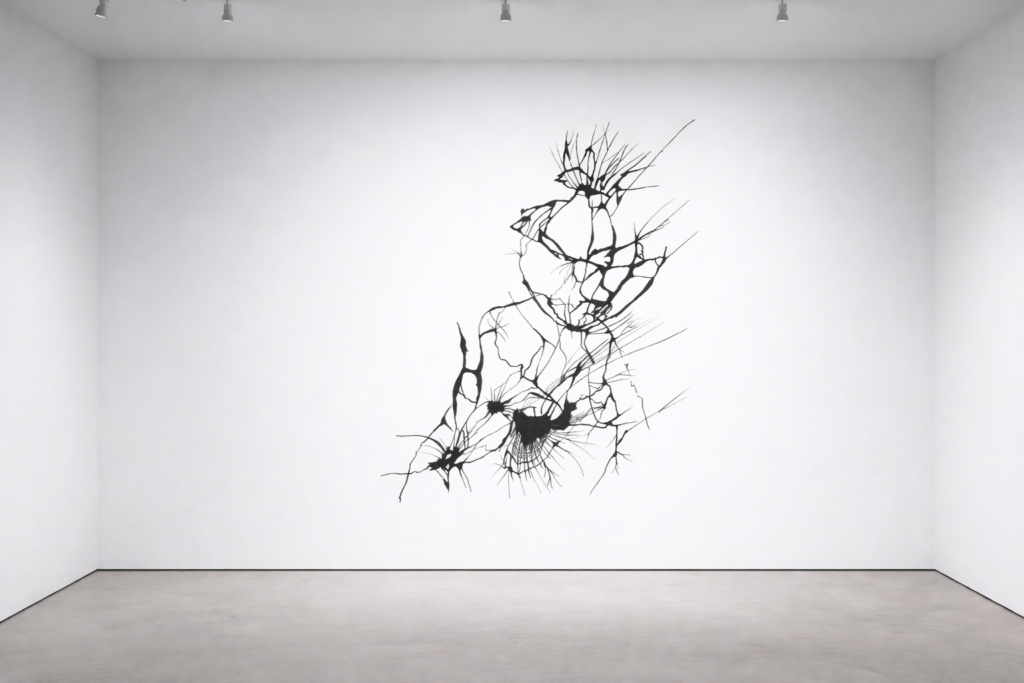
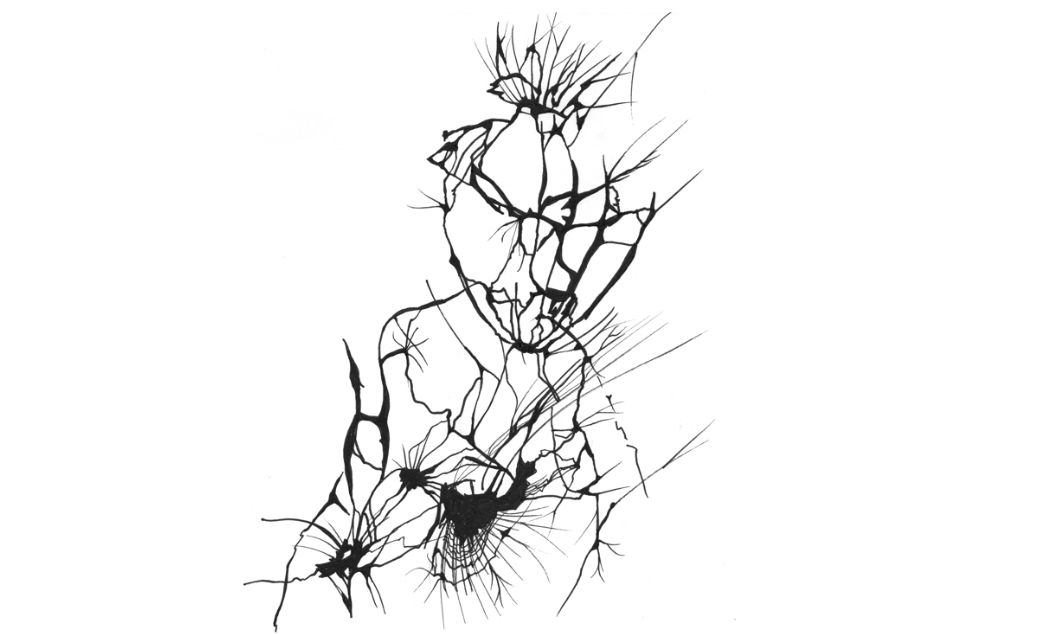
    A web of fractures mimicking a nervous system, or maybe the inverse — nerves mimicking the breaks in our machines. This figure is composed from three actual broken smartphone screens, reassembled into the silhouette of a human head and torso, spidering from a dense wound in the chest.

    The cracks become neurons. The neurons become vulnerability. The device, once a window to the world, now becomes a shattered mirror. The reference to Spiderman is neither heroic nor nostalgic — it’s anatomical, visceral. The power isn’t superhuman; it’s damage, perfectly mapped.

    There is no repair here, only exposure.

  • Uberlazied

    Old greek x Couch x Laziness economy

    Un corps néoclassique, idéalisé et lisse, repose sur un trône synthétique : le canapé. La virilité de la Grèce antique rencontre le confort de l’économie des plateformes. Ce n’est pas un héros au repos, c’est un monument à la passivité, façonné par l’hyper-efficacité et la sur-assistance. Tout est blanc. Tout est silencieux. La statue ne parle pas, ne bouge pas, n’a besoin de rien. L’homme « ubérisé par la paresse » n’est plus un penseur ni un guerrier, seulement un utilisateur, optimisé, immobile, esthétiquement stérile. La tension naît de cette contradiction : des muscles divins, sculptés pour l’action, pétrifiés par le confort. C’est le client parfait de l’économie de la paresse. Celui qui scrolle au lieu de chercher, qui commande au lieu de se déplacer, qui clique au lieu d’agir. Les géants du numérique n’ont aucun intérêt à l’éveiller. Son inertie est leur modèle économique. Tant qu’il reste assis, il produit : des données, de l’engagement, de l’argent. Un corps immobilisé, un esprit soumis, mais extrêmement rentable.

    —–
    A neoclassical body, idealised and smooth, reclines on a synthetic throne: the couch.
    The virility of ancient Greece meets the comfort of the gig economy. This is not a hero resting—it’s a monument to passivity, shaped by hyper-efficiency and over-servicing.
    Everything is white. Everything is silent. The statue doesn’t speak, doesn’t move, doesn’t need to.
    The ‘Uberlazied’ man is no longer a thinker or a warrior, just a user—optimised, idle, aesthetically sterile.
    The tension lies in this contradiction: divine muscles, sculpted for action, petrified by convenience.

    This is the perfect client of the laziness economy.
    The one who scrolls instead of searching, who orders instead of moving, who clicks instead of acting.
    The digital giants have no interest in awakening him. His inertia is their business model.
    As long as he stays seated, he produces: data, engagement, money.
    A body immobilised, a mind subdued—yet hyperprofitable.

  • Underwater

    Underwater private network cables x brain

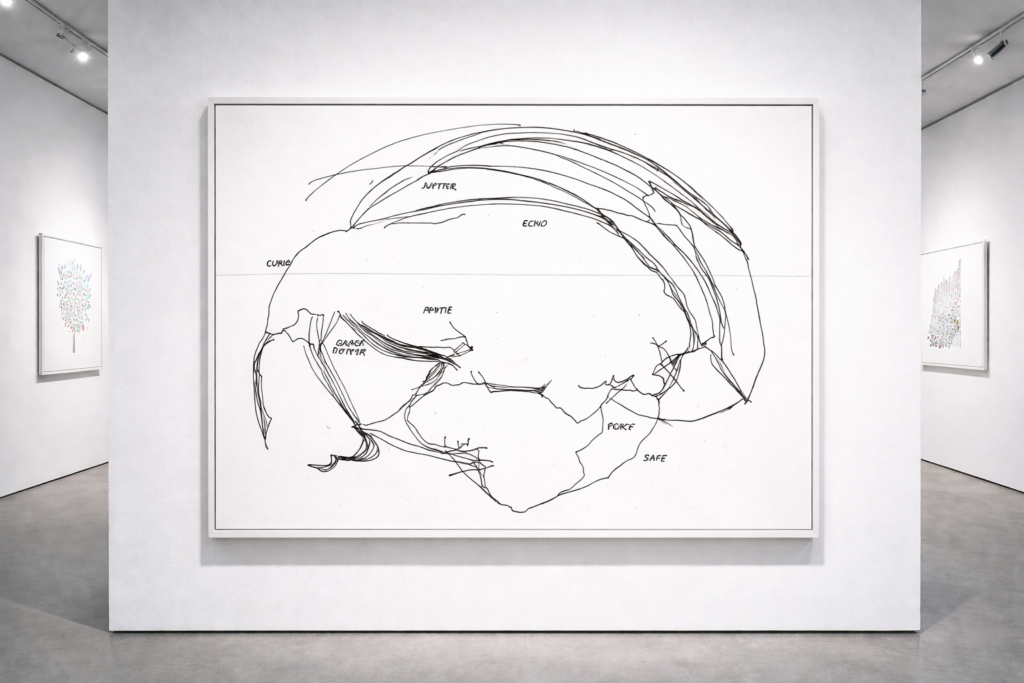
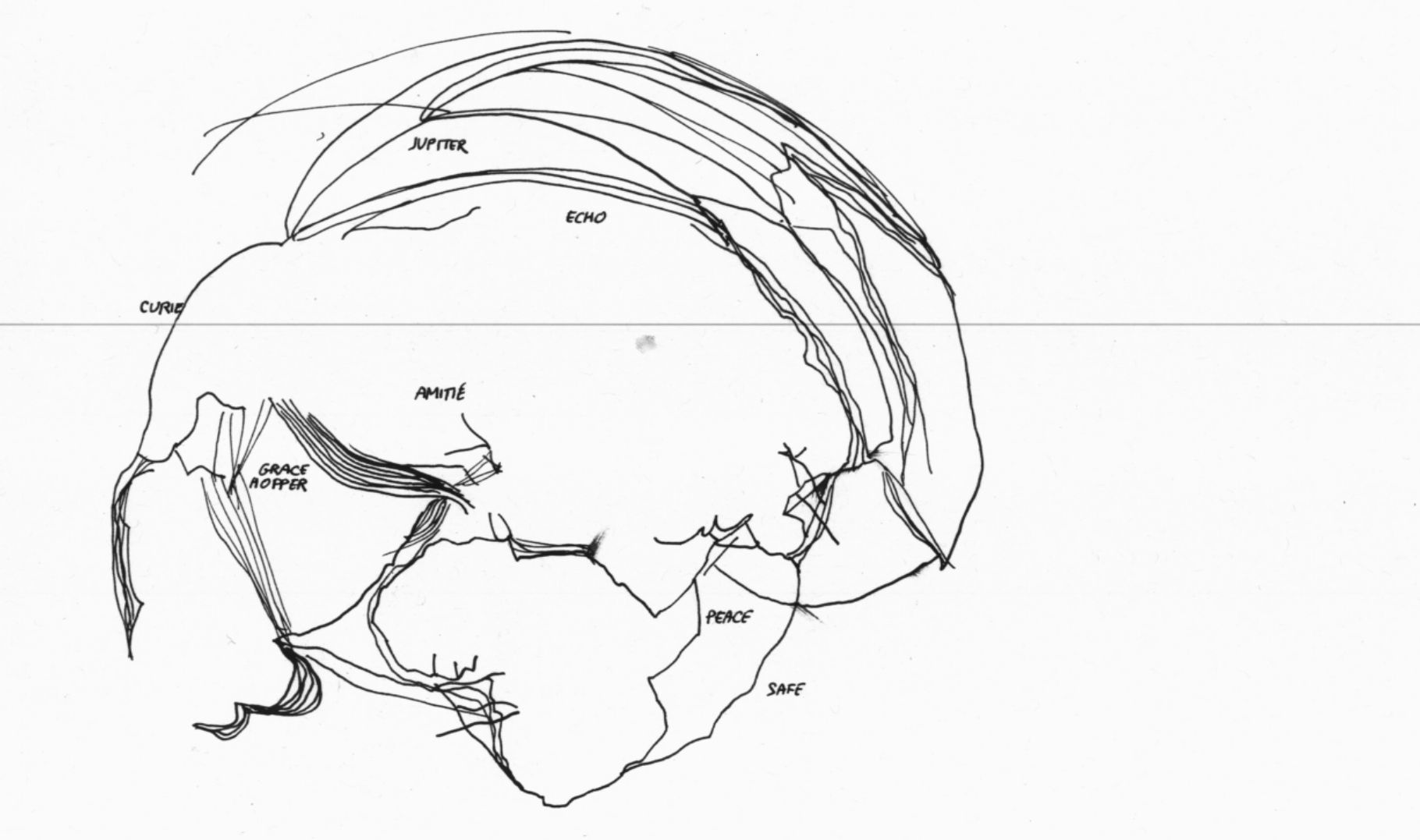
    À première vue, le dessin évoque un cerveau humain. Une masse nerveuse, fragile, parcourue d’ondes et de synapses. Les tracés semblent organiques, presque vivants. En réalité, il ne s’agit pas de neurones mais de câbles sous-marins bien réels, posés au fond des océans, qui transportent l’intégralité de nos flux numériques. Les noms inscrits, Echo, Jupiter, Grace Hopper, Curie, ne désignent pas des zones cérébrales mais des infrastructures privées, appartenant aux géants technologiques. Leur cartographie reproduit involontairement la forme d’un cortex. Les continents sont reliés comme des hémisphères. Les océans deviennent un tissu conjonctif. Ce réseau compose un système nerveux artificiel, mondial, silencieux. Ce dessin interroge l’anatomie de la connexion au XXIᵉ siècle. Qui relie qui. Qui contrôle les flux. Qui possède la pensée en circulation. L’Internet n’est pas immatériel. Il n’est pas dans un nuage. Il est physique, enfoui, cartographié, financiarisé.  Il traverse les fonds marins comme une colonne vertébrale de fibre optique.Ce n’est plus une métaphore. C’est une structure.Un cerveau non biologique, constitué de câbles, où la circulation des données remplace l’influx nerveux. Un cerveau sous l’eau.

    At first glance, the drawing appears to be a crude sketch of a human brain—nervous, pulsing, alive. But a closer look reveals a different truth: these are the real-world underwater cables that transmit global internet data, linking continents through the ocean floor.

    Names like Echo, Jupiter, Grace Hopper, and Curie trace not neurons, but corporate arteries—private infrastructure owned by tech giants, invisible yet vital. Their layout unintentionally mimics a cerebral cortex, forming a new digital nervous system, artificial yet organic in form.

    Underwater Private Network Cables questions the anatomy of connection in the 21st century. Are we still the ones thinking—or have these cables begun to think for us? It’s no longer metaphor. It’s structure.
    The internet is not in the cloud.
    It’s underwater, wired, mapped—and increasingly privatized.
    A brain not of flesh, but of fiber.

  • Shouting tomatoes

    Food Waste x Tomatoe shout sound x Water Waste x WC

    The bathroom, a symbol of excess and hygiene, becomes the unlikely greenhouse for a grotesque harvest. Overflowing with lush tomato plants rooted in the bowl of a toilet, this sterile space is transformed into a site of vegetal protest.

    Science tells us tomatoes emit ultrasonic cries when stressed by thirst. Here, that finding is turned into a visual scream. Red fruit—ripe, luminous—spills from a place of waste, while water, the most vital resource, leaks and pools in silence.

    The installation plays with paradox: food growing from filth, beauty in a site of disposal, plants pleading in frequencies humans cannot hear. The absurdity becomes confrontation.

    This is not about growth, but neglect. Not about ecology, but the irony of abundance. A piece where the tomatoes, quite literally, have something to say.

  • Wood animals

    Nature x serendipity

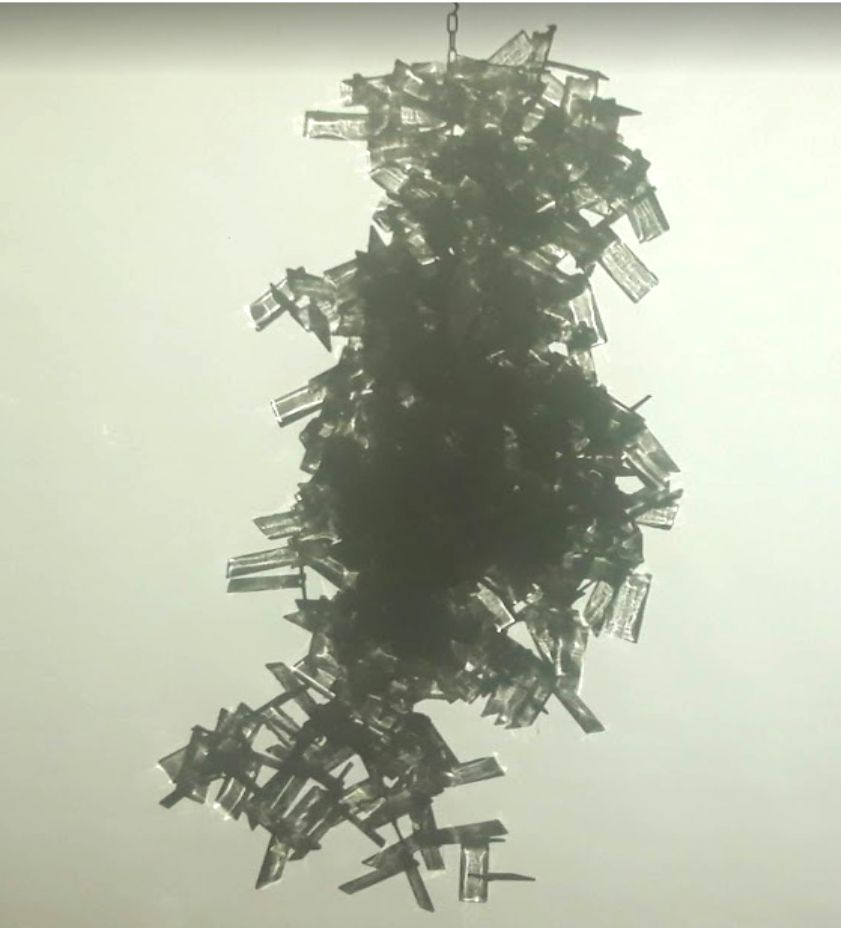
  • Rootless Retail Tree

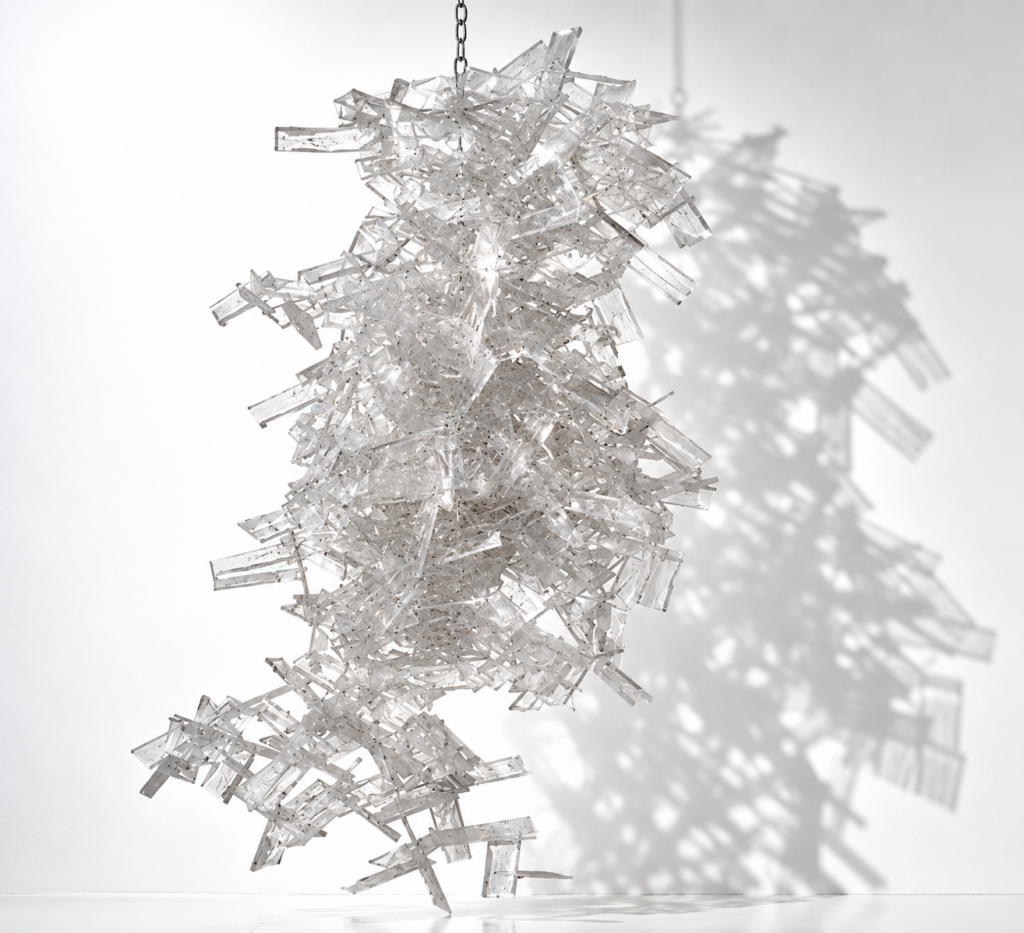
    Pharmacy marketing plastic rubish x Light transparency x Low hanging fruit

    Plastic sculpture 90 x 50 x 50 cm

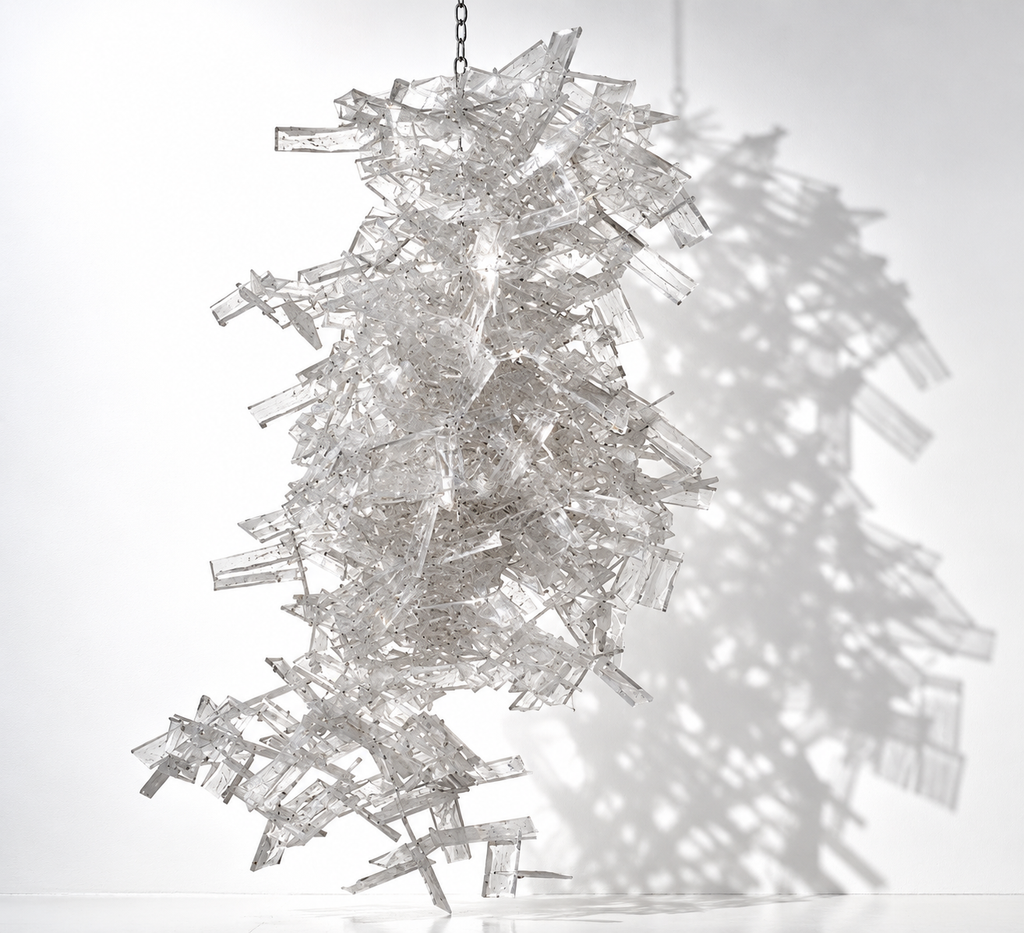
    Suspendue à une chaîne métallique, cette forme spectrale émerge d’un amas de fragments plastiques transparents — éléments d’étagères jetés, avant même d’être utilisés pour mettre en valeur des produits pharmaceutiques. Des rebuts. Des coproduits produits inutilement. La sculpture flotte comme un fruit contaminé de l’économie moderne : fragile, lumineux, mais saturé des résidus de l’hyperconsommation.

    La lumière traverse la structure, projetant un halo chaotique qui révèle la violence invisible des déchets marketing du quotidien. Plastic Tree se dresse comme un monument au cycle de vie invisible de la marchandisation — montrant comment même les structures censées « aider » sont vouées à l’excès, à la pollution, à l’effondrement.

    Un fossile de la logique promotionnelle, suspendu dans un silence stérile.

    —

    Suspended by a metal chain, this ghostly form emerges from a mass of transparent plastic fragments—discarded shelving elements once used to promote pharmaceutical products. The sculpture hangs like a contaminated fruit of the modern economy: fragile, luminous, yet saturated with the residues of hyper-consumption. Light penetrates the structure, projecting a chaotic halo that reveals the invisible violence of everyday marketing debris. Plastic Tree stands as a monument to the unseen lifecycle of commodification—how even the structures meant to “help” are wasteful, polluting, and destined to collapse. A fossil of promotional logic suspended in sterile silence.

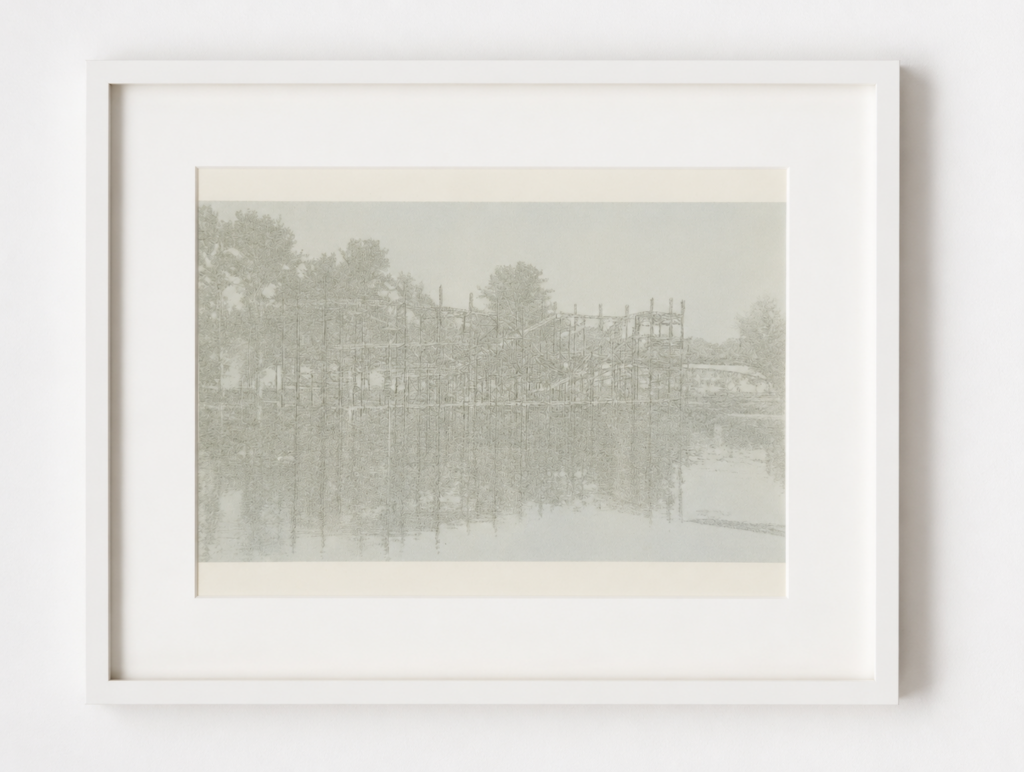
  • Party is over

    Funfair x Flood x Rollercoaster x Digital Twin

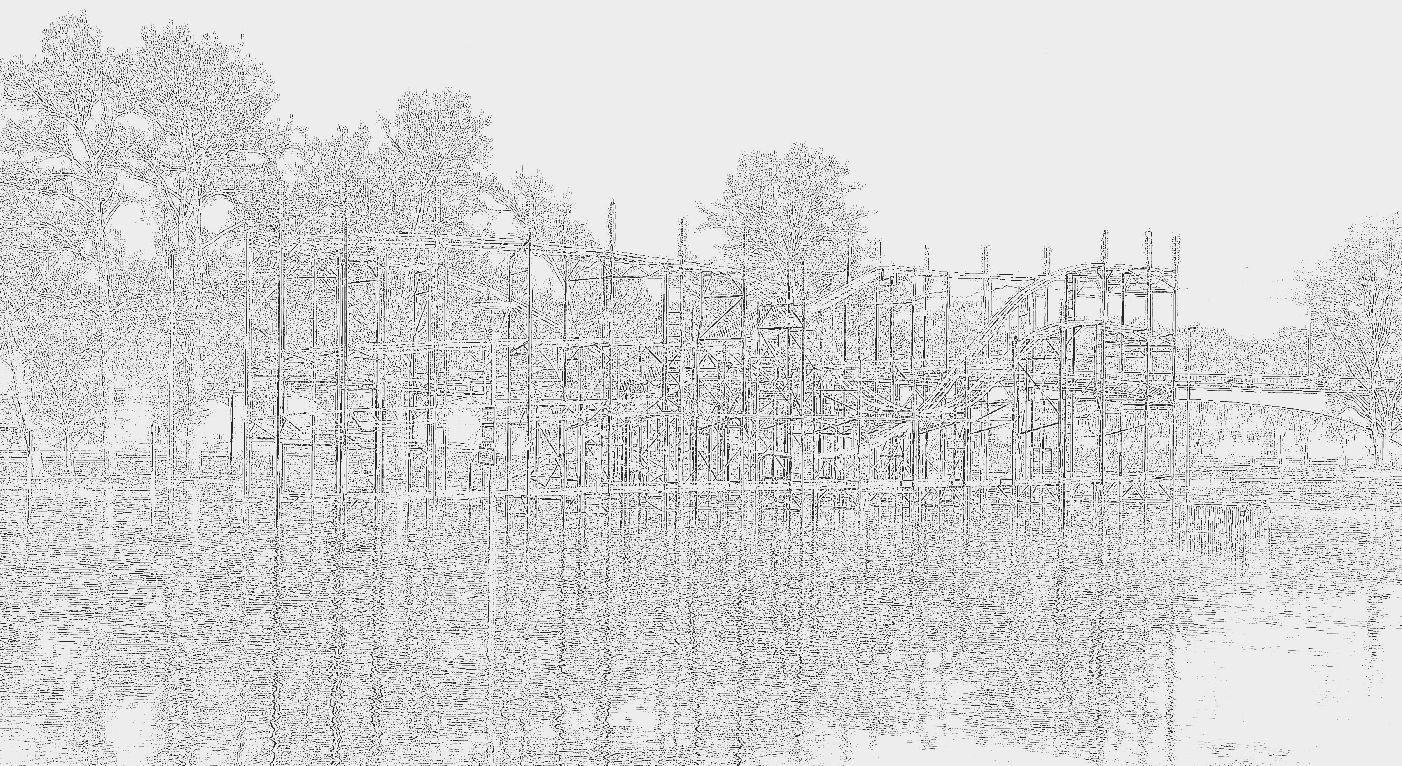
    Montagnes russes partiellement submergées, la structure apparaît comme un squelette : autrefois promesse de vertige et de plaisir, elle devient fragile, spectrale. Cette fête foraine saisie au milieu de l’inondation semble suspendue dans un moment étrange, comme si le divertissement avait été interrompu. Pourtant, rien ne s’est vraiment arrêté. Le double numérique persiste. Les métadonnées de l’amusement survivent, redémarrent, continuent de produire de la valeur. Dans cette gravure fantomatique, la joie et l’effondrement se superposent. L’image devient l’instantané d’un déni : une société qui continue de danser pendant que l’eau monte. La fête s’interrompt le temps de la crue, puis reprend, aveugle à ce qui l’engloutit. Le reflet dans l’eau renvoie à une vérité plus profonde : ce que nous répliquons, nous refusons de l’abandonner. L’inondation n’est pas seulement physique. Elle devient le symbole d’une époque qui se noie sous l’excès, la distraction et le spectacle. Cette image rappelle que l’architecture du divertissement trouvera toujours un moyen de redémarrer, jusqu’au moment où il sera trop tard.

    A rollercoaster, partially submerged, reveals its skeletal structure—once thrilling, now fragile, spectral. This funfair, captured mid-flood, seems paused in an uncanny moment where pleasure is suspended. Yet nothing has truly stopped. The digital twin persists. The metadata of the amusement survives, resumes, profits.

    In this ghostly engraving, joy and collapse are superimposed. It’s a snapshot of denial: a society that continues to dance as the water rises. The party pauses for the flood, only to resume, oblivious. The reflection in the water echoes a deeper truth—what we replicate, we refuse to abandon.

    The flood isn’t just physical. It’s symbolic of an age that drowns beneath excess, distraction, spectacle. This image reminds us: the architecture of entertainment will always find a way to restart—until it’s too late.

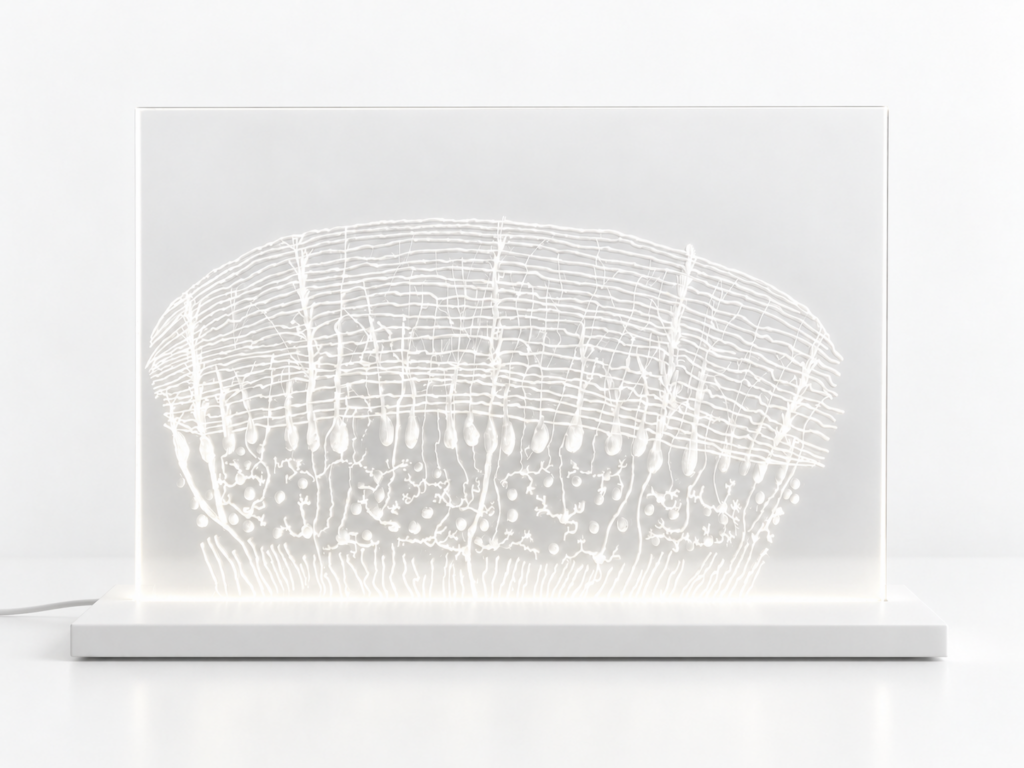
  • Rat Race

    Engraving on plexiglas 20 x 30 cm

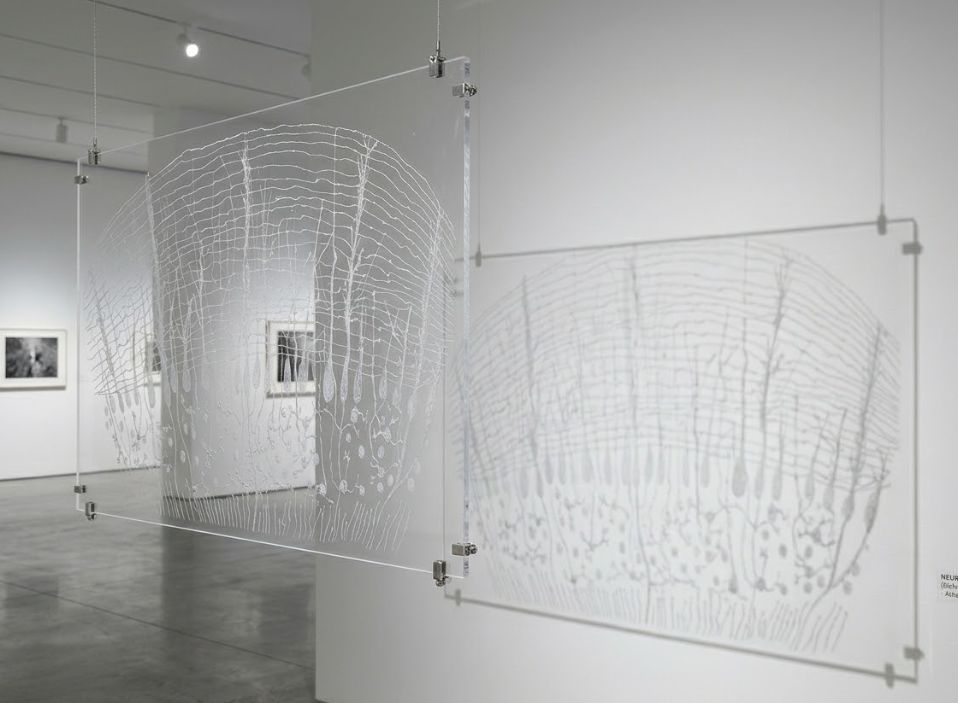
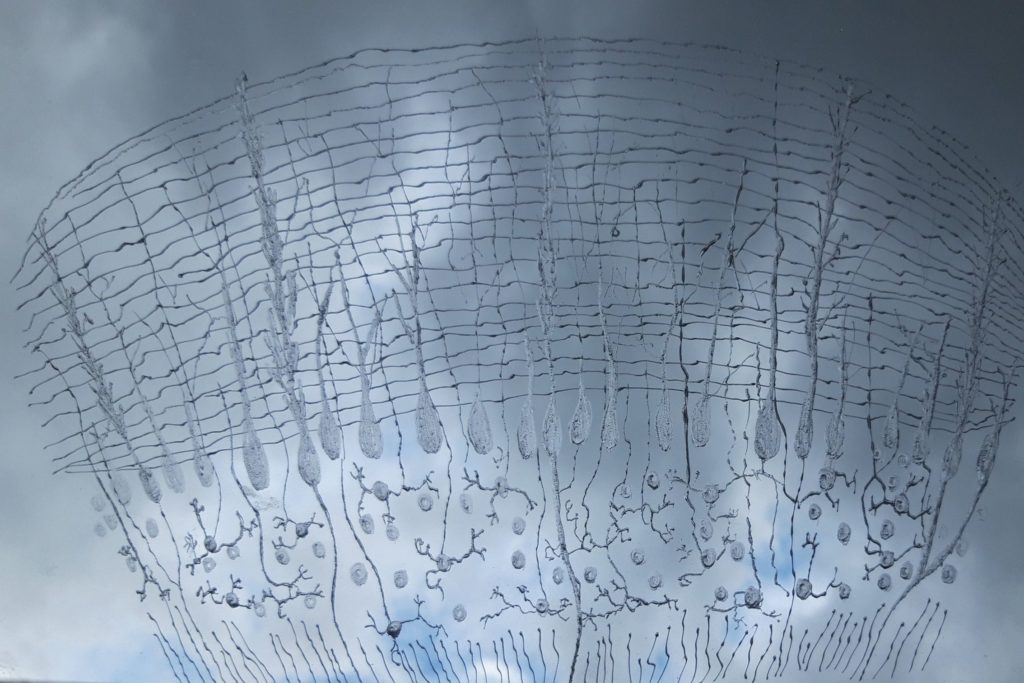
    Gravé sur une plaque de plexiglas transparent, un réseau neuronal détaillé flotte devant un ciel en dérive — à mi-chemin entre schéma scientifique et carte spirituelle. La structure évoque une coupe corticale, mais dans ce cadre aérien, elle devient métaphore du tapis roulant cognitif moderne : connexions infinies, aucune issue. Le ciel transperce les lignes synaptiques, transformant le cerveau en une prison de lumière et d’air.

    Rat Race incarne le paradoxe de notre intellect — capable d’émerveillement, mais piégé dans des boucles d’accélération, de performance et de bruit. Un esprit suspendu, exposé, rendu vain, à la poursuite de sens sous un ciel algorithmique.

    Cette gravure de cortex, inspirée des premières représentations neuronales, suspendue sur un fond de nuages mouvants, conjugue précision anatomique et enfermement existentiel. Le cerveau y apparaît disséqué mais flottant, ses circuits figés dans une complexité aussi brillante qu’inutile. À travers cette transparence, Rat Race devient une allégorie — non seulement de la surcharge mentale, mais de la culture start-up elle-même, où l’intelligence, la vitesse et l’innovation tournent à vide… jusqu’au burn-out. Et où de nombreuses start-up se trouvent piégées dans une rat race, une compétition sans fin pour émerger et un jour devenir une licorne, quoi qu’il en coûte!

    Le maillage neuronal reflète la logique du capital-risque : connexions accélérées, pensée performative, raisonnement scalable — jusqu’à l’effondrement. L’arrière-plan nuageux suggère la liberté, mais elle reste inaccessible, distordue par la grille. Voici le cerveau comme champ de bataille : là où chaque neurone rivalise, chaque idée se « pitche », et où penser n’est plus un processus — mais une course à la visibilité, au financement, à la survie.

    —

    Engraved on a transparent plexiglass sheet, a detailed neural network floats against a drifting sky—part scientific diagram, part spiritual map. The structure resembles a slice of cortex, yet in this elevated setting it becomes a metaphor for the modern cognitive treadmill: endless connections, zero escape. The sky bleeds through the synaptic lines, turning the brain into a prison made of light and air. Rat Race evokes the paradox of our intellect—capable of wonder, yet trapped in loops of acceleration, performance, and noise. A suspended mind, exposed and futile, chasing meaning under an algorithmic sky.

    This plexiglass engraving of a cortical section, suspended against a backdrop of drifting clouds, evokes both anatomical precision and existential entrapment. The brain appears dissected yet hovering, its neural circuits frozen in a moment of futile complexity. Through this transparency, Rat Race becomes an allegory—not only of cognitive overload, but of the relentless startup culture where intellect, speed, and innovation spiral into burnout….and where start-up fight for immediate success

    The neural mesh mirrors the logic of venture capital: accelerated connections, performative thinking, scalable reasoning—until collapse. The cloudscape behind suggests freedom, but it remains unreachable, distorted through the grid. This is the brain as battleground: one where every neuron competes, every idea pitches itself, and where thinking is no longer a process, but a race for visibility, funding, and survival.

  • Rootless Retail Tree

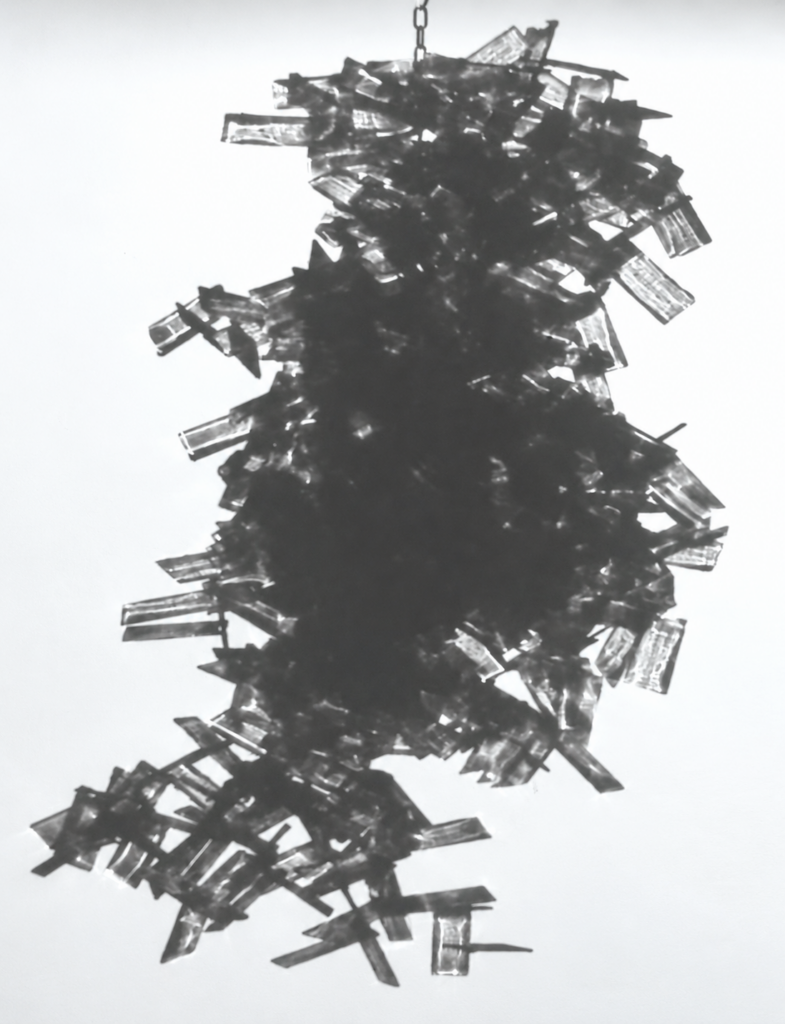
    Drugs plastic commercial racks x shadows x sculpture

    Video of the dancing shadows of the sculpture

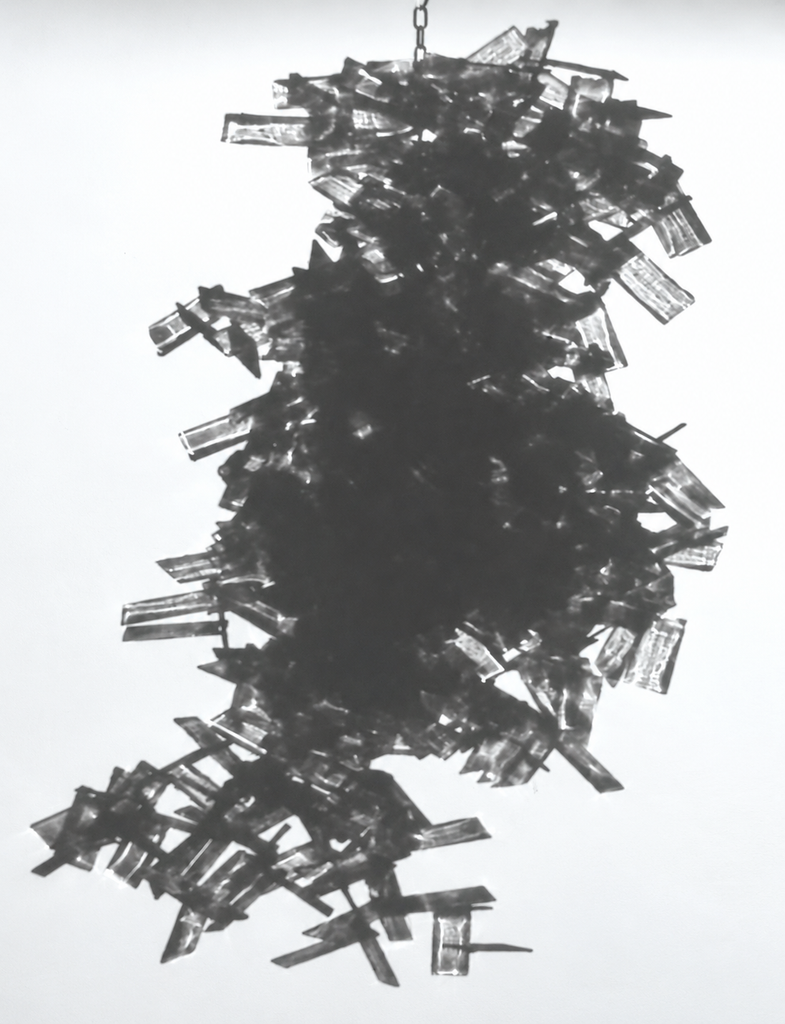
    Suspendue à une chaîne métallique, cette forme spectrale émerge d’un amas de fragments plastiques transparents — jetés même avant d’être des vestiges d’étagères publicitaires utilisés pour promouvoir des produits pharmaceutiques. La sculpture flotte comme un fruit contaminé de l’économie moderne : fragile, lumineux, mais saturé des résidus de l’hyperconsommation.

    La lumière traverse la structure, projetant un halo chaotique qui révèle la violence invisible des déchets marketing du quotidien. Rootless Retail Tree se dresse comme un monument au cycle de vie invisible de la marchandisation — montrant comment même les structures censées « aider » sont fondamentalement vouées au gaspillage, à la pollution et à l’effondrement.

    Un fossile de la logique promotionnelle, suspendu dans un silence stérile.

  • Magnetic Pendulum Puppets

    Dancing Metal Puppets x Magnetic motion x Dead tree x Daily flowers

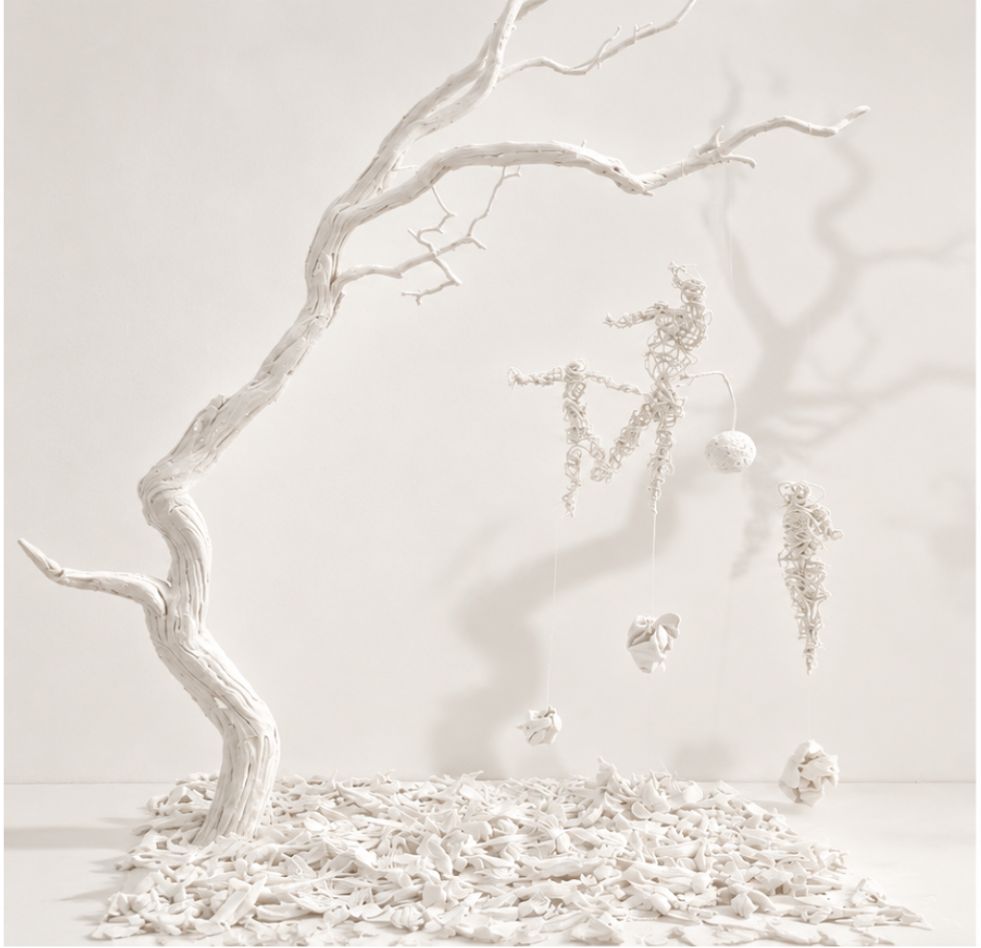
    Sculpture iron – wood – flowers – magnets | 80 x 50 x 50 cm

    Dans cette séquence vidéo, des figures humanoïdes en fil de fer oscillent sous un arbre noueux et sans vie, animées non par des ficelles, mais par des forces magnétiques invisibles. Elles se balancent avec une grâce mécanique au-dessus d’un sol parsemé de pétales d’hypomées — ces fleurs qui ne durent qu’un jour avant de disparaître. Le pendule devient l’axe du contrôle, mesurant le temps non en heures, mais en gestes compulsifs et cycles fragiles.

    The Pendulum Tree met en scène un rituel de répétition : des êtres artificiels dansent sans fin pendant que la beauté organique se fane en silence. L’arbre, à la fois bourreau et vestige, encadre la scène comme une métaphore de l’existence moderne — où la vie quotidienne devient un mouvement performatif dicté par des systèmes invisibles, et où la nature n’est plus qu’un décor périmé.

    Une boucle discrète, fatale, où même la grâce est sous contrôle.

    —

    In this video snapshot, wiry human-like figures oscillate beneath a gnarled, lifeless tree, animated not by strings but by invisible magnetic forces. They sway with mechanical grace above a ground scattered with ephemeral morning glory petals—hypomées, flowers that bloom for a single day before vanishing. The pendulum becomes the axis of control, marking time not in hours but in compulsive gestures and fragile cycles.

    The Pendulum Tree stages a ritual of repetition: artificial beings dance endlessly while organic beauty withers in silence. The tree, both executioner and relic, frames the scene as a metaphor of modern existence—where daily life becomes performative movement dictated by unseen systems, and nature serves only as expired décor. A quiet, fatal loop where even grace is governed.

  • Melting Ice Cream

    A pink human running slowly after its meal made of plastic bottles drifting like melting icebergs

    A man in a bright pink suit tries to run. In vain. In front of him drifts a surreal, white, glistening island made of plastic bottles and synthetic volumes, resembling both a melting ice cream and a stranded iceberg. His effort is grotesquely slowed down, almost ridiculous — not due to his weight, but because the destination itself is unreachable, toxic, and absurd.

    This piece stages the tragic loop of modern overconsumption: our cravings for junk pleasures, plastic-sweetened foods and disposables, pushing us toward a collective wreck. The white shape — an amalgam of packaging waste — is the new unreachable paradise: cold, artificial, and melting under the weight of its own irony.

    The body becomes a metaphor for society: swollen with excess, immobilized by its own inertia, and still reaching out for what is destroying it. A visual and physiological dead end.

  • La Vie en Rose, on Thin Ice

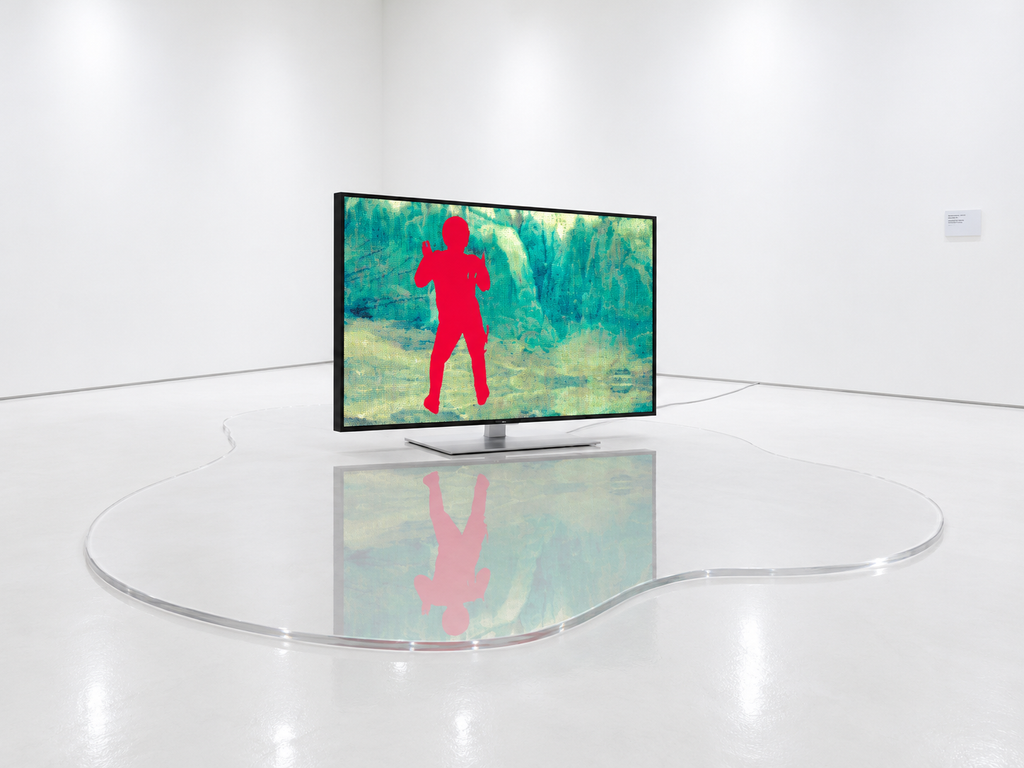
    Ice melting x slow dancing x La vie en rose

    Video

    Un enfant sans visage, silhouette rose en aplat, danse avec joie — maladroitement, innocemment — sur fond d’effondrement lent d’un glacier numérique. Des blocs de glace tombent, fondent, se dissolvent dans une mer montante, tandis qu’une version fragile de La Vie en Rose s’échappe d’un petit carrousel musical à lamelles métalliques : nostalgique, imparfaite, étrangement mécanique.

    Le contraste est chirurgical. La joie est automatisée. L’arrière-plan meurt.
    Pink Dancer met en scène une contradiction saisissante : un corps enfantin qui bouge avec grâce, pendant que la planète se désintègre. Le son, censé apaiser, devient une berceuse du déni. Le temps se fige, l’eau s’écoule, et la danse continue — inconsciente… ou incapable de s’arrêter.

    —

    A faceless child in flat pink silhouette dances joyfully—awkwardly, innocently—against the slow collapse of a digital glacier. Blocks of ice fall, melt, dissolve into the rising sea, while a fragile version of La Vie en Rose plays from a metal-combed toy music box: nostalgic, imperfect, eerily mechanical.

    The contrast is surgical. The joy is automated. The background is dying.
    Pink Dancer stages a haunting contradiction: a childlike body moving with grace while the planet behind disintegrates. The sound, meant to soothe, becomes a lullaby of denial. Time freezes, water flows, and the dance continues—unaware, or unwilling to stop.

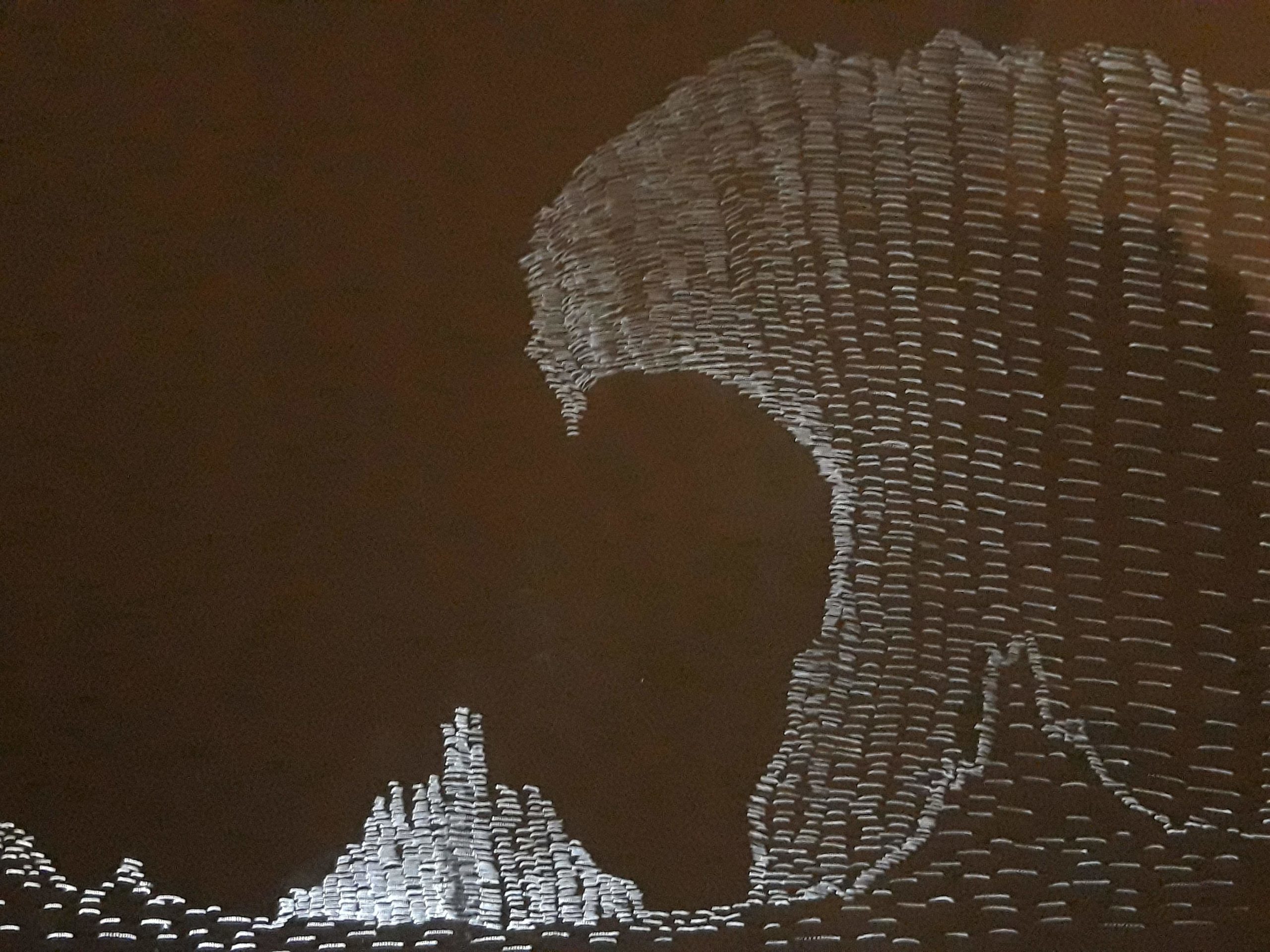
  • Hashima II – The wave of Tech Capital

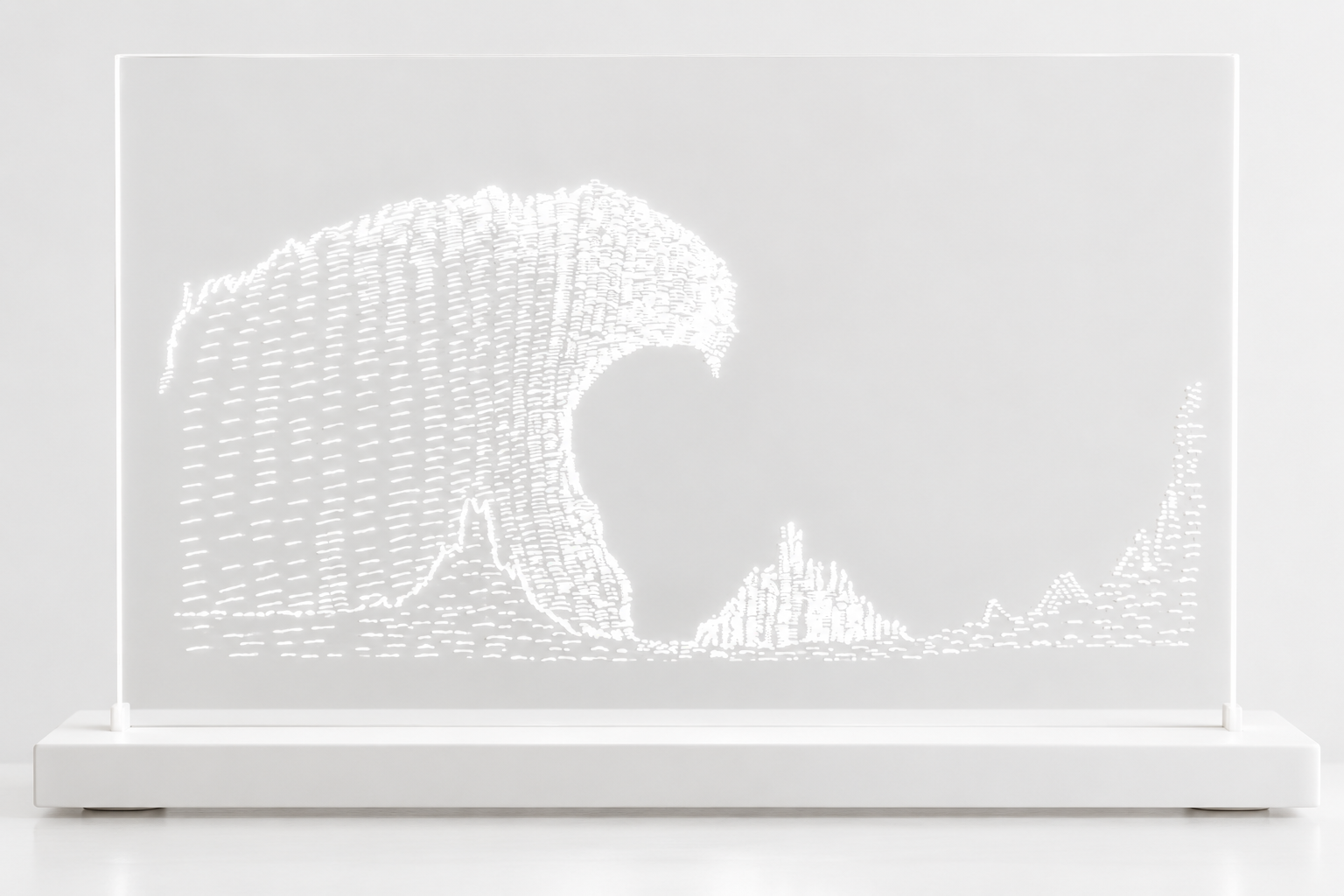
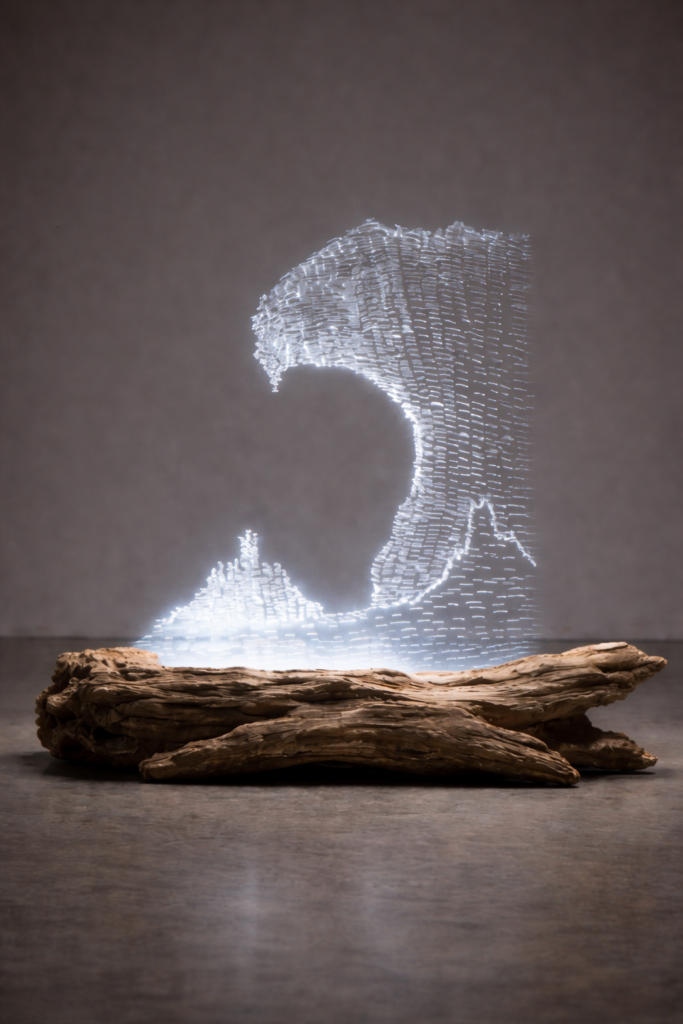
    Gafa stock exchange annual growth x Hokusai wave

    Engraving on Plexiglas x Led blue light – 20 x 30 cm

    Dans cette œuvre, une vague stylisée — qui évoque la célèbre Grande Vague de Kanagawa d’Hokusai — émerge de centaines de traits gravés, éclairés par une lumière LED froide. Mais ici, la vague est abstraite, algorithmique, presque numérique. À sa base : une silhouette dentelée qui rappelle l’île de Hashima, cité minière japonaise abandonnée, ville fantôme d’une ambition industrielle révolue.

    La courbe de la vague reprend les graphiques de croissance annuelle des GAFAM (Google, Amazon, Facebook, Apple, Microsoft). Un tsunami de valeur cumulée, une forme de violence économique rendue avec une finesse poétique. La lumière anime les lignes à la manière de mouvements boursiers, évoquant à la fois séduction et menace.

    Hashima Dead City est un monument à l’obsolescence. Ce qui autrefois s’élevait au nom du progrès repose désormais englouti sous l’accélération technologique. La vague s’écrasera.
    La ville a déjà disparu.
    Ne subsistent que les courbes — illuminées, suspendues.

    —

    In this piece, a stylized wave—reminiscent of Hokusai’s iconic Great Wave off Kanagawa—emerges from hundreds of engraved dashes lit by cold LED light. But here, the wave is abstract, algorithmic, almost digital. At its base: a jagged silhouette echoing the island of Hashima, the abandoned Japanese mining city, ghost town of industrial ambition.

    The curvature of the wave mirrors the annual growth charts of the GAFAM (Google, Amazon, Facebook, Apple, Microsoft). It is a tsunami of compounded value, a form of economic violence rendered with poetic finesse. The light animates the lines like stock movements, evoking both seduction and menace.

    Hashima Dead City is a monument to obsolescence. What once rose in the name of progress now lies sunken beneath technological acceleration. The wave will crash. The city has already disappeared. Only the metrics remain—lit and suspended.

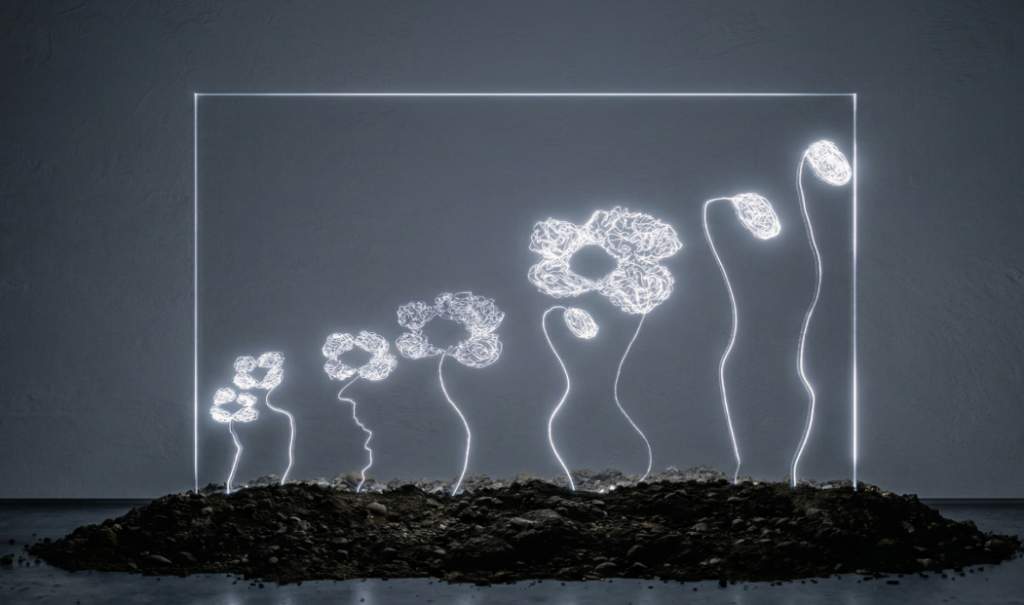
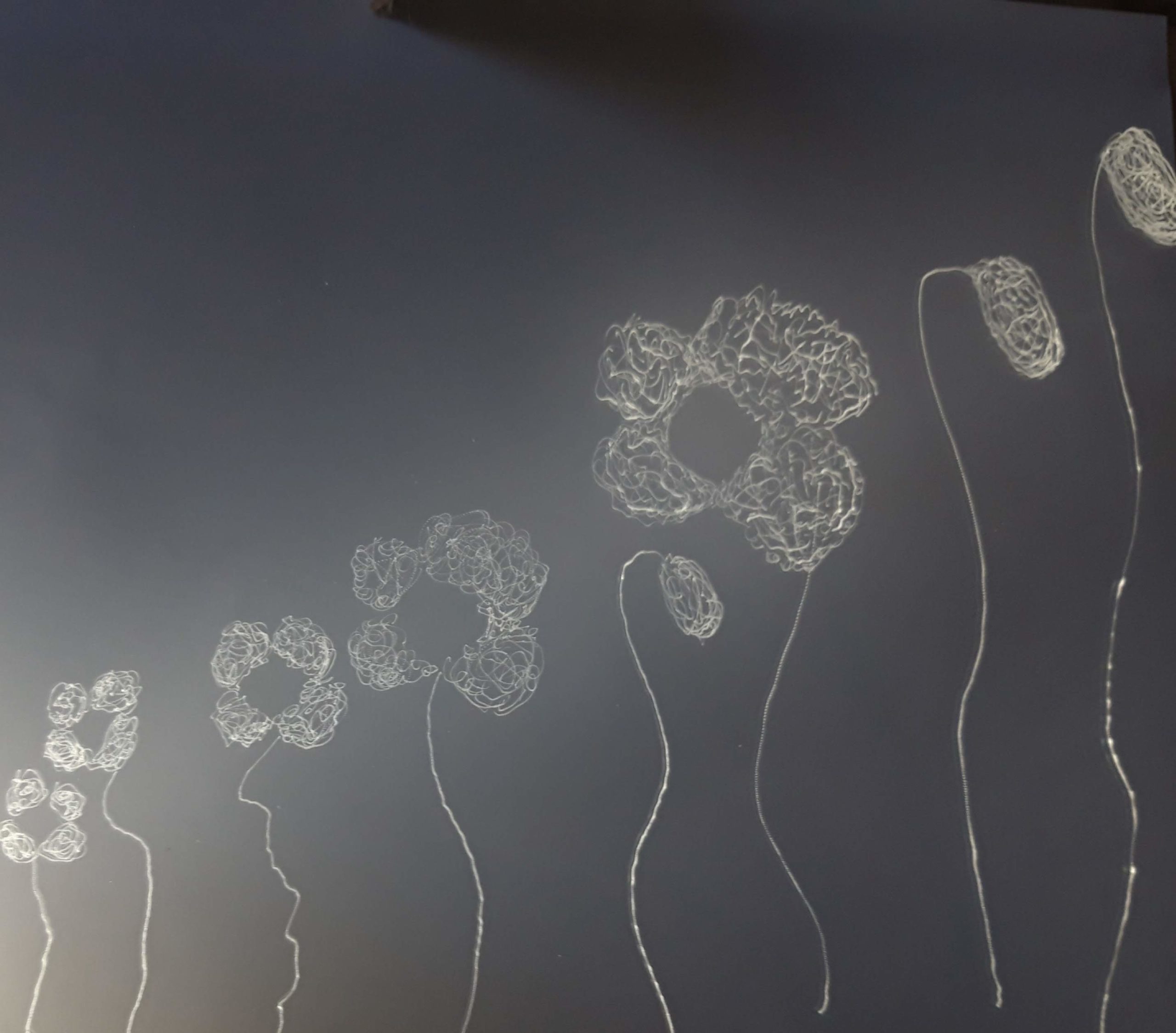
  • Poppies

    Gafa turnover growth rate x Poppies

    Champ de coquelicots, d’abord perçu comme fragile et lumineux, presque apaisant. Une surface douce, organique, familière. Mais très vite, le regard accroche une anomalie de rythme. Les fleurs ne poussent pas selon une logique naturelle. Elles obéissent à une autre loi.

    Chaque tige devient une ligne de temps. Chaque corolle s’élargit en fonction d’un indicateur précis, le taux de croissance annuel du chiffre d’affaires des géants du numérique. De leurs débuts jusqu’à la date de création de l’image, la progression est traduite en expansion florale. Ce qui semble vivant est en réalité calculé.

    La composition bascule alors. Le végétal n’est plus qu’un masque. Derrière l’apparence d’un champ, se déploie une cartographie économique. Les coquelicots deviennent des signaux de domination, des excroissances de croissance continue. Plus la donnée s’accélère, plus la fleur s’impose, jusqu’à saturer l’espace.

    Aucune décroissance, aucun cycle. Ici, rien ne fane. Ces fleurs ne meurent pas, contrairement aux coquelicots. Elles sont conçues pour croître sans limite, pour occuper, pour persister. Une nature détournée, instrumentalisée, où l’organique simule l’expansion industrielle.

    Posée sur un tas de terre stérile, l’image accentue la rupture. Le sol ne nourrit rien. Il ne produit aucune vie réelle. Il devient simple support, substrat mort pour une croissance artificielle. Le contraste est frontal, entre la promesse visuelle du vivant et la réalité d’un système extractif, autonome, sans retour.

    Engraving on Plexiglas + Led light

    At first glance, a delicate field of luminous poppies stretches across the surface. But these flowers bloom according to a different rhythm—their size corresponds precisely to the annual turnover growth rate of the one of the tech giants, from their early years to the creation date of this work.

    What appears botanical is, in truth, economic. Each stem is a data timeline. Each flower head, a flourish of exponential expansion. From bud to overgrown bloom, the composition evokes both vitality and imbalance. Nature becomes a proxy for figures—living growth mimicking corporate domination.

    The progression suggests no plateau. This is not an allegory of natural life cycles, but of unchecked scaling. These flowers will not wilt. They are engineered to thrive endlessly.

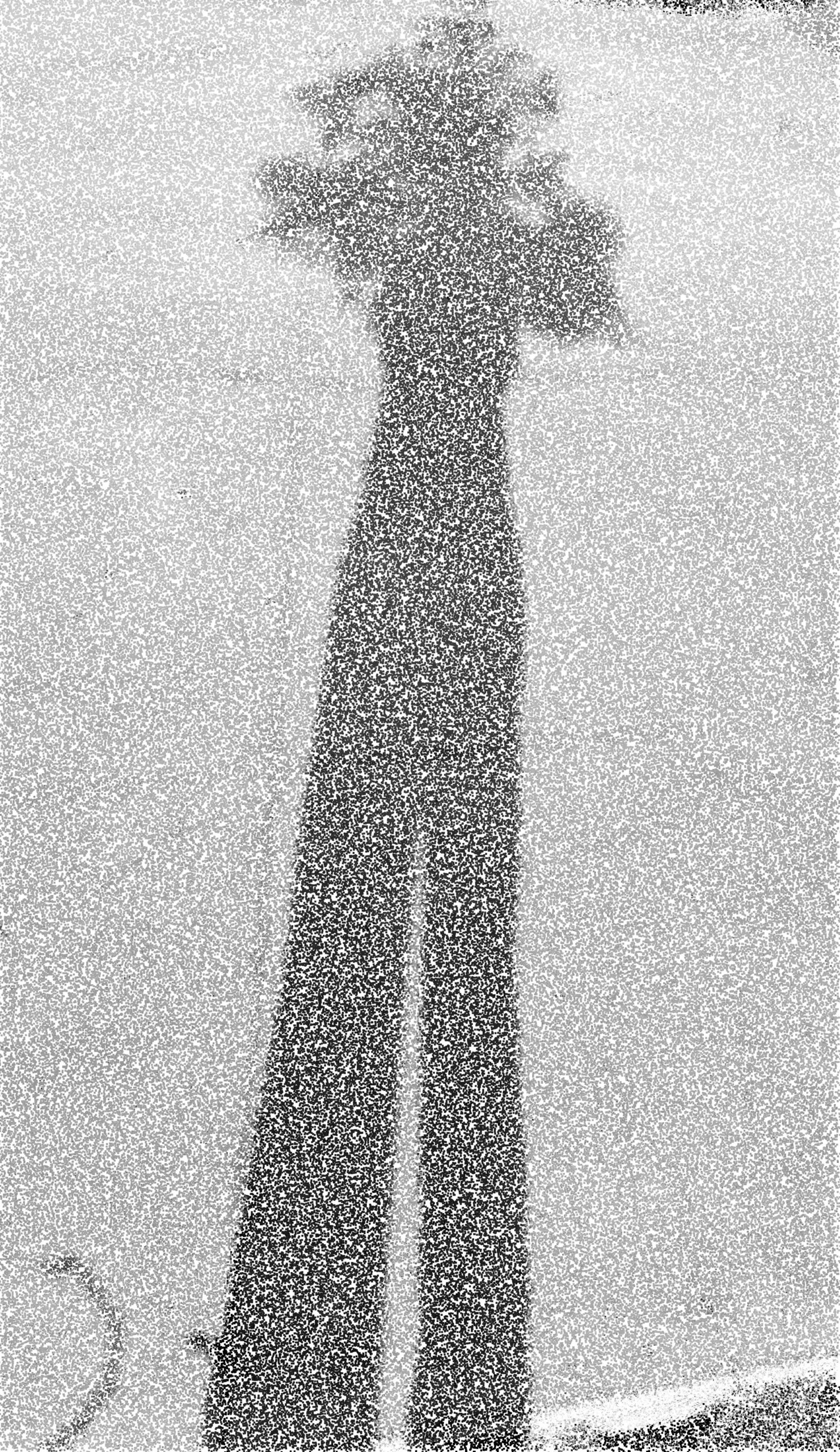
  • Me in a tree

    Pixellised photo of myself in front of a tree

    Photography

    A silhouette stretches along the ground, merging the shape of a human body (the artist himself) with the upper branches of a tree. The figure is rooted, yet intangible — made not of bark or flesh, but of digital grain, pixel noise, interference.

    The image stages a strange grafting: man and nature, collapsed into a single outline. But the medium betrays the illusion. What looks like a photograph of connection is corrupted by technological detachment. The digital surface is noisy, sterile, disembodied. The tree, once a symbol of rootedness, becomes just another texture, flattened and encoded.

    This is no longer about belonging to nature — it is about being absorbed by its simulation. The self is pixelated. The soil is gone.